This extraction supports search. Read the original page for complete notation and layout.
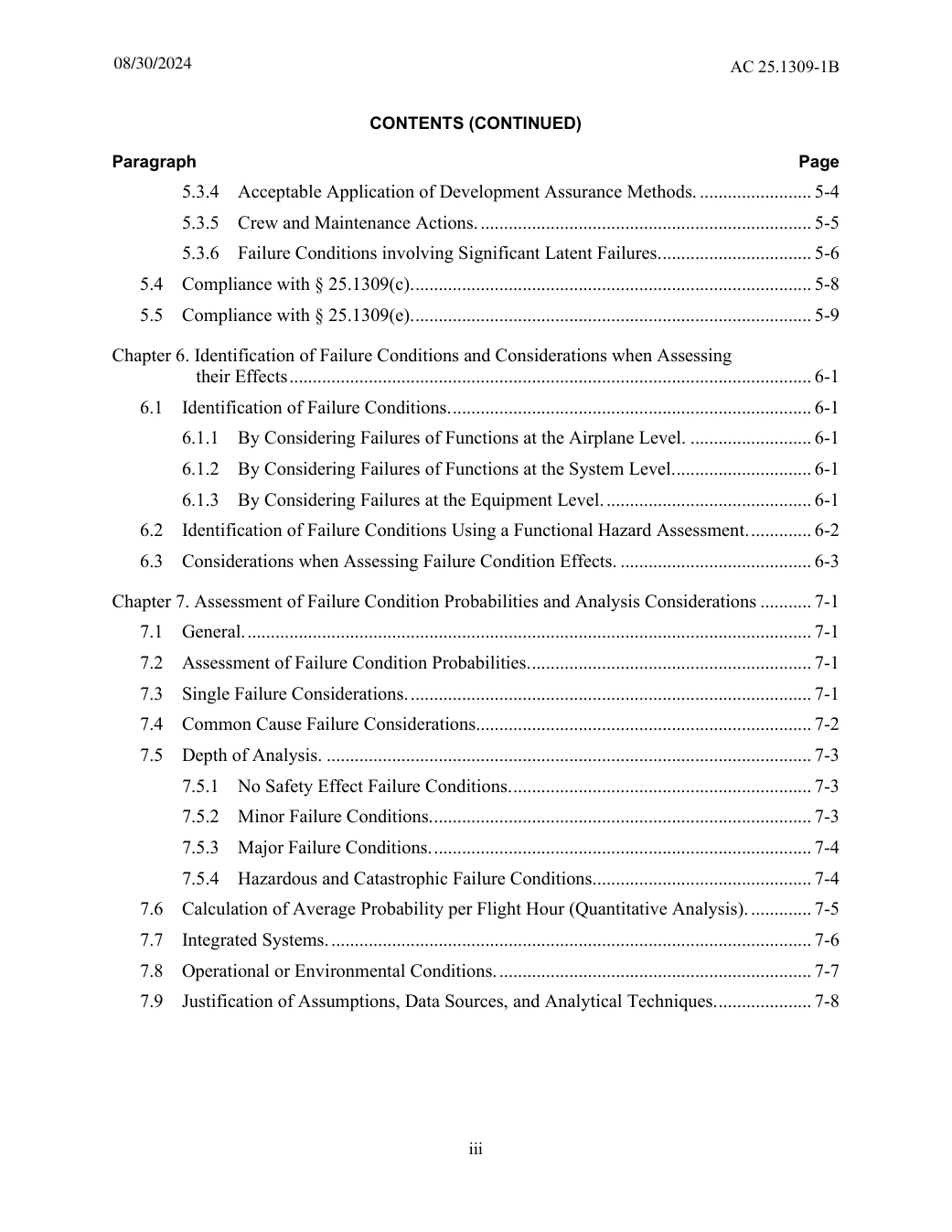
CONTENTS (CONTINUED)

Paragraph Page

5.3.4 Acceptable Application of Development Assurance Methods. ........................ 5-4

5.3.5 Crew and Maintenance Actions. ....................................................................... 5-5

5.3.6 Failure Conditions involving Significant Latent Failures. ................................ 5-6

5.4 Compliance with § 25.1309(c). ..................................................................................... 5-8

5.5 Compliance with § 25.1309(e). ..................................................................................... 5-9

Chapter 6. Identification of Failure Conditions and Considerations when Assessing their Effects ................................................................................................................ 6-1

6.1 Identification of Failure Conditions. ............................................................................. 6-1

6.1.1 By Considering Failures of Functions at the Airplane Level. .......................... 6-1

6.1.2 By Considering Failures of Functions at the System Level. ............................. 6-1

6.1.3 By Considering Failures at the Equipment Level. ............................................ 6-1

6.2 Identification of Failure Conditions Using a Functional Hazard Assessment. ............. 6-2

6.3 Considerations when Assessing Failure Condition Effects. ......................................... 6-3

Chapter 7. Assessment of Failure Condition Probabilities and Analysis Considerations ........... 7-1

7.1 General. ......................................................................................................................... 7-1

7.2 Assessment of Failure Condition Probabilities. ............................................................ 7-1

7.3 Single Failure Considerations. ...................................................................................... 7-1

7.4 Common Cause Failure Considerations........................................................................ 7-2

7.5 Depth of Analysis. ........................................................................................................ 7-3

7.5.1 No Safety Effect Failure Conditions. ................................................................ 7-3

7.5.2 Minor Failure Conditions. ................................................................................. 7-3

7.5.3 Major Failure Conditions. ................................................................................. 7-4

7.5.4 Hazardous and Catastrophic Failure Conditions. .............................................. 7-4

7.6 Calculation of Average Probability per Flight Hour (Quantitative Analysis). ............. 7-5

7.7 Integrated Systems. ....................................................................................................... 7-6

7.8 Operational or Environmental Conditions. ................................................................... 7-7

7.9 Justification of Assumptions, Data Sources, and Analytical Techniques. .................... 7-8
Saved from the FAA on November 16, 2026. All original pages are retained. Engineering explanations are presented separately below.
Aerospace Consulting / Engineering perspective
Connect the analysis to the design.
A useful assessment explains why the architecture meets the safety objectives, what assumptions it relies on, and how those assumptions will be verified. We use the guidance to structure the questions and evidence around the actual system.
01 / Define the failure conditions
Begin with functions and effects.
Describe the operating context, affected functions, crew response and interactions with other systems. Carry the resulting safety objectives into the architecture and requirements.
Explain monitoring, fault containment and common causes. Examine significant latent failures and the assumptions about how long a failure can remain present.
Connect the analysis to the implemented configuration, justified data, verification results, crew actions and maintenance requirements. Keep unresolved assumptions visible until they are closed.
Our practice uses ARP4761A and ARP4754B to organise safety assessment and systems development work. This AC refers to ARP 4761 and ARP 4754 without revision letters. Its references alone do not establish acceptance of a particular revision for a programme.
75 original pages. 55 pages have reviewed text reflows. Original-first pages retain the source layout, with extracted text available for finding words.
A focused review, an agreed assessment package or ongoing support alongside your team. We can agree the relevant inputs and scope in the initial conversation.
This opens your email application.
Start a conversation
Tell us about your programme, the system you are developing and the support you need.
We can agree a focused use-case review, a defined evidence package or ongoing programme support.
This opens your email application.
Specialist aerospace expertise
Aerospace Consulting is led by Hussein Khimji, an FAA Designated Engineering Representative in systems and equipment, with a focus on system safety, flight controls and avionics.
We work with aircraft developers and systems suppliers to connect technical decisions, safety assessments and certification evidence.
This is the proposed introduction. The full About page will add your approved biography and associate expertise.
Systems engineering & development assurance
Tell us about the aircraft or system, its intended function, stage of development and the support you need.