This extraction supports search. Read the original page for complete notation and layout.
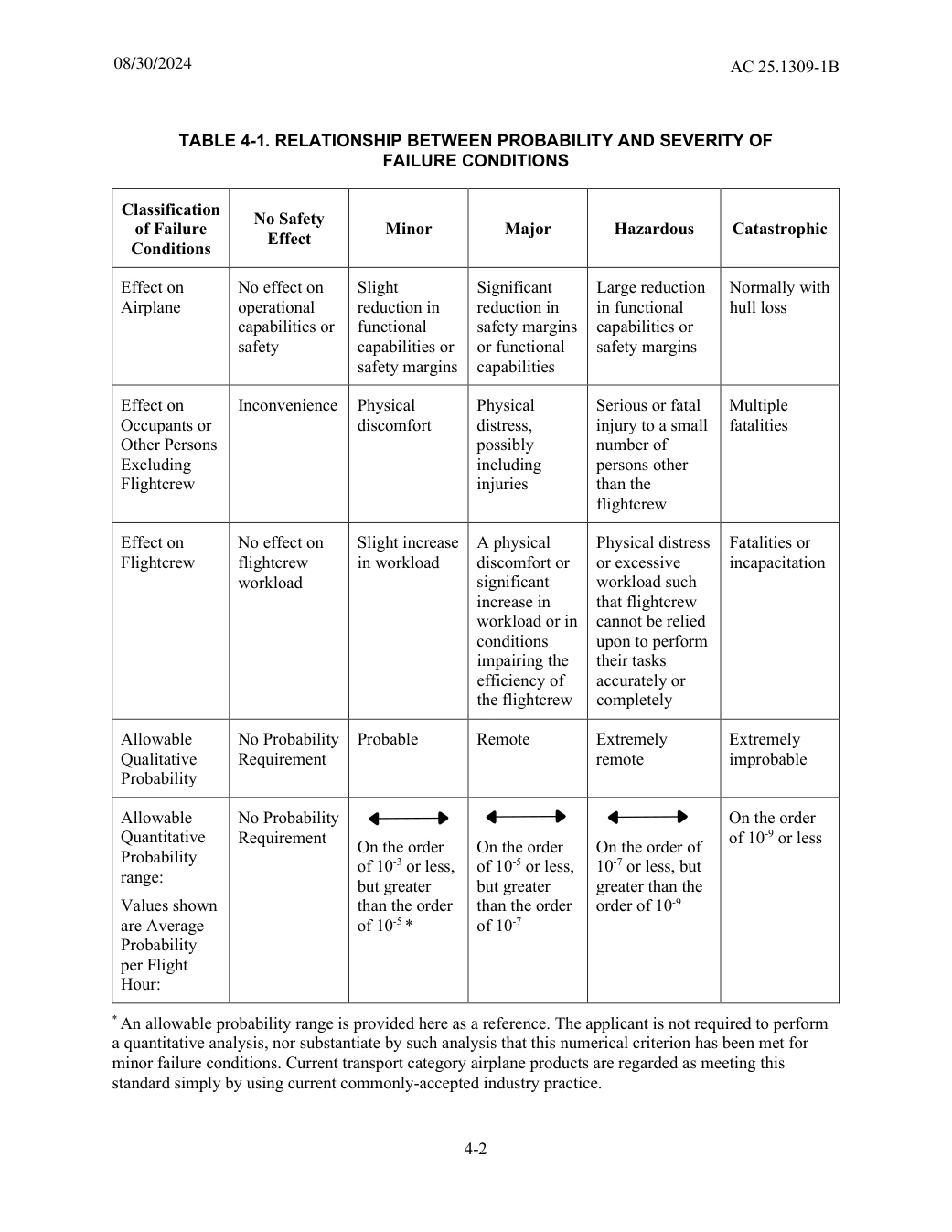
TABLE 4-1. RELATIONSHIP BETWEEN PROBABILITY AND SEVERITY OF FAILURE CONDITIONS

No Safety Effect Minor Major Hazardous Catastrophic

Classification of Failure Conditions

Normally with hull loss

Large reduction in functional capabilities or safety margins

Effect on Airplane No effect on operational capabilities or safety

Significant reduction in safety margins or functional capabilities

Slight reduction in functional capabilities or safety margins

Multiple fatalities

Inconvenience Physical discomfort Physical distress, possibly including injuries

Effect on Occupants or Other Persons Excluding Flightcrew

Serious or fatal injury to a small number of persons other than the flightcrew

Fatalities or incapacitation

Effect on Flightcrew No effect on flightcrew workload

Physical distress or excessive workload such that flightcrew cannot be relied upon to perform their tasks accurately or completely

Slight increase in workload A physical discomfort or significant increase in workload or in conditions impairing the efficiency of the flightcrew

No Probability Requirement Probable Remote Extremely remote Extremely improbable

Allowable Qualitative Probability

No Probability Requirement

On the order of 10-9 or less

Allowable Quantitative Probability range:

On the order of 10-7 or less, but greater than the order of 10-9

On the order of 10-3 or less, but greater than the order of 10-5 *

On the order of 10-5 or less, but greater than the order of 10-7

Values shown are Average Probability per Flight Hour:

* An allowable probability range is provided here as a reference. The applicant is not required to perform a quantitative analysis, nor substantiate by such analysis that this numerical criterion has been met for minor failure conditions. Current transport category airplane products are regarded as meeting this standard simply by using current commonly-accepted industry practice.
Saved from the FAA on November 16, 2026. All original pages are retained. Engineering explanations are presented separately below.
Aerospace Consulting / Engineering perspective
Connect the analysis to the design.
A useful assessment explains why the architecture meets the safety objectives, what assumptions it relies on, and how those assumptions will be verified. We use the guidance to structure the questions and evidence around the actual system.
01 / Define the failure conditions
Begin with functions and effects.
Describe the operating context, affected functions, crew response and interactions with other systems. Carry the resulting safety objectives into the architecture and requirements.
Explain monitoring, fault containment and common causes. Examine significant latent failures and the assumptions about how long a failure can remain present.
Connect the analysis to the implemented configuration, justified data, verification results, crew actions and maintenance requirements. Keep unresolved assumptions visible until they are closed.
Our practice uses ARP4761A and ARP4754B to organise safety assessment and systems development work. This AC refers to ARP 4761 and ARP 4754 without revision letters. Its references alone do not establish acceptance of a particular revision for a programme.
75 original pages. 55 pages have reviewed text reflows. Original-first pages retain the source layout, with extracted text available for finding words.
A focused review, an agreed assessment package or ongoing support alongside your team. We can agree the relevant inputs and scope in the initial conversation.
This opens your email application.
Start a conversation
Tell us about your programme, the system you are developing and the support you need.
We can agree a focused use-case review, a defined evidence package or ongoing programme support.
This opens your email application.
Specialist aerospace expertise
Aerospace Consulting is led by Hussein Khimji, an FAA Designated Engineering Representative in systems and equipment, with a focus on system safety, flight controls and avionics.
We work with aircraft developers and systems suppliers to connect technical decisions, safety assessments and certification evidence.
This is the proposed introduction. The full About page will add your approved biography and associate expertise.
Systems engineering & development assurance
Tell us about the aircraft or system, its intended function, stage of development and the support you need.