
MOC SC-VTOL
Means of Compliance with SC-VTOL — Batch 1
Issue 2 — FINAL Source checked 2026-11-28
Scope, source and reading notes
Complete final batch 1 of SC-VTOL means of compliance. Later batches may amend individual provisions in earlier batches.
Aerospace Consulting reference note: Initial final means of compliance with SC-VTOL. Later final MoC batches supplement or amend specific provisions.
The complete selected publication is available in reading text and as the original PDF. Reading text is extracted from the official PDF; page layout is simplified, and figures and tables should be checked in the original page view.
Search covers extracted text. Words contained only in graphics may not be searchable. The original publication is available below.
Official source recordOriginal PDF on this siteSource: EASA. Reproduced with source acknowledgment; source edition and status are shown above. SHA-256: db12643dc7ceea42b40a49945615bf06cf39e0f2e6743090241a00eafca7a8a2
Means of Compliance with the Special Condition VTOL
Doc. No: MOC SC-VTOL Issue: 2 Date: 12 May 2021
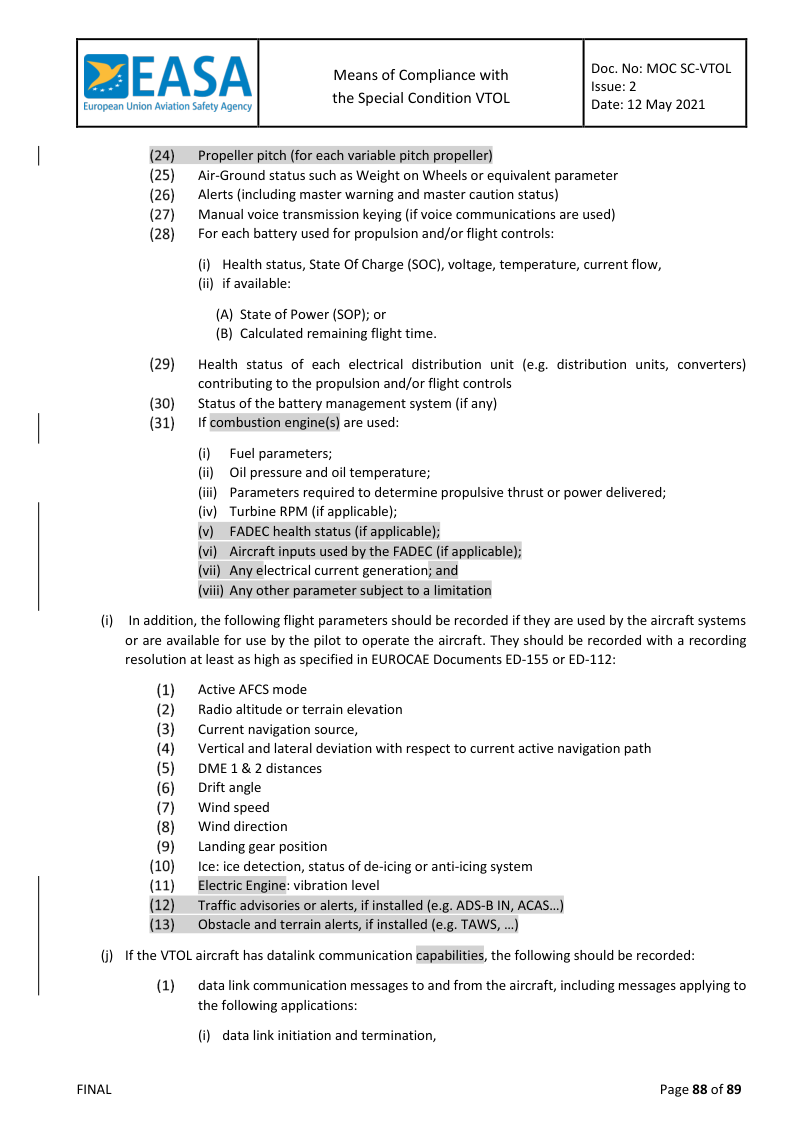
Propeller pitch (for each variable pitch propeller) Air-Ground status such as Weight on Wheels or equivalent parameter Alerts (including master warning and master caution status) Manual voice transmission keying (if voice communications are used) For each battery used for propulsion and/or flight controls:
(i) Health status, State Of Charge (SOC), voltage, temperature, current flow, (ii) if available:
(A) State of Power (SOP); or (B) Calculated remaining flight time.
Health status of each electrical distribution unit (e.g. distribution units, converters) contributing to the propulsion and/or flight controls Status of the battery management system (if any) If combustion engine(s) are used:
(i) Fuel parameters; (ii) Oil pressure and oil temperature; (iii) Parameters required to determine propulsive thrust or power delivered; (iv) Turbine RPM (if applicable); (v) FADEC health status (if applicable); (vi) Aircraft inputs used by the FADEC (if applicable); (vii) Any electrical current generation; and (viii) Any other parameter subject to a limitation
(i) In addition, the following flight parameters should be recorded if they are used by the aircraft systems
or are available for use by the pilot to operate the aircraft. They should be recorded with a recording resolution at least as high as specified in EUROCAE Documents ED-155 or ED-112:
Active AFCS mode Radio altitude or terrain elevation Current navigation source, Vertical and lateral deviation with respect to current active navigation path DME 1 & 2 distances Drift angle Wind speed Wind direction Landing gear position Ice: ice detection, status of de-icing or anti-icing system Electric Engine: vibration level Traffic advisories or alerts, if installed (e.g. ADS-B IN, ACAS…) Obstacle and terrain alerts, if installed (e.g. TAWS, …)
(j) If the VTOL aircraft has datalink communication capabilities, the following should be recorded:
data link communication messages to and from the aircraft, including messages applying to the following applications:
(i) data link initiation and termination,
View figures, tables and original page layout
Connected references
Source-backed citations and subject-based engineering context are labelled separately. These links do not establish equivalence or project acceptance.
Related technical context
Engineering contextEvidence and scope
SC-VTOL-02 and MOC SC-VTOL — published scope
Aerospace Consulting navigation suggestion based on the subject and stated scope of the two publications.
This connection does not establish regulatory equivalence, acceptance of a newer edition, or applicability of a project-specific precedent to another programme.
Supporting source