
MOC SC-VTOL
Means of Compliance with SC-VTOL — Batch 1
Issue 2 — FINAL Source checked 2026-11-28
Scope, source and reading notes
Complete final batch 1 of SC-VTOL means of compliance. Later batches may amend individual provisions in earlier batches.
Aerospace Consulting reference note: Initial final means of compliance with SC-VTOL. Later final MoC batches supplement or amend specific provisions.
The complete selected publication is available in reading text and as the original PDF. Reading text is extracted from the official PDF; page layout is simplified, and figures and tables should be checked in the original page view.
Search covers extracted text. Words contained only in graphics may not be searchable. The original publication is available below.
Official source recordOriginal PDF on this siteSource: EASA. Reproduced with source acknowledgment; source edition and status are shown above. SHA-256: db12643dc7ceea42b40a49945615bf06cf39e0f2e6743090241a00eafca7a8a2
Means of Compliance with the Special Condition VTOL
Doc. No: MOC SC-VTOL Issue: 2 Date: 12 May 2021
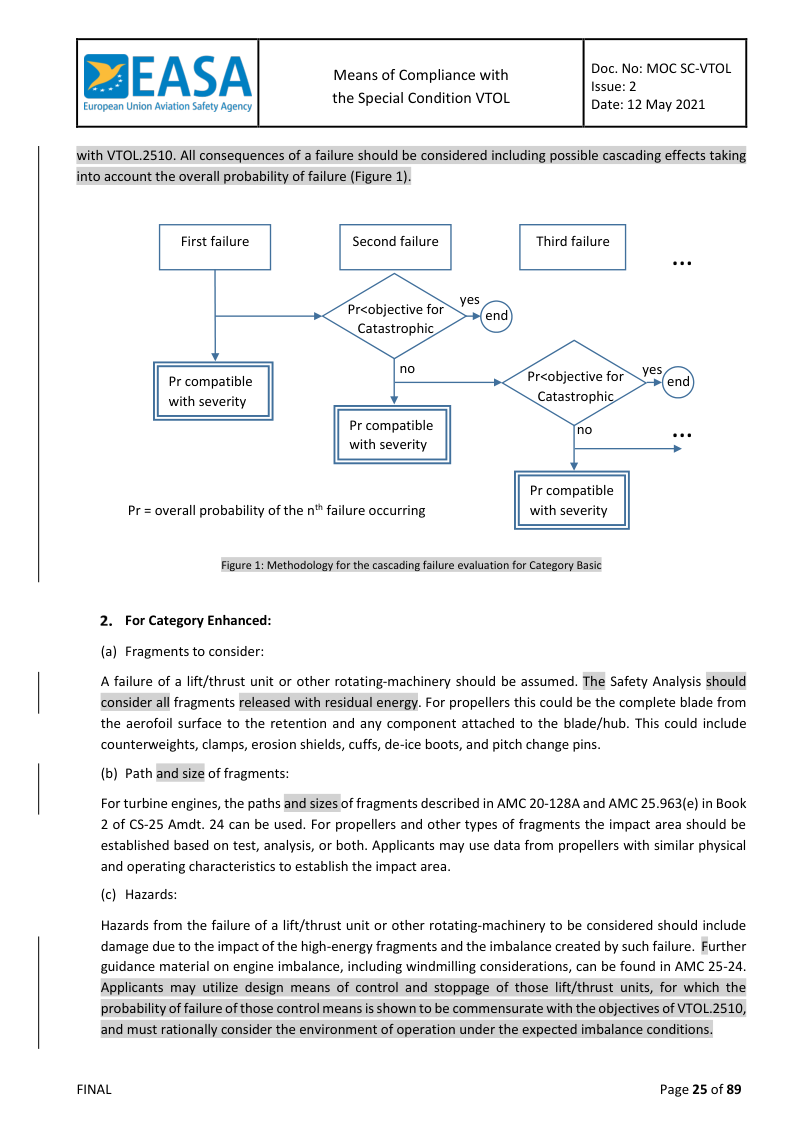
with VTOL.2510. All consequences of a failure should be considered including possible cascading effects taking into account the overall probability of failure (Figure 1).
First failure
Second failure Third failure
…
Pr<objective for
yes
end
Catastrophic
no
yes
Pr<objective for
end
Catastrophic
Pr compatible with severity
no
…
Pr compatible with severity
Pr compatible with severity
Pr = overall probability of the nth failure occurring
Figure 1: Methodology for the cascading failure evaluation for Category Basic
For Category Enhanced:
(a) Fragments to consider:
A failure of a lift/thrust unit or other rotating-machinery should be assumed. The Safety Analysis should consider all fragments released with residual energy. For propellers this could be the complete blade from the aerofoil surface to the retention and any component attached to the blade/hub. This could include counterweights, clamps, erosion shields, cuffs, de-ice boots, and pitch change pins.
(b) Path and size of fragments:
For turbine engines, the paths and sizes of fragments described in AMC 20-128A and AMC 25.963(e) in Book 2 of CS-25 Amdt. 24 can be used. For propellers and other types of fragments the impact area should be established based on test, analysis, or both. Applicants may use data from propellers with similar physical and operating characteristics to establish the impact area.
(c) Hazards:
Hazards from the failure of a lift/thrust unit or other rotating-machinery to be considered should include damage due to the impact of the high-energy fragments and the imbalance created by such failure. Further guidance material on engine imbalance, including windmilling considerations, can be found in AMC 25-24. Applicants may utilize design means of control and stoppage of those lift/thrust units, for which the probability of failure of those control means is shown to be commensurate with the objectives of VTOL.2510, and must rationally consider the environment of operation under the expected imbalance conditions.
View figures, tables and original page layout
Connected references
Source-backed citations and subject-based engineering context are labelled separately. These links do not establish equivalence or project acceptance.
Related technical context
Engineering contextEvidence and scope
SC-VTOL-02 and MOC SC-VTOL — published scope
Aerospace Consulting navigation suggestion based on the subject and stated scope of the two publications.
This connection does not establish regulatory equivalence, acceptance of a newer edition, or applicability of a project-specific precedent to another programme.
Supporting source