
MOC SC-VTOL
Means of Compliance with SC-VTOL — Batch 1
Issue 2 — FINAL Source checked 2026-11-28
Scope, source and reading notes
Complete final batch 1 of SC-VTOL means of compliance. Later batches may amend individual provisions in earlier batches.
Aerospace Consulting reference note: Initial final means of compliance with SC-VTOL. Later final MoC batches supplement or amend specific provisions.
The complete selected publication is available in reading text and as the original PDF. Reading text is extracted from the official PDF; page layout is simplified, and figures and tables should be checked in the original page view.
Search covers extracted text. Words contained only in graphics may not be searchable. The original publication is available below.
Official source recordOriginal PDF on this siteSource: EASA. Reproduced with source acknowledgment; source edition and status are shown above. SHA-256: db12643dc7ceea42b40a49945615bf06cf39e0f2e6743090241a00eafca7a8a2
Means of Compliance with the Special Condition VTOL
Doc. No: MOC SC-VTOL Issue: 2 Date: 12 May 2021
(d) Safety Analysis:
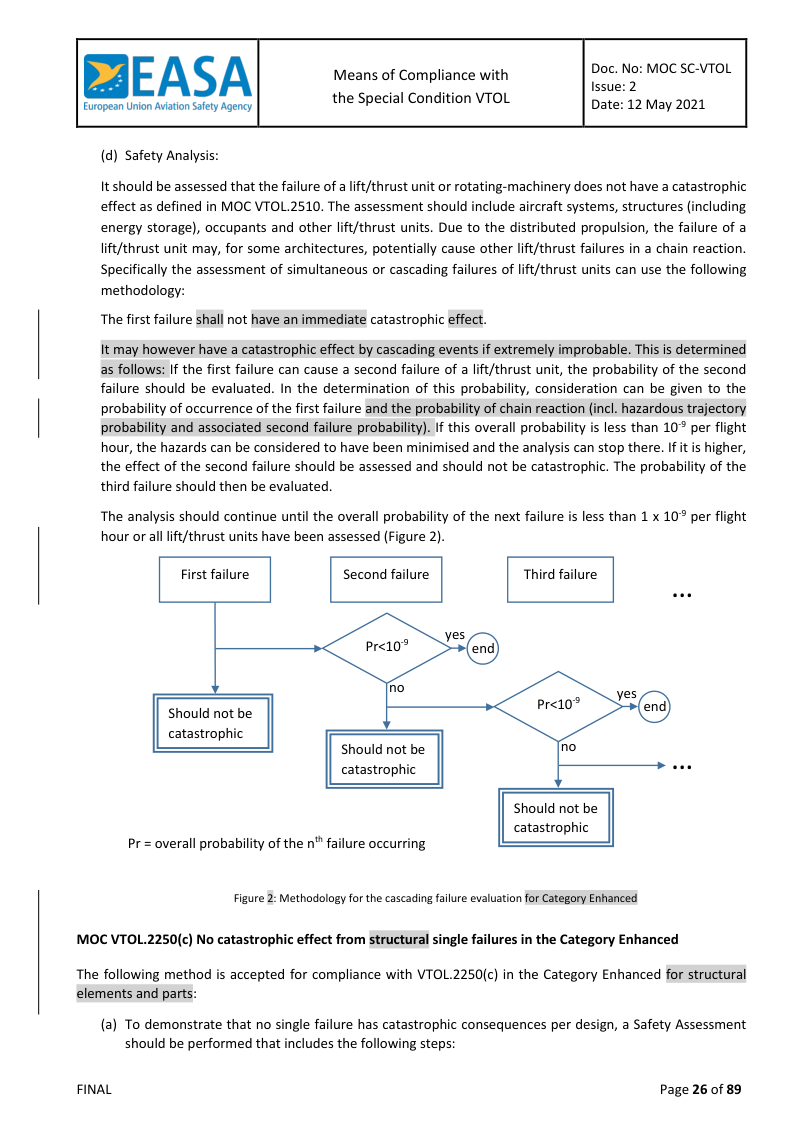
It should be assessed that the failure of a lift/thrust unit or rotating-machinery does not have a catastrophic effect as defined in MOC VTOL.2510. The assessment should include aircraft systems, structures (including energy storage), occupants and other lift/thrust units. Due to the distributed propulsion, the failure of a lift/thrust unit may, for some architectures, potentially cause other lift/thrust failures in a chain reaction. Specifically the assessment of simultaneous or cascading failures of lift/thrust units can use the following methodology:
The first failure shall not have an immediate catastrophic effect.
It may however have a catastrophic effect by cascading events if extremely improbable. This is determined as follows: If the first failure can cause a second failure of a lift/thrust unit, the probability of the second failure should be evaluated. In the determination of this probability, consideration can be given to the probability of occurrence of the first failure and the probability of chain reaction (incl. hazardous trajectory probability and associated second failure probability). If this overall probability is less than 10-9 per flight hour, the hazards can be considered to have been minimised and the analysis can stop there. If it is higher, the effect of the second failure should be assessed and should not be catastrophic. The probability of the third failure should then be evaluated.
The analysis should continue until the overall probability of the next failure is less than 1 x 10⁻⁹ per flight hour or all lift/thrust units have been assessed (Figure 2).
First failure Second failure Third failure
…
Pr<10-9 yes
end
no
Pr<10-9 yes
end
Should not be catastrophic
no
Should not be catastrophic …
Should not be catastrophic
Pr = overall probability of the nth failure occurring
Figure 2: Methodology for the cascading failure evaluation for Category Enhanced
MOC VTOL.2250(c) No catastrophic effect from structural single failures in the Category Enhanced
The following method is accepted for compliance with VTOL.2250(c) in the Category Enhanced for structural elements and parts:
(a) To demonstrate that no single failure has catastrophic consequences per design, a Safety Assessment
should be performed that includes the following steps:
View figures, tables and original page layout
Connected references
Source-backed citations and subject-based engineering context are labelled separately. These links do not establish equivalence or project acceptance.
Related technical context
Engineering contextEvidence and scope
SC-VTOL-02 and MOC SC-VTOL — published scope
Aerospace Consulting navigation suggestion based on the subject and stated scope of the two publications.
This connection does not establish regulatory equivalence, acceptance of a newer edition, or applicability of a project-specific precedent to another programme.
Supporting source