
MOC SC-VTOL
Means of Compliance with SC-VTOL — Batch 1
Issue 2 — FINAL Source checked 2026-11-28
Scope, source and reading notes
Complete final batch 1 of SC-VTOL means of compliance. Later batches may amend individual provisions in earlier batches.
Aerospace Consulting reference note: Initial final means of compliance with SC-VTOL. Later final MoC batches supplement or amend specific provisions.
The complete selected publication is available in reading text and as the original PDF. Reading text is extracted from the official PDF; page layout is simplified, and figures and tables should be checked in the original page view.
Search covers extracted text. Words contained only in graphics may not be searchable. The original publication is available below.
Official source recordOriginal PDF on this siteSource: EASA. Reproduced with source acknowledgment; source edition and status are shown above. SHA-256: db12643dc7ceea42b40a49945615bf06cf39e0f2e6743090241a00eafca7a8a2
Means of Compliance with the Special Condition VTOL
Doc. No: MOC SC-VTOL Issue: 2 Date: 12 May 2021
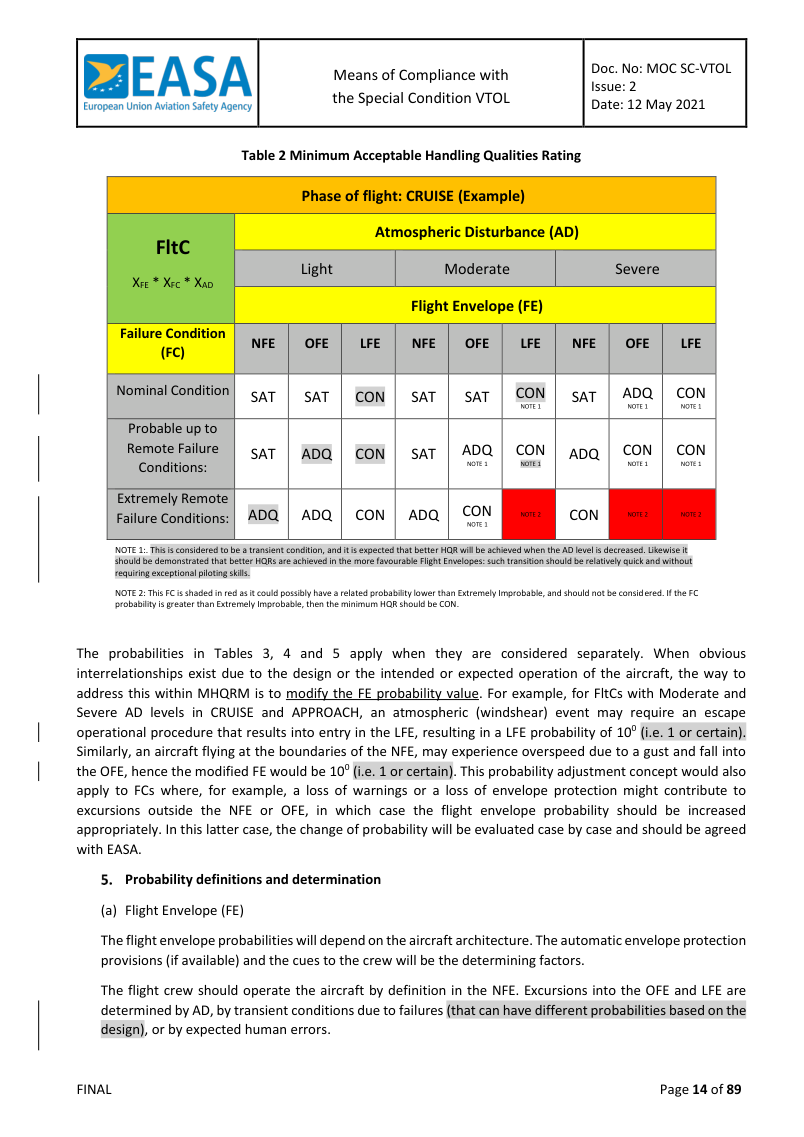
Table 2 Minimum Acceptable Handling Qualities Rating
Phase of flight: CRUISE (Example)
Atmospheric Disturbance (AD)
FltC
Light Moderate Severe
XFE * XFC * XAD
Flight Envelope (FE)
Failure Condition
(FC) NFE OFE LFE NFE OFE LFE NFE OFE LFE
Nominal Condition SAT SAT CON SAT SAT CON
NOTE 1 SAT ADQ
NOTE 1 CON
NOTE 1
Probable up to Remote Failure
NOTE 1 CON
NOTE 1 ADQ CON
NOTE 1 CON
NOTE 1
Conditions: SAT ADQ CON SAT ADQ
NOTE 2 CON NOTE 2 NOTE 2
Extremely Remote Failure Conditions: ADQ ADQ CON ADQ CON
NOTE 1
NOTE 1:. This is considered to be a transient condition, and it is expected that better HQR will be achieved when the AD level is decreased. Likewise it should be demonstrated that better HQRs are achieved in the more favourable Flight Envelopes: such transition should be relatively quick and without requiring exceptional piloting skills.
NOTE 2: This FC is shaded in red as it could possibly have a related probability lower than Extremely Improbable, and should not be considered. If the FC probability is greater than Extremely Improbable, then the minimum HQR should be CON.
The probabilities in Tables 3, 4 and 5 apply when they are considered separately. When obvious interrelationships exist due to the design or the intended or expected operation of the aircraft, the way to address this within MHQRM is to modify the FE probability value. For example, for FltCs with Moderate and Severe AD levels in CRUISE and APPROACH, an atmospheric (windshear) event may require an escape operational procedure that results into entry in the LFE, resulting in a LFE probability of 100 (i.e. 1 or certain). Similarly, an aircraft flying at the boundaries of the NFE, may experience overspeed due to a gust and fall into the OFE, hence the modified FE would be 100 (i.e. 1 or certain). This probability adjustment concept would also apply to FCs where, for example, a loss of warnings or a loss of envelope protection might contribute to excursions outside the NFE or OFE, in which case the flight envelope probability should be increased appropriately. In this latter case, the change of probability will be evaluated case by case and should be agreed with EASA.
Probability definitions and determination
(a) Flight Envelope (FE)
The flight envelope probabilities will depend on the aircraft architecture. The automatic envelope protection provisions (if available) and the cues to the crew will be the determining factors.
The flight crew should operate the aircraft by definition in the NFE. Excursions into the OFE and LFE are determined by AD, by transient conditions due to failures (that can have different probabilities based on the design), or by expected human errors.
View figures, tables and original page layout
Connected references
Source-backed citations and subject-based engineering context are labelled separately. These links do not establish equivalence or project acceptance.
Related technical context
Engineering contextEvidence and scope
SC-VTOL-02 and MOC SC-VTOL — published scope
Aerospace Consulting navigation suggestion based on the subject and stated scope of the two publications.
This connection does not establish regulatory equivalence, acceptance of a newer edition, or applicability of a project-specific precedent to another programme.
Supporting source