
MOC SC-VTOL
Means of Compliance with SC-VTOL — Batch 1
Issue 2 — FINAL Source checked 2026-11-28
Scope, source and reading notes
Complete final batch 1 of SC-VTOL means of compliance. Later batches may amend individual provisions in earlier batches.
Aerospace Consulting reference note: Initial final means of compliance with SC-VTOL. Later final MoC batches supplement or amend specific provisions.
The complete selected publication is available in reading text and as the original PDF. Reading text is extracted from the official PDF; page layout is simplified, and figures and tables should be checked in the original page view.
Search covers extracted text. Words contained only in graphics may not be searchable. The original publication is available below.
Official source recordOriginal PDF on this siteSource: EASA. Reproduced with source acknowledgment; source edition and status are shown above. SHA-256: db12643dc7ceea42b40a49945615bf06cf39e0f2e6743090241a00eafca7a8a2
Means of Compliance with the Special Condition VTOL
Doc. No: MOC SC-VTOL Issue: 2 Date: 12 May 2021
Extremely Improbable Failure Conditions are those so unlikely that they are not anticipated to occur during the entire operational life of all aircraft of one type.
Safety Objectives
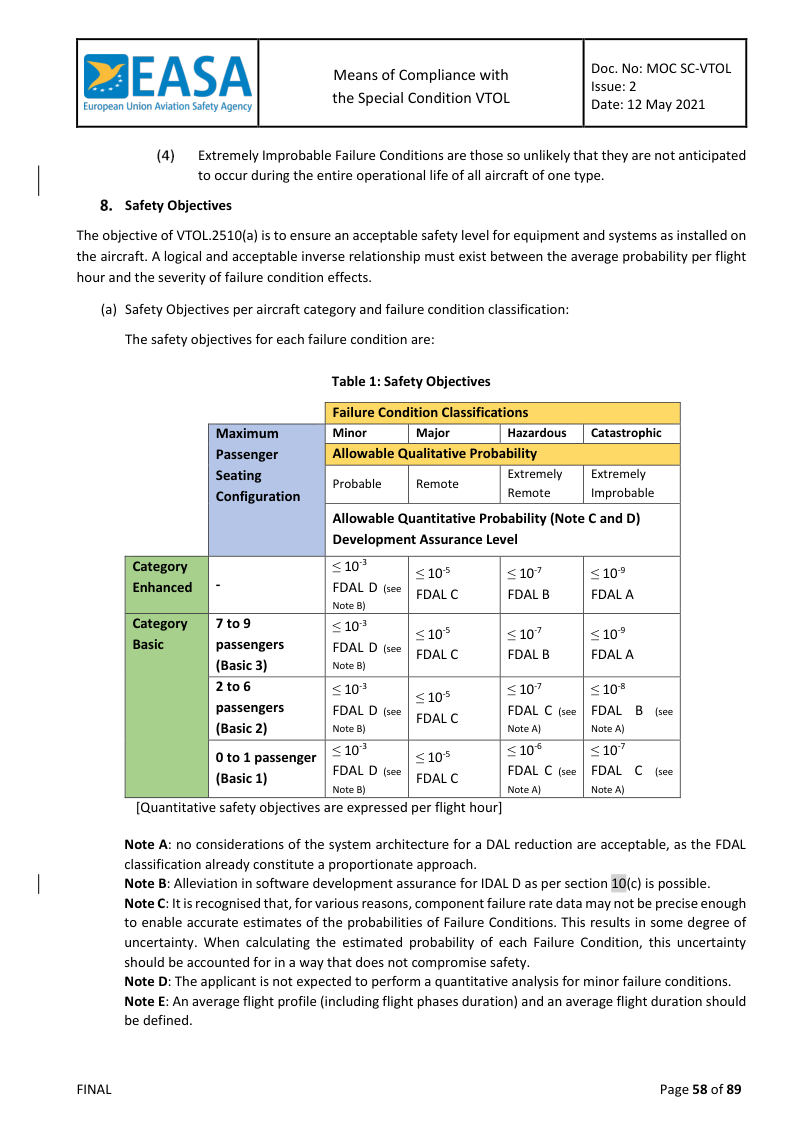
The objective of VTOL.2510(a) is to ensure an acceptable safety level for equipment and systems as installed on the aircraft. A logical and acceptable inverse relationship must exist between the average probability per flight hour and the severity of failure condition effects.
(a) Safety Objectives per aircraft category and failure condition classification:
The safety objectives for each failure condition are:
Table 1: Safety Objectives
Minor Major Hazardous Catastrophic Allowable Qualitative Probability
Probable Remote Extremely Remote
Failure Condition Classifications Maximum Passenger Seating Configuration
Extremely Improbable Allowable Quantitative Probability (Note C and D) Development Assurance Level
Category Enhanced -
≤ 10-3 FDAL D (see
≤ 10-5 FDAL C
≤ 10-7 FDAL B
≤ 10-9 FDAL A
Note B)
Category Basic
≤ 10-3 FDAL D (see
≤ 10-5 FDAL C
≤ 10-7 FDAL B
≤ 10-9 FDAL A
Note B)
7 to 9 passengers (Basic 3)
≤ 10-3 FDAL D (see
≤ 10-7 FDAL C (see
≤ 10-8 FDAL B (see
≤ 10-5 FDAL C
Note B)
Note A)
Note A)
2 to 6 passengers (Basic 2)
≤ 10-3 FDAL D (see
≤ 10-6 FDAL C (see
≤ 10-7 FDAL C (see
0 to 1 passenger (Basic 1)
≤ 10-5 FDAL C
Note B)
Note A)
Note A) [Quantitative safety objectives are expressed per flight hour]
Note A: no considerations of the system architecture for a DAL reduction are acceptable, as the FDAL classification already constitute a proportionate approach. Note B: Alleviation in software development assurance for IDAL D as per section 10(c) is possible. Note C: It is recognised that, for various reasons, component failure rate data may not be precise enough to enable accurate estimates of the probabilities of Failure Conditions. This results in some degree of uncertainty. When calculating the estimated probability of each Failure Condition, this uncertainty should be accounted for in a way that does not compromise safety. Note D: The applicant is not expected to perform a quantitative analysis for minor failure conditions. Note E: An average flight profile (including flight phases duration) and an average flight duration should be defined.
View figures, tables and original page layout
Connected references
Source-backed citations and subject-based engineering context are labelled separately. These links do not establish equivalence or project acceptance.
Related technical context
Engineering contextEvidence and scope
SC-VTOL-02 and MOC SC-VTOL — published scope
Aerospace Consulting navigation suggestion based on the subject and stated scope of the two publications.
This connection does not establish regulatory equivalence, acceptance of a newer edition, or applicability of a project-specific precedent to another programme.
Supporting source