
MOC SC-VTOL
Means of Compliance with SC-VTOL — Batch 1
Issue 2 — FINAL Source checked 2026-11-28
Scope, source and reading notes
Complete final batch 1 of SC-VTOL means of compliance. Later batches may amend individual provisions in earlier batches.
Aerospace Consulting reference note: Initial final means of compliance with SC-VTOL. Later final MoC batches supplement or amend specific provisions.
The complete selected publication is available in reading text and as the original PDF. Reading text is extracted from the official PDF; page layout is simplified, and figures and tables should be checked in the original page view.
Search covers extracted text. Words contained only in graphics may not be searchable. The original publication is available below.
Official source recordOriginal PDF on this siteSource: EASA. Reproduced with source acknowledgment; source edition and status are shown above. SHA-256: db12643dc7ceea42b40a49945615bf06cf39e0f2e6743090241a00eafca7a8a2
Means of Compliance with the Special Condition VTOL
Doc. No: MOC SC-VTOL Issue: 2 Date: 12 May 2021
Notes:
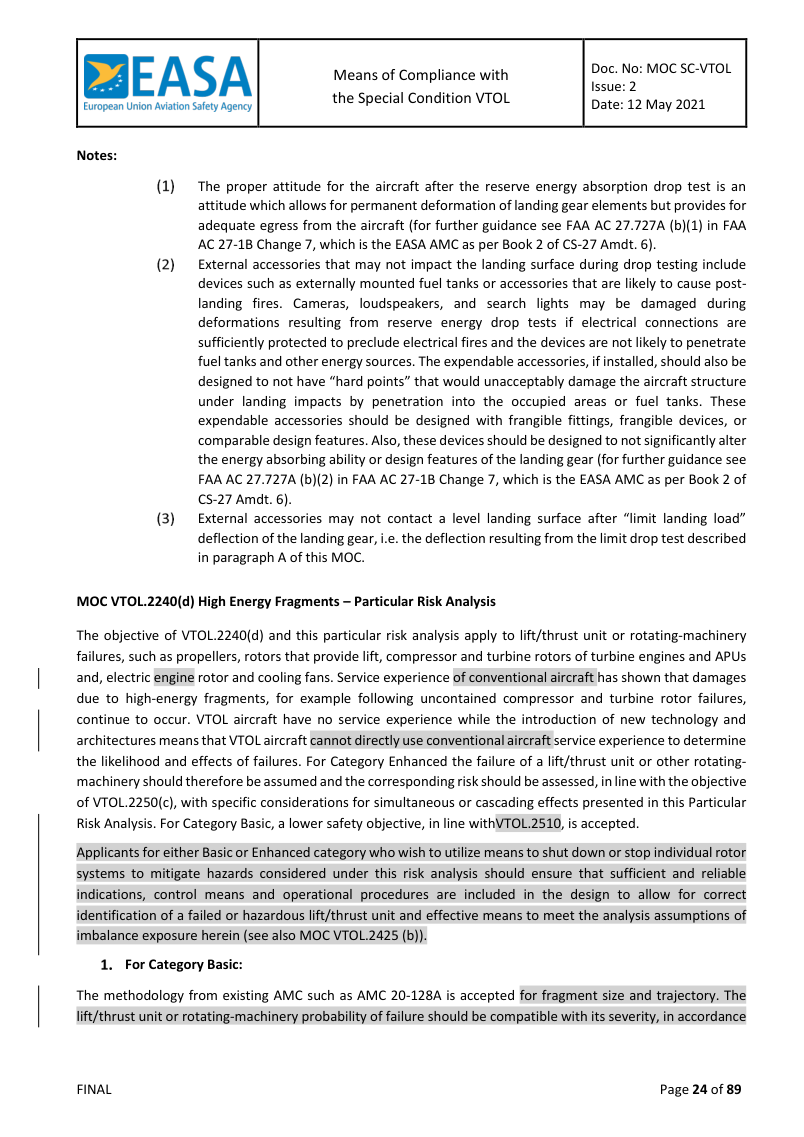
The proper attitude for the aircraft after the reserve energy absorption drop test is an attitude which allows for permanent deformation of landing gear elements but provides for adequate egress from the aircraft (for further guidance see FAA AC 27.727A (b)(1) in FAA AC 27-1B Change 7, which is the EASA AMC as per Book 2 of CS-27 Amdt. 6). External accessories that may not impact the landing surface during drop testing include devices such as externally mounted fuel tanks or accessories that are likely to cause post- landing fires. Cameras, loudspeakers, and search lights may be damaged during deformations resulting from reserve energy drop tests if electrical connections are sufficiently protected to preclude electrical fires and the devices are not likely to penetrate fuel tanks and other energy sources. The expendable accessories, if installed, should also be designed to not have “hard points” that would unacceptably damage the aircraft structure under landing impacts by penetration into the occupied areas or fuel tanks. These expendable accessories should be designed with frangible fittings, frangible devices, or comparable design features. Also, these devices should be designed to not significantly alter the energy absorbing ability or design features of the landing gear (for further guidance see FAA AC 27.727A (b)(2) in FAA AC 27-1B Change 7, which is the EASA AMC as per Book 2 of CS-27 Amdt. 6). External accessories may not contact a level landing surface after “limit landing load” deflection of the landing gear, i.e. the deflection resulting from the limit drop test described in paragraph A of this MOC.
MOC VTOL.2240(d) High Energy Fragments – Particular Risk Analysis
The objective of VTOL.2240(d) and this particular risk analysis apply to lift/thrust unit or rotating-machinery failures, such as propellers, rotors that provide lift, compressor and turbine rotors of turbine engines and APUs and, electric engine rotor and cooling fans. Service experience of conventional aircraft has shown that damages due to high-energy fragments, for example following uncontained compressor and turbine rotor failures, continue to occur. VTOL aircraft have no service experience while the introduction of new technology and architectures means that VTOL aircraft cannot directly use conventional aircraft service experience to determine the likelihood and effects of failures. For Category Enhanced the failure of a lift/thrust unit or other rotating- machinery should therefore be assumed and the corresponding risk should be assessed, in line with the objective of VTOL.2250(c), with specific considerations for simultaneous or cascading effects presented in this Particular Risk Analysis. For Category Basic, a lower safety objective, in line withVTOL.2510, is accepted.
Applicants for either Basic or Enhanced category who wish to utilize means to shut down or stop individual rotor systems to mitigate hazards considered under this risk analysis should ensure that sufficient and reliable indications, control means and operational procedures are included in the design to allow for correct identification of a failed or hazardous lift/thrust unit and effective means to meet the analysis assumptions of imbalance exposure herein (see also MOC VTOL.2425 (b)).
For Category Basic:
The methodology from existing AMC such as AMC 20-128A is accepted for fragment size and trajectory. The lift/thrust unit or rotating-machinery probability of failure should be compatible with its severity, in accordance
View figures, tables and original page layout
Connected references
Source-backed citations and subject-based engineering context are labelled separately. These links do not establish equivalence or project acceptance.
Related technical context
Engineering contextEvidence and scope
SC-VTOL-02 and MOC SC-VTOL — published scope
Aerospace Consulting navigation suggestion based on the subject and stated scope of the two publications.
This connection does not establish regulatory equivalence, acceptance of a newer edition, or applicability of a project-specific precedent to another programme.
Supporting source