
MOC SC-VTOL
Means of Compliance with SC-VTOL — Batch 1
Issue 2 — FINAL Source checked 2026-11-28
Scope, source and reading notes
Complete final batch 1 of SC-VTOL means of compliance. Later batches may amend individual provisions in earlier batches.
Aerospace Consulting reference note: Initial final means of compliance with SC-VTOL. Later final MoC batches supplement or amend specific provisions.
The complete selected publication is available in reading text and as the original PDF. Reading text is extracted from the official PDF; page layout is simplified, and figures and tables should be checked in the original page view.
Search covers extracted text. Words contained only in graphics may not be searchable. The original publication is available below.
Official source recordOriginal PDF on this siteSource: EASA. Reproduced with source acknowledgment; source edition and status are shown above. SHA-256: db12643dc7ceea42b40a49945615bf06cf39e0f2e6743090241a00eafca7a8a2
Means of Compliance with the Special Condition VTOL
Doc. No: MOC SC-VTOL Issue: 2 Date: 12 May 2021
Minimum ACCEPTABLE HQR
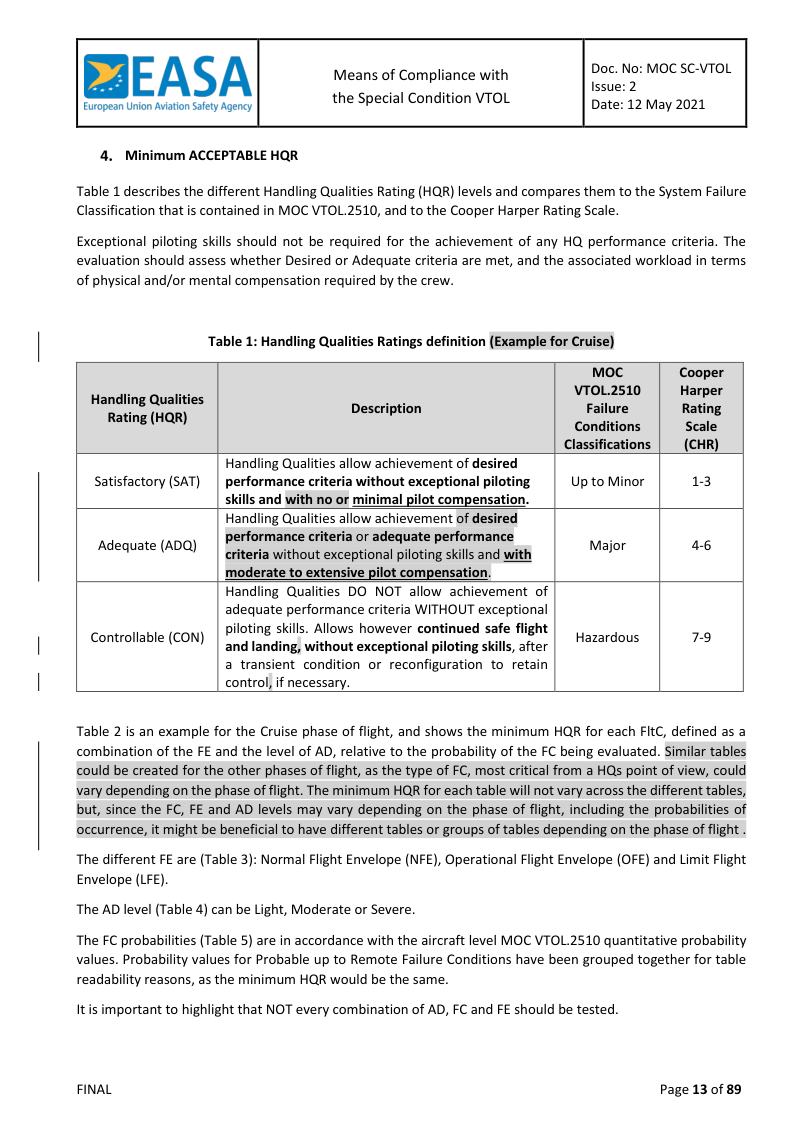
Table 1 describes the different Handling Qualities Rating (HQR) levels and compares them to the System Failure Classification that is contained in MOC VTOL.2510, and to the Cooper Harper Rating Scale.
Exceptional piloting skills should not be required for the achievement of any HQ performance criteria. The evaluation should assess whether Desired or Adequate criteria are met, and the associated workload in terms of physical and/or mental compensation required by the crew.
Table 1: Handling Qualities Ratings definition (Example for Cruise)
Cooper
MOC VTOL.2510
Harper
Handling Qualities
Rating
Rating (HQR) Description
Failure Conditions Classifications
Scale (CHR)
Satisfactory (SAT)
Up to Minor 1-3
Handling Qualities allow achievement of desired performance criteria without exceptional piloting skills and with no or minimal pilot compensation.
Adequate (ADQ)
Major 4-6
Handling Qualities allow achievement of desired performance criteria or adequate performance criteria without exceptional piloting skills and with moderate to extensive pilot compensation.
Controllable (CON)
Hazardous 7-9
Handling Qualities DO NOT allow achievement of adequate performance criteria WITHOUT exceptional piloting skills. Allows however continued safe flight and landing, without exceptional piloting skills, after a transient condition or reconfiguration to retain control, if necessary.
Table 2 is an example for the Cruise phase of flight, and shows the minimum HQR for each FltC, defined as a combination of the FE and the level of AD, relative to the probability of the FC being evaluated. Similar tables could be created for the other phases of flight, as the type of FC, most critical from a HQs point of view, could vary depending on the phase of flight. The minimum HQR for each table will not vary across the different tables, but, since the FC, FE and AD levels may vary depending on the phase of flight, including the probabilities of occurrence, it might be beneficial to have different tables or groups of tables depending on the phase of flight .
The different FE are (Table 3): Normal Flight Envelope (NFE), Operational Flight Envelope (OFE) and Limit Flight Envelope (LFE).
The AD level (Table 4) can be Light, Moderate or Severe.
The FC probabilities (Table 5) are in accordance with the aircraft level MOC VTOL.2510 quantitative probability values. Probability values for Probable up to Remote Failure Conditions have been grouped together for table readability reasons, as the minimum HQR would be the same.
It is important to highlight that NOT every combination of AD, FC and FE should be tested.
View figures, tables and original page layout
Connected references
Source-backed citations and subject-based engineering context are labelled separately. These links do not establish equivalence or project acceptance.
Related technical context
Engineering contextEvidence and scope
SC-VTOL-02 and MOC SC-VTOL — published scope
Aerospace Consulting navigation suggestion based on the subject and stated scope of the two publications.
This connection does not establish regulatory equivalence, acceptance of a newer edition, or applicability of a project-specific precedent to another programme.
Supporting source