
MOC SC-VTOL
Means of Compliance with SC-VTOL — Batch 1
Issue 2 — FINAL Source checked 2026-11-28
Scope, source and reading notes
Complete final batch 1 of SC-VTOL means of compliance. Later batches may amend individual provisions in earlier batches.
Aerospace Consulting reference note: Initial final means of compliance with SC-VTOL. Later final MoC batches supplement or amend specific provisions.
The complete selected publication is available in reading text and as the original PDF. Reading text is extracted from the official PDF; page layout is simplified, and figures and tables should be checked in the original page view.
Search covers extracted text. Words contained only in graphics may not be searchable. The original publication is available below.
Official source recordOriginal PDF on this siteSource: EASA. Reproduced with source acknowledgment; source edition and status are shown above. SHA-256: db12643dc7ceea42b40a49945615bf06cf39e0f2e6743090241a00eafca7a8a2
Means of Compliance with the Special Condition VTOL
Doc. No: MOC SC-VTOL Issue: 2 Date: 12 May 2021
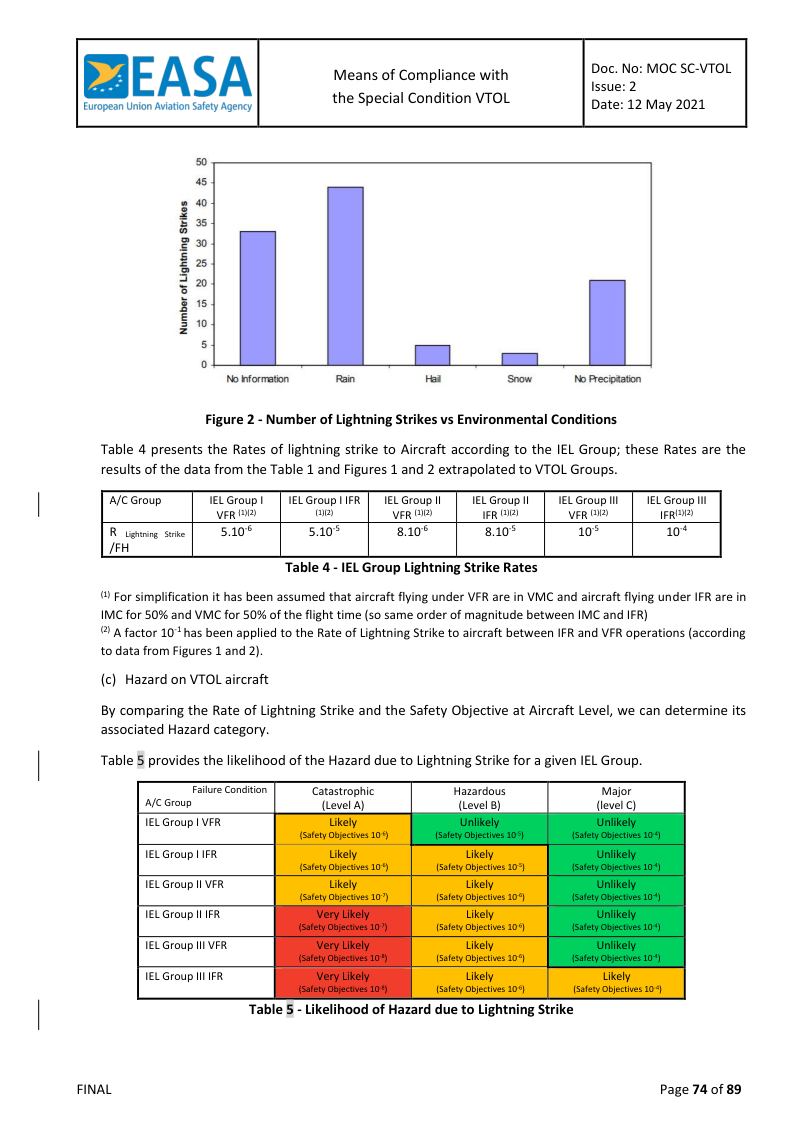
Figure 2 - Number of Lightning Strikes vs Environmental Conditions
Table 4 presents the Rates of lightning strike to Aircraft according to the IEL Group; these Rates are the results of the data from the Table 1 and Figures 1 and 2 extrapolated to VTOL Groups.
IEL Group I IFR
IEL Group II
IEL Group II
IEL Group III
IEL Group III
A/C Group IEL Group I
(1)(2)
VFR (1)(2)
IFR (1)(2)
VFR (1)(2)
VFR (1)(2)
5.10-6 5.10-5 8.10-6 8.10-5 10-5 10-4
IFR(1)(2) R Lightning Strike /FH
Table 4 - IEL Group Lightning Strike Rates
(1) For simplification it has been assumed that aircraft flying under VFR are in VMC and aircraft flying under IFR are in IMC for 50% and VMC for 50% of the flight time (so same order of magnitude between IMC and IFR)
(2) A factor 10-1 has been applied to the Rate of Lightning Strike to aircraft between IFR and VFR operations (according to data from Figures 1 and 2).
(c) Hazard on VTOL aircraft
By comparing the Rate of Lightning Strike and the Safety Objective at Aircraft Level, we can determine its associated Hazard category.
Table 5 provides the likelihood of the Hazard due to Lightning Strike for a given IEL Group.
Catastrophic
Hazardous
Failure Condition A/C Group
(Level A)
(Level B)
Major (level C) IEL Group I VFR Likely (Safety Objectives 10-6)
Unlikely (Safety Objectives 10-5)
Unlikely (Safety Objectives 10-4)
IEL Group I IFR Likely (Safety Objectives 10-6)
Likely (Safety Objectives 10-5)
Unlikely (Safety Objectives 10-4) IEL Group II VFR Likely (Safety Objectives 10-7)
Likely (Safety Objectives 10-6)
Very Likely (Safety Objectives 10-7)
Likely (Safety Objectives 10-6)
Unlikely (Safety Objectives 10-4)
Unlikely (Safety Objectives 10-4) IEL Group II IFR
IEL Group III VFR Very Likely (Safety Objectives 10-8)
Likely (Safety Objectives 10-6)
Unlikely (Safety Objectives 10-4)
IEL Group III IFR Very Likely (Safety Objectives 10-8)
Likely (Safety Objectives 10-6)
Likely (Safety Objectives 10-4) Table 5 - Likelihood of Hazard due to Lightning Strike
View figures, tables and original page layout
Connected references
Source-backed citations and subject-based engineering context are labelled separately. These links do not establish equivalence or project acceptance.
Related technical context
Engineering contextEvidence and scope
SC-VTOL-02 and MOC SC-VTOL — published scope
Aerospace Consulting navigation suggestion based on the subject and stated scope of the two publications.
This connection does not establish regulatory equivalence, acceptance of a newer edition, or applicability of a project-specific precedent to another programme.
Supporting source