
MOC SC-VTOL
Means of Compliance with SC-VTOL — Batch 1
Issue 2 — FINAL Source checked 2026-11-28
Scope, source and reading notes
Complete final batch 1 of SC-VTOL means of compliance. Later batches may amend individual provisions in earlier batches.
Aerospace Consulting reference note: Initial final means of compliance with SC-VTOL. Later final MoC batches supplement or amend specific provisions.
The complete selected publication is available in reading text and as the original PDF. Reading text is extracted from the official PDF; page layout is simplified, and figures and tables should be checked in the original page view.
Search covers extracted text. Words contained only in graphics may not be searchable. The original publication is available below.
Official source recordOriginal PDF on this siteSource: EASA. Reproduced with source acknowledgment; source edition and status are shown above. SHA-256: db12643dc7ceea42b40a49945615bf06cf39e0f2e6743090241a00eafca7a8a2
Means of Compliance with the Special Condition VTOL
Doc. No: MOC SC-VTOL Issue: 2 Date: 12 May 2021
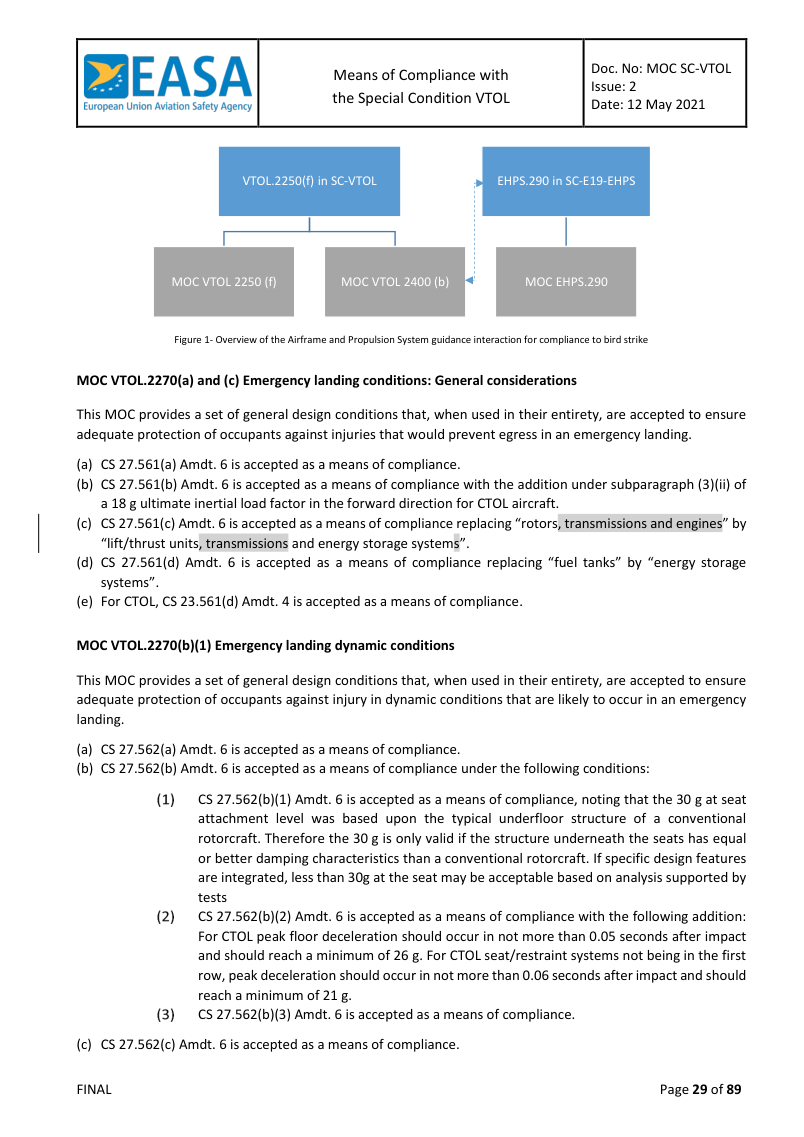
VTOL.2250(f) in SC-VTOL
EHPS.290 in SC-E19-EHPS
MOC VTOL 2250 (f) MOC VTOL 2400 (b)
MOC EHPS.290
Figure 1- Overview of the Airframe and Propulsion System guidance interaction for compliance to bird strike
MOC VTOL.2270(a) and (c) Emergency landing conditions: General considerations
This MOC provides a set of general design conditions that, when used in their entirety, are accepted to ensure adequate protection of occupants against injuries that would prevent egress in an emergency landing.
(a) CS 27.561(a) Amdt. 6 is accepted as a means of compliance. (b) CS 27.561(b) Amdt. 6 is accepted as a means of compliance with the addition under subparagraph (3)(ii) of
a 18 g ultimate inertial load factor in the forward direction for CTOL aircraft. (c) CS 27.561(c) Amdt. 6 is accepted as a means of compliance replacing “rotors, transmissions and engines” by
“lift/thrust units, transmissions and energy storage systems”. (d) CS 27.561(d) Amdt. 6 is accepted as a means of compliance replacing “fuel tanks” by “energy storage
systems”. (e) For CTOL, CS 23.561(d) Amdt. 4 is accepted as a means of compliance.
MOC VTOL.2270(b)(1) Emergency landing dynamic conditions
This MOC provides a set of general design conditions that, when used in their entirety, are accepted to ensure adequate protection of occupants against injury in dynamic conditions that are likely to occur in an emergency landing.
(a) CS 27.562(a) Amdt. 6 is accepted as a means of compliance. (b) CS 27.562(b) Amdt. 6 is accepted as a means of compliance under the following conditions:
CS 27.562(b)(1) Amdt. 6 is accepted as a means of compliance, noting that the 30 g at seat attachment level was based upon the typical underfloor structure of a conventional rotorcraft. Therefore the 30 g is only valid if the structure underneath the seats has equal or better damping characteristics than a conventional rotorcraft. If specific design features are integrated, less than 30g at the seat may be acceptable based on analysis supported by tests CS 27.562(b)(2) Amdt. 6 is accepted as a means of compliance with the following addition: For CTOL peak floor deceleration should occur in not more than 0.05 seconds after impact and should reach a minimum of 26 g. For CTOL seat/restraint systems not being in the first row, peak deceleration should occur in not more than 0.06 seconds after impact and should reach a minimum of 21 g. CS 27.562(b)(3) Amdt. 6 is accepted as a means of compliance.
(c) CS 27.562(c) Amdt. 6 is accepted as a means of compliance.
View figures, tables and original page layout
Connected references
Source-backed citations and subject-based engineering context are labelled separately. These links do not establish equivalence or project acceptance.
Related technical context
Engineering contextEvidence and scope
SC-VTOL-02 and MOC SC-VTOL — published scope
Aerospace Consulting navigation suggestion based on the subject and stated scope of the two publications.
This connection does not establish regulatory equivalence, acceptance of a newer edition, or applicability of a project-specific precedent to another programme.
Supporting source