
MOC SC-VTOL
Means of Compliance with SC-VTOL — Batch 1
Issue 2 — FINAL Source checked 2026-11-28
Scope, source and reading notes
Complete final batch 1 of SC-VTOL means of compliance. Later batches may amend individual provisions in earlier batches.
Aerospace Consulting reference note: Initial final means of compliance with SC-VTOL. Later final MoC batches supplement or amend specific provisions.
The complete selected publication is available in reading text and as the original PDF. Reading text is extracted from the official PDF; page layout is simplified, and figures and tables should be checked in the original page view.
Search covers extracted text. Words contained only in graphics may not be searchable. The original publication is available below.
Official source recordOriginal PDF on this siteSource: EASA. Reproduced with source acknowledgment; source edition and status are shown above. SHA-256: db12643dc7ceea42b40a49945615bf06cf39e0f2e6743090241a00eafca7a8a2
Means of Compliance with the Special Condition VTOL
Doc. No: MOC SC-VTOL Issue: 2 Date: 12 May 2021
(i) For aircraft with primarily metal structure, the metal skin provides a low impedance
electrical conductor. Standard rivets and bolts should provide adequate electrical bonding between permanent structural joints. Electrical bonding straps or jumpers should be installed on moving parts or for removable panels or parts. (ii) For aircraft with primarily carbon fibre or fiberglass structure, metal mesh, metal foil,
or expanded metal foil should be incorporated onto the external surfaces of the aircraft composite structure. This mesh or foil should be joined together electrically and provide a continuous electrical conductor between the extremities of the aircraft. Metallic components that are internal to the structure of the aircraft may also be used to provide similar shielding for equipment and its wiring. (iii) For aircraft constructed of tube and fabric, the tube skeleton can be considered to be
the low impedance electrical path through the aircraft. The bonding also may be achieved by the use of bonding straps or jumpers where required to electrically bond other metallic sub-structure that might be relied upon to provide bonding for equipment.
Electrical bonding specifications and verifications should be developed and implemented on the production drawings and instructions for continued airworthiness.
(b) HIRF Group Determination
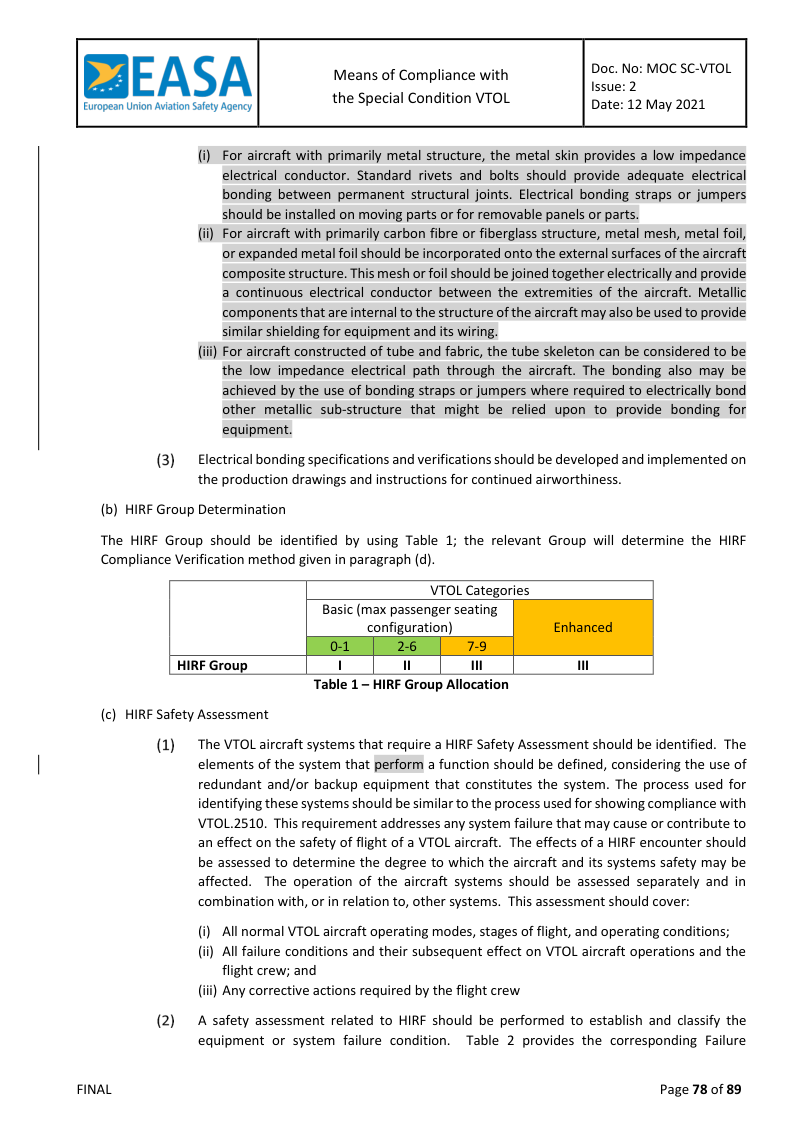
The HIRF Group should be identified by using Table 1; the relevant Group will determine the HIRF Compliance Verification method given in paragraph (d).
VTOL Categories Basic (max passenger seating
configuration)
Enhanced 0-1 2-6 7-9 HIRF Group I II III III Table 1 – HIRF Group Allocation
(c) HIRF Safety Assessment
The VTOL aircraft systems that require a HIRF Safety Assessment should be identified. The elements of the system that perform a function should be defined, considering the use of redundant and/or backup equipment that constitutes the system. The process used for identifying these systems should be similar to the process used for showing compliance with VTOL.2510. This requirement addresses any system failure that may cause or contribute to an effect on the safety of flight of a VTOL aircraft. The effects of a HIRF encounter should be assessed to determine the degree to which the aircraft and its systems safety may be affected. The operation of the aircraft systems should be assessed separately and in combination with, or in relation to, other systems. This assessment should cover:
(i) All normal VTOL aircraft operating modes, stages of flight, and operating conditions; (ii) All failure conditions and their subsequent effect on VTOL aircraft operations and the
flight crew; and (iii) Any corrective actions required by the flight crew
A safety assessment related to HIRF should be performed to establish and classify the equipment or system failure condition. Table 2 provides the corresponding Failure
View figures, tables and original page layout
Connected references
Source-backed citations and subject-based engineering context are labelled separately. These links do not establish equivalence or project acceptance.
Related technical context
Engineering contextEvidence and scope
SC-VTOL-02 and MOC SC-VTOL — published scope
Aerospace Consulting navigation suggestion based on the subject and stated scope of the two publications.
This connection does not establish regulatory equivalence, acceptance of a newer edition, or applicability of a project-specific precedent to another programme.
Supporting source