
CS-25
Large Aeroplanes
Amendment 28; corrected 20 November 2025 Source checked 2026-11-28
Scope, source and reading notes
Complete official CS-25 Amendment 28, including AMC and appendices.
Aerospace Consulting reference note: Certification specifications and acceptable means of compliance for large aeroplanes, using the corrected official publication.
The complete selected publication is available in reading text and as the original PDF. Reading text is extracted from the official PDF; page layout is simplified, and figures and tables should be checked in the original page view.
Search covers extracted text. Words contained only in graphics may not be searchable. The original publication is available below.
Official source recordOriginal PDF on this siteSource: EASA. Reproduced with source acknowledgment; source edition and status are shown above. SHA-256: 32f1a9acf26e8ceceb291d206bf07a7071f7f59f40f10c096bb17f34c6a58007
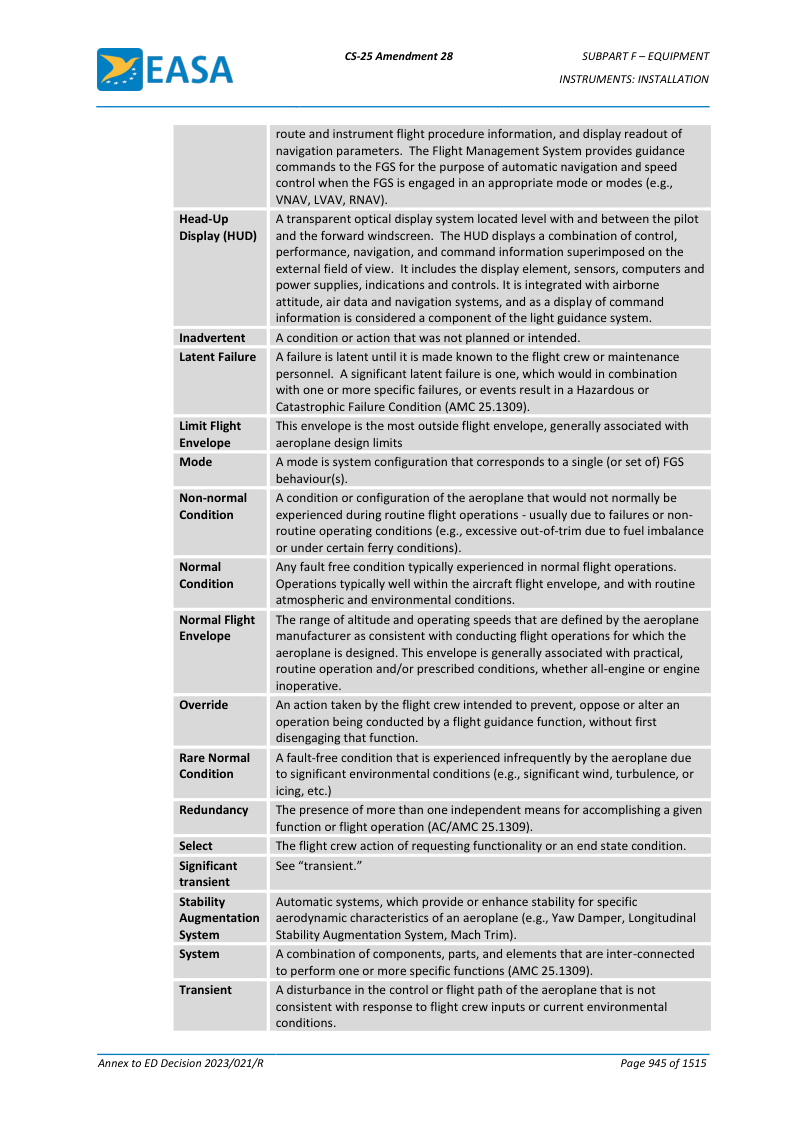
route and instrument flight procedure information, and display readout of navigation parameters. The Flight Management System provides guidance commands to the FGS for the purpose of automatic navigation and speed control when the FGS is engaged in an appropriate mode or modes (e.g., VNAV, LVAV, RNAV). Head-Up Display (HUD)
A transparent optical display system located level with and between the pilot and the forward windscreen. The HUD displays a combination of control, performance, navigation, and command information superimposed on the external field of view. It includes the display element, sensors, computers and power supplies, indications and controls. It is integrated with airborne attitude, air data and navigation systems, and as a display of command information is considered a component of the light guidance system. Inadvertent A condition or action that was not planned or intended. Latent Failure A failure is latent until it is made known to the flight crew or maintenance personnel. A significant latent failure is one, which would in combination with one or more specific failures, or events result in a Hazardous or Catastrophic Failure Condition (AMC 25.1309). Limit Flight Envelope
This envelope is the most outside flight envelope, generally associated with aeroplane design limits Mode A mode is system configuration that corresponds to a single (or set of) FGS behaviour(s). Non-normal Condition
A condition or configuration of the aeroplane that would not normally be experienced during routine flight operations - usually due to failures or non- routine operating conditions (e.g., excessive out-of-trim due to fuel imbalance or under certain ferry conditions). Normal Condition
Any fault free condition typically experienced in normal flight operations. Operations typically well within the aircraft flight envelope, and with routine atmospheric and environmental conditions. Normal Flight Envelope
The range of altitude and operating speeds that are defined by the aeroplane manufacturer as consistent with conducting flight operations for which the aeroplane is designed. This envelope is generally associated with practical, routine operation and/or prescribed conditions, whether all-engine or engine inoperative. Override An action taken by the flight crew intended to prevent, oppose or alter an operation being conducted by a flight guidance function, without first disengaging that function. Rare Normal Condition
See “transient.”
A fault-free condition that is experienced infrequently by the aeroplane due to significant environmental conditions (e.g., significant wind, turbulence, or icing, etc.) Redundancy The presence of more than one independent means for accomplishing a given function or flight operation (AC/AMC 25.1309). Select The flight crew action of requesting functionality or an end state condition. Significant transient
Stability Augmentation System
Automatic systems, which provide or enhance stability for specific aerodynamic characteristics of an aeroplane (e.g., Yaw Damper, Longitudinal Stability Augmentation System, Mach Trim). System A combination of components, parts, and elements that are inter-connected to perform one or more specific functions (AMC 25.1309). Transient A disturbance in the control or flight path of the aeroplane that is not consistent with response to flight crew inputs or current environmental conditions.
View figures, tables and original page layout
Connected references
Source-backed citations and subject-based engineering context are labelled separately. These links do not establish equivalence or project acceptance.
Listed as related material by
Source-backedEvidence and scope
AMC 20-152A §8(a)(2)
Lists CS-25 without an amendment or specific paragraph.
Family reference; does not select a certification basis.
Supporting source