
CS-25
Large Aeroplanes
Amendment 28; corrected 20 November 2025 Source checked 2026-11-28
Scope, source and reading notes
Complete official CS-25 Amendment 28, including AMC and appendices.
Aerospace Consulting reference note: Certification specifications and acceptable means of compliance for large aeroplanes, using the corrected official publication.
The complete selected publication is available in reading text and as the original PDF. Reading text is extracted from the official PDF; page layout is simplified, and figures and tables should be checked in the original page view.
Search covers extracted text. Words contained only in graphics may not be searchable. The original publication is available below.
Official source recordOriginal PDF on this siteSource: EASA. Reproduced with source acknowledgment; source edition and status are shown above. SHA-256: 32f1a9acf26e8ceceb291d206bf07a7071f7f59f40f10c096bb17f34c6a58007
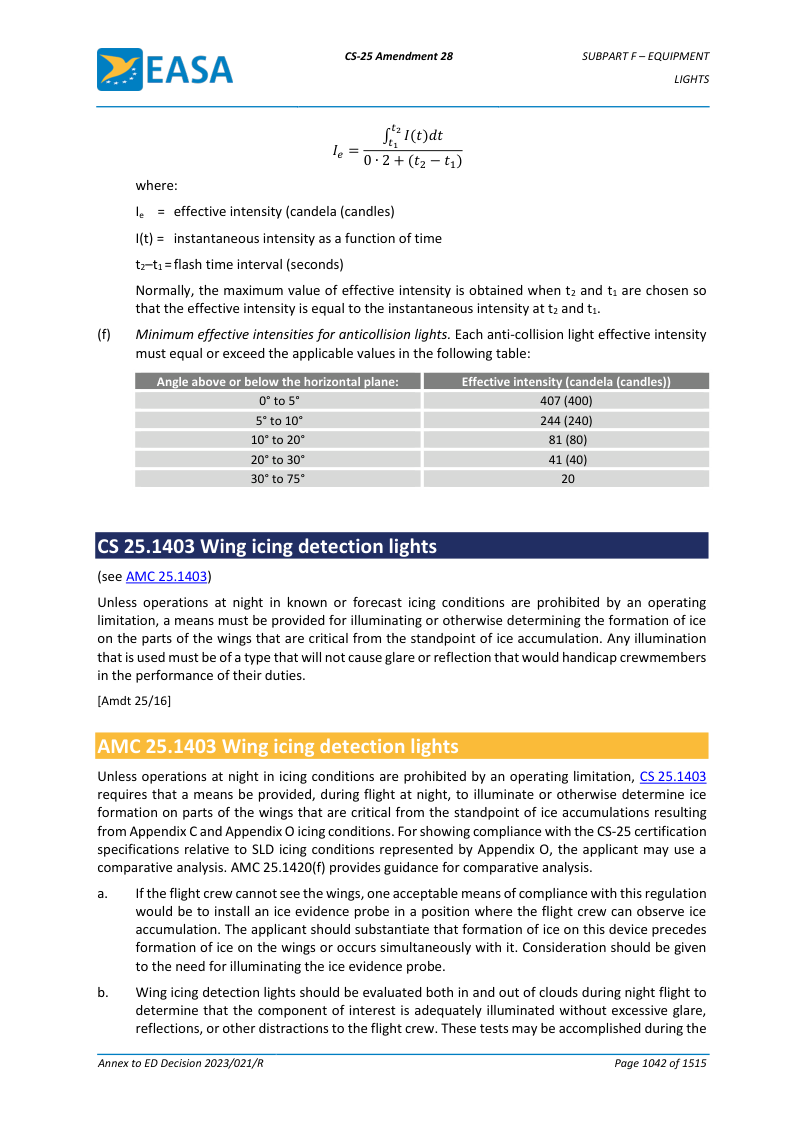
𝐼𝑒=
∫ 𝐼(𝑡)𝑑𝑡 𝑡2 𝑡1 0 ∙2 + (𝑡2 −𝑡1)
where:
Ie = effective intensity (candela (candles)
I(t) = instantaneous intensity as a function of time
t2–t1 = flash time interval (seconds)
Normally, the maximum value of effective intensity is obtained when t2 and t1 are chosen so that the effective intensity is equal to the instantaneous intensity at t2 and t1.
(f) Minimum effective intensities for anticollision lights. Each anti-collision light effective intensity must equal or exceed the applicable values in the following table:
Angle above or below the horizontal plane: Effective intensity (candela (candles)) 0° to 5° 407 (400) 5° to 10° 244 (240) 10° to 20° 81 (80) 20° to 30° 41 (40) 30° to 75° 20
CS 25.1403 Wing icing detection lights
(see AMC 25.1403)
Unless operations at night in known or forecast icing conditions are prohibited by an operating limitation, a means must be provided for illuminating or otherwise determining the formation of ice on the parts of the wings that are critical from the standpoint of ice accumulation. Any illumination that is used must be of a type that will not cause glare or reflection that would handicap crewmembers in the performance of their duties.
[Amdt 25/16]
AMC 25.1403 Wing icing detection lights
Unless operations at night in icing conditions are prohibited by an operating limitation, CS 25.1403 requires that a means be provided, during flight at night, to illuminate or otherwise determine ice formation on parts of the wings that are critical from the standpoint of ice accumulations resulting from Appendix C and Appendix O icing conditions. For showing compliance with the CS-25 certification specifications relative to SLD icing conditions represented by Appendix O, the applicant may use a comparative analysis. AMC 25.1420(f) provides guidance for comparative analysis.
a. If the flight crew cannot see the wings, one acceptable means of compliance with this regulation would be to install an ice evidence probe in a position where the flight crew can observe ice accumulation. The applicant should substantiate that formation of ice on this device precedes formation of ice on the wings or occurs simultaneously with it. Consideration should be given to the need for illuminating the ice evidence probe.
b. Wing icing detection lights should be evaluated both in and out of clouds during night flight to determine that the component of interest is adequately illuminated without excessive glare, reflections, or other distractions to the flight crew. These tests may be accomplished during the
View figures, tables and original page layout
Connected references
Source-backed citations and subject-based engineering context are labelled separately. These links do not establish equivalence or project acceptance.
Listed as related material by
Source-backedEvidence and scope
AMC 20-152A §8(a)(2)
Lists CS-25 without an amendment or specific paragraph.
Family reference; does not select a certification basis.
Supporting source