
CS-25
Large Aeroplanes
Amendment 28; corrected 20 November 2025 Source checked 2026-11-28
Scope, source and reading notes
Complete official CS-25 Amendment 28, including AMC and appendices.
Aerospace Consulting reference note: Certification specifications and acceptable means of compliance for large aeroplanes, using the corrected official publication.
The complete selected publication is available in reading text and as the original PDF. Reading text is extracted from the official PDF; page layout is simplified, and figures and tables should be checked in the original page view.
Search covers extracted text. Words contained only in graphics may not be searchable. The original publication is available below.
Official source recordOriginal PDF on this siteSource: EASA. Reproduced with source acknowledgment; source edition and status are shown above. SHA-256: 32f1a9acf26e8ceceb291d206bf07a7071f7f59f40f10c096bb17f34c6a58007
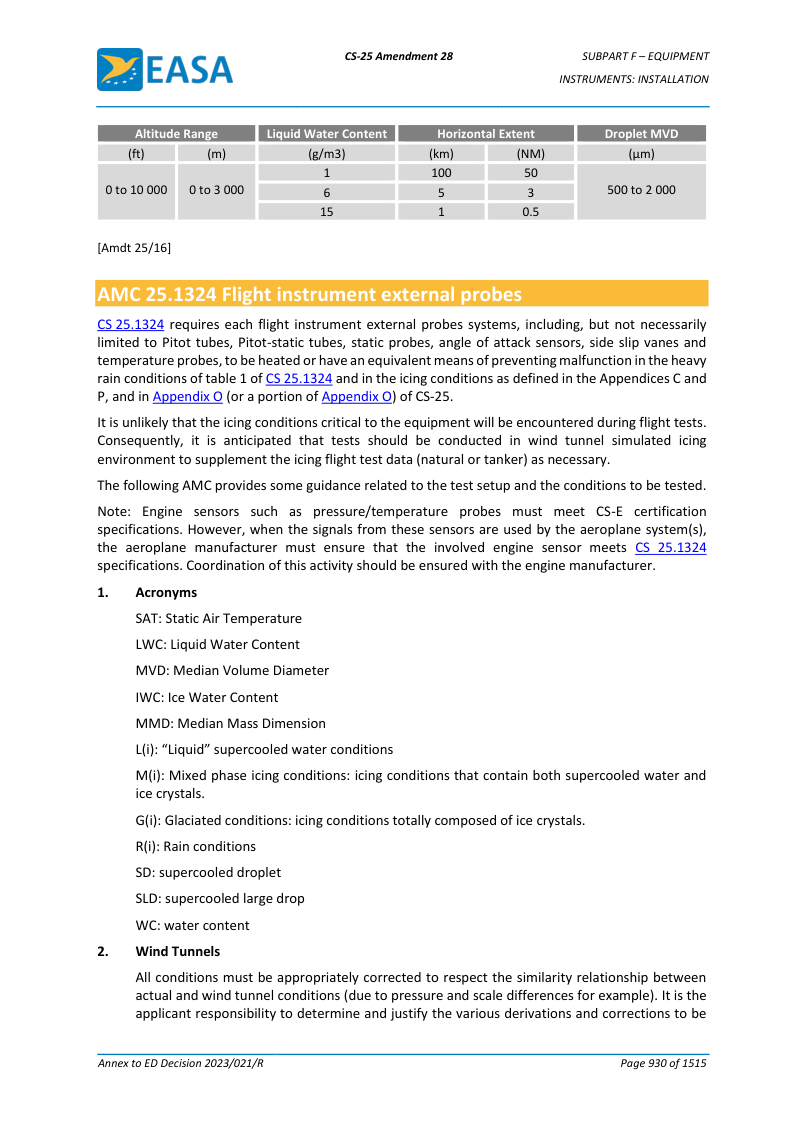
Altitude Range Liquid Water Content Horizontal Extent Droplet MVD (ft) (m) (g/m3) (km) (NM) (µm)
1 100 50
0 to 10 000
0 to 3 000
500 to 2 000 6 5 3 15 1 0.5 [Amdt 25/16]
AMC 25.1324 Flight instrument external probes
CS 25.1324 requires each flight instrument external probes systems, including, but not necessarily limited to Pitot tubes, Pitot-static tubes, static probes, angle of attack sensors, side slip vanes and temperature probes, to be heated or have an equivalent means of preventing malfunction in the heavy rain conditions of table 1 of CS 25.1324 and in the icing conditions as defined in the Appendices C and P, and in Appendix O (or a portion of Appendix O) of CS-25.
It is unlikely that the icing conditions critical to the equipment will be encountered during flight tests. Consequently, it is anticipated that tests should be conducted in wind tunnel simulated icing environment to supplement the icing flight test data (natural or tanker) as necessary.
The following AMC provides some guidance related to the test setup and the conditions to be tested.
Note: Engine sensors such as pressure/temperature probes must meet CS-E certification specifications. However, when the signals from these sensors are used by the aeroplane system(s), the aeroplane manufacturer must ensure that the involved engine sensor meets CS 25.1324 specifications. Coordination of this activity should be ensured with the engine manufacturer.
1. Acronyms
SAT: Static Air Temperature
LWC: Liquid Water Content
MVD: Median Volume Diameter
IWC: Ice Water Content
MMD: Median Mass Dimension
L(i): “Liquid” supercooled water conditions
M(i): Mixed phase icing conditions: icing conditions that contain both supercooled water and ice crystals.
G(i): Glaciated conditions: icing conditions totally composed of ice crystals.
R(i): Rain conditions
SD: supercooled droplet
SLD: supercooled large drop
WC: water content
2. Wind Tunnels
All conditions must be appropriately corrected to respect the similarity relationship between actual and wind tunnel conditions (due to pressure and scale differences for example). It is the applicant responsibility to determine and justify the various derivations and corrections to be
View figures, tables and original page layout
Connected references
Source-backed citations and subject-based engineering context are labelled separately. These links do not establish equivalence or project acceptance.
Listed as related material by
Source-backedEvidence and scope
AMC 20-152A §8(a)(2)
Lists CS-25 without an amendment or specific paragraph.
Family reference; does not select a certification basis.
Supporting source