
CS-25
Large Aeroplanes
Amendment 28; corrected 20 November 2025 Source checked 2026-11-28
Scope, source and reading notes
Complete official CS-25 Amendment 28, including AMC and appendices.
Aerospace Consulting reference note: Certification specifications and acceptable means of compliance for large aeroplanes, using the corrected official publication.
The complete selected publication is available in reading text and as the original PDF. Reading text is extracted from the official PDF; page layout is simplified, and figures and tables should be checked in the original page view.
Search covers extracted text. Words contained only in graphics may not be searchable. The original publication is available below.
Official source recordOriginal PDF on this siteSource: EASA. Reproduced with source acknowledgment; source edition and status are shown above. SHA-256: 32f1a9acf26e8ceceb291d206bf07a7071f7f59f40f10c096bb17f34c6a58007
(1) Surface temperature developed by the generator during operation may not create a hazard to the aeroplane or to its occupants.
(2) Means must be provided to relieve any internal pressure that may be hazardous.
(3) Comply with CS 25.795(d).
(c) In addition to meeting the requirements in sub-paragraph (b) of this paragraph, each portable chemical oxygen generator that is capable of sustained operation by successive replacement of a generator element must be placarded to show –
(1) The rate of oxygen flow, in litres per minute;
(2) The duration of oxygen flow, in minutes, for the replaceable generator element; and
(3) A warning that the replaceable generator element may be hot, unless the element construction is such that the surface temperature cannot exceed 37.8°C (100°F).
[Amdt 25/17]
CS 25.1453 Protection of oxygen equipment from rupture
(a) Each element of the system, excluding chemical oxygen generators, must have sufficient strength to withstand the maximum working pressures and temperatures in combination with any externally applied load, arising from consideration of limit structural loads that may be acting on that part of the system in service.
(1) The maximum working pressure must include the maximum normal operating pressure, the transient and surge pressures, tolerances of any pressure limiting means and possible pressure variations in the normal operating modes. Transient or surge pressures need not be considered except where these exceed the maximum normal operating pressure multiplied by 1·10.
(2) Account must be taken of the effects of temperature up to the maximum anticipated temperature to which the system may be subjected.
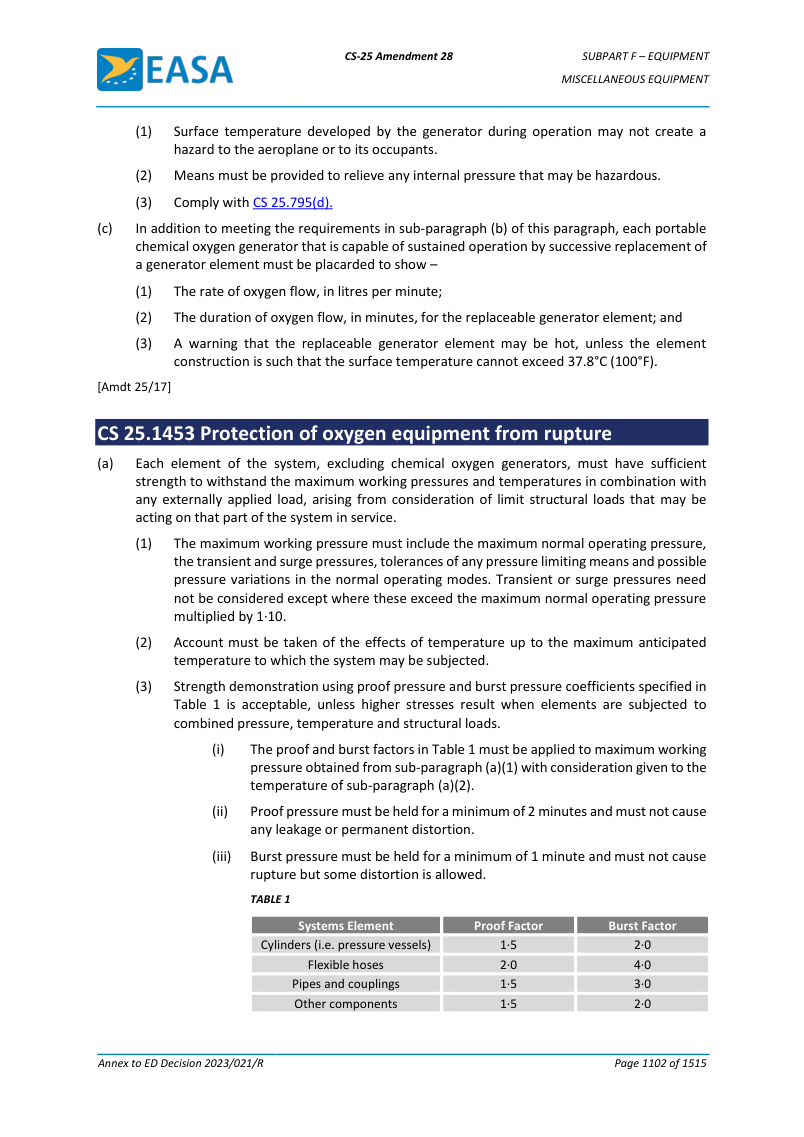
(3) Strength demonstration using proof pressure and burst pressure coefficients specified in Table 1 is acceptable, unless higher stresses result when elements are subjected to combined pressure, temperature and structural loads.
(i) The proof and burst factors in Table 1 must be applied to maximum working pressure obtained from sub-paragraph (a)(1) with consideration given to the temperature of sub-paragraph (a)(2).
(ii) Proof pressure must be held for a minimum of 2 minutes and must not cause any leakage or permanent distortion.
(iii) Burst pressure must be held for a minimum of 1 minute and must not cause rupture but some distortion is allowed.
TABLE 1
Systems Element Proof Factor Burst Factor Cylinders (i.e. pressure vessels) 1·5 2·0 Flexible hoses 2·0 4·0 Pipes and couplings 1·5 3·0 Other components 1·5 2·0
View figures, tables and original page layout
Connected references
Source-backed citations and subject-based engineering context are labelled separately. These links do not establish equivalence or project acceptance.
Listed as related material by
Source-backedEvidence and scope
AMC 20-152A §8(a)(2)
Lists CS-25 without an amendment or specific paragraph.
Family reference; does not select a certification basis.
Supporting source