
CS-25
Large Aeroplanes
Amendment 28; corrected 20 November 2025 Source checked 2026-11-28
Scope, source and reading notes
Complete official CS-25 Amendment 28, including AMC and appendices.
Aerospace Consulting reference note: Certification specifications and acceptable means of compliance for large aeroplanes, using the corrected official publication.
The complete selected publication is available in reading text and as the original PDF. Reading text is extracted from the official PDF; page layout is simplified, and figures and tables should be checked in the original page view.
Search covers extracted text. Words contained only in graphics may not be searchable. The original publication is available below.
Official source recordOriginal PDF on this siteSource: EASA. Reproduced with source acknowledgment; source edition and status are shown above. SHA-256: 32f1a9acf26e8ceceb291d206bf07a7071f7f59f40f10c096bb17f34c6a58007
CONTROLLABILITY AND MANOEUVRABILITY
CS 25.143 General
(a) (See AMC 25.143(a) and (b)) The aeroplane must be safely controllable and manoeuvrable during:
(1) take-off;
(2) climb;
(3) level flight;
(4) descent;
(5) approach and go-around; and
(6) approach and landing.
(b) (See AMC 25.143(a) and (b)) It must be possible to make a smooth transition from one flight condition to any other flight condition without exceptional piloting skill, alertness, or strength, and without danger of exceeding the aeroplane limit-load factor under any probable operating conditions, including:
(1) The sudden failure of the critical engine; (See AMC 25.143(b)(1).)
(2) For aeroplanes with three or more engines, the sudden failure of the second critical engine when the aeroplane is in the en-route, approach, or landing configuration and is trimmed with the critical engine inoperative; and
(3) Configuration changes, including deployment or retraction of deceleration devices; and
(4) Go-around manoeuvres with all engines operating. The assessment must include, in addition to controllability and manoeuvrability aspects, the flight crew workload and the risk of a somatogravic illusion. (See AMC 25.143(b)(4))
(c) The aeroplane must be shown to be safely controllable and manoeuvrable with the most critical ice accretion(s) appropriate to the phase of flight as defined in appendices C and O, as applicable, in accordance with CS 25.21(g), and with the critical engine inoperative and its propeller (if applicable) in the minimum drag position:
(1) At the minimum V2 for take-off;
(2) During an approach and go-around; and
(3) During an approach and landing.
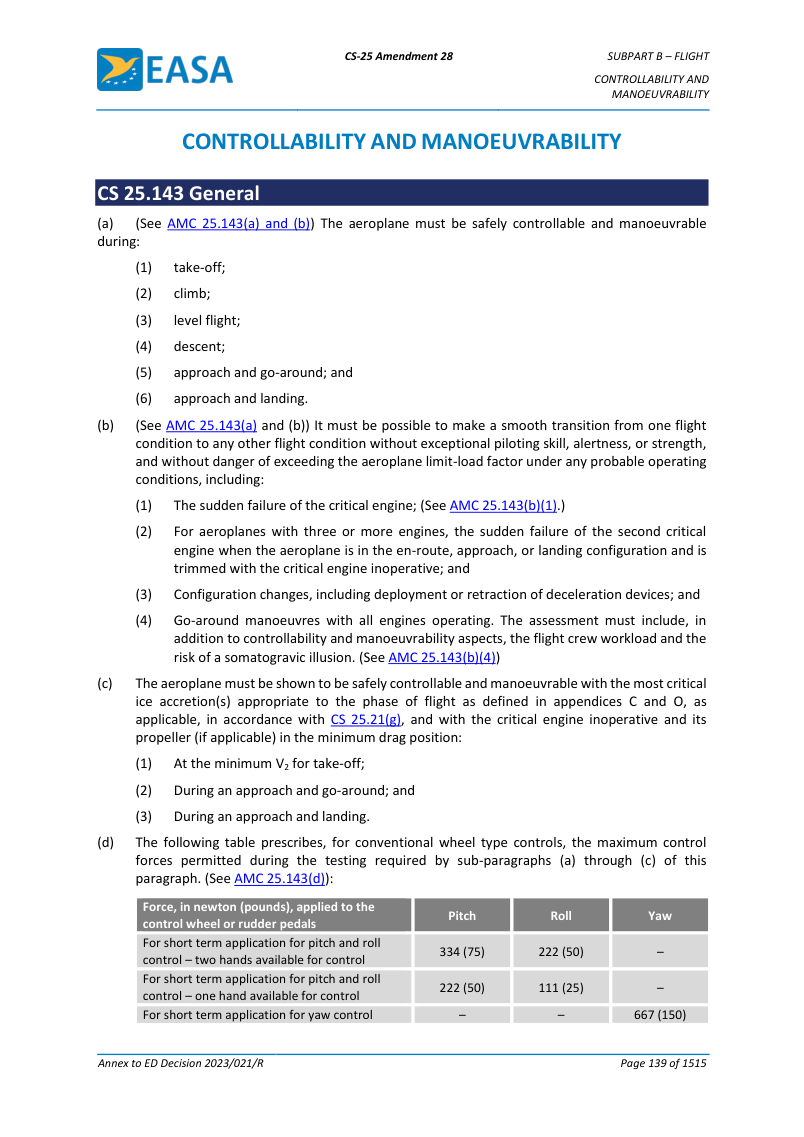
(d) The following table prescribes, for conventional wheel type controls, the maximum control forces permitted during the testing required by sub-paragraphs (a) through (c) of this paragraph. (See AMC 25.143(d)):
Force, in newton (pounds), applied to the control wheel or rudder pedals Pitch Roll Yaw
For short term application for pitch and roll control – two hands available for control 334 (75) 222 (50) –
For short term application for pitch and roll control – one hand available for control 222 (50) 111 (25) –
For short term application for yaw control – – 667 (150)
View figures, tables and original page layout
Connected references
Source-backed citations and subject-based engineering context are labelled separately. These links do not establish equivalence or project acceptance.
Listed as related material by
Source-backedEvidence and scope
AMC 20-152A §8(a)(2)
Lists CS-25 without an amendment or specific paragraph.
Family reference; does not select a certification basis.
Supporting source