
CS-25
Large Aeroplanes
Amendment 28; corrected 20 November 2025 Source checked 2026-11-28
Scope, source and reading notes
Complete official CS-25 Amendment 28, including AMC and appendices.
Aerospace Consulting reference note: Certification specifications and acceptable means of compliance for large aeroplanes, using the corrected official publication.
The complete selected publication is available in reading text and as the original PDF. Reading text is extracted from the official PDF; page layout is simplified, and figures and tables should be checked in the original page view.
Search covers extracted text. Words contained only in graphics may not be searchable. The original publication is available below.
Official source recordOriginal PDF on this siteSource: EASA. Reproduced with source acknowledgment; source edition and status are shown above. SHA-256: 32f1a9acf26e8ceceb291d206bf07a7071f7f59f40f10c096bb17f34c6a58007
AMC 25.1436(c)(2) Pneumatic Systems
The loads due to vibration and the loads due to temperature effects are those loads, which act upon the elements of the system due to environmental conditions.
CS 25.1438 Pressurisation and low pressure pneumatic systems
(See AMC 25.1438)
Pneumatic systems (ducting and components) served by bleed air, such as engine bleed air, air conditioning, pressurisation, engine starting and hotair ice-protection systems, which are essential for the safe operation of the aeroplane or whose failure may adversely affect any essential or critical part of the aeroplane or the safety of the occupants, must be so designed and installed as to comply the CS 25.1309 In particular account must be taken of bursting or excessive leakage. (See AMC 25.1438 paragraph 1 for strength and AMC 25.1438 paragraph 2 for testing.)
[Amdt 25/18]
AMC 25.1438 Pressurisation and low pressure pneumatic systems
1 Strength
1.1 Compliance with CS 25.1309(b) in relation to leakage in ducts and components will be achieved if it is shown that no hazardous effect will result from any single burst or excessive leakage.
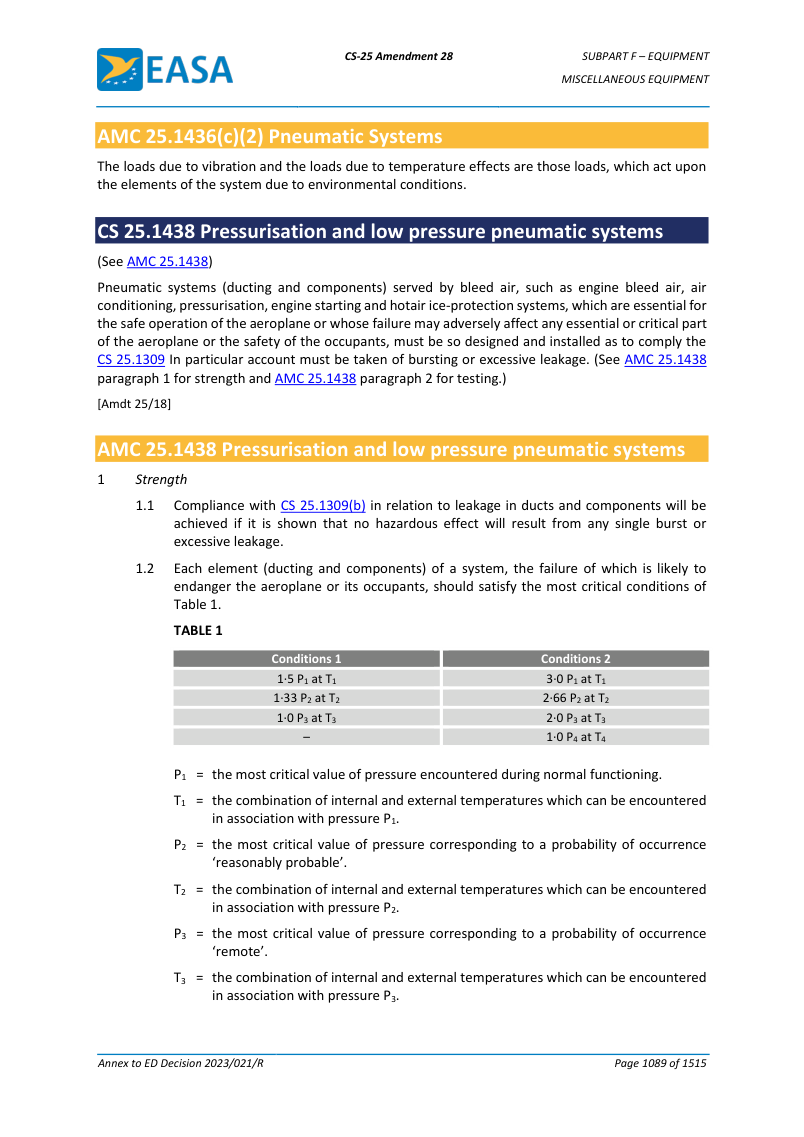
1.2 Each element (ducting and components) of a system, the failure of which is likely to endanger the aeroplane or its occupants, should satisfy the most critical conditions of Table 1.
TABLE 1
Conditions 1 Conditions 2 1·5 P1 at T1 3·0 P1 at T1 1·33 P2 at T2 2·66 P2 at T2 1·0 P3 at T3 2·0 P3 at T3 – 1·0 P4 at T4
P1 = the most critical value of pressure encountered during normal functioning.
T1 = the combination of internal and external temperatures which can be encountered
in association with pressure P1.
P2 = the most critical value of pressure corresponding to a probability of occurrence
‘reasonably probable’.
T2 = the combination of internal and external temperatures which can be encountered
in association with pressure P2.
P3 = the most critical value of pressure corresponding to a probability of occurrence
‘remote’.
T3 = the combination of internal and external temperatures which can be encountered
in association with pressure P3.
View figures, tables and original page layout
Connected references
Source-backed citations and subject-based engineering context are labelled separately. These links do not establish equivalence or project acceptance.
Listed as related material by
Source-backedEvidence and scope
AMC 20-152A §8(a)(2)
Lists CS-25 without an amendment or specific paragraph.
Family reference; does not select a certification basis.
Supporting source