
CS-25
Large Aeroplanes
Amendment 28; corrected 20 November 2025 Source checked 2026-11-28
Scope, source and reading notes
Complete official CS-25 Amendment 28, including AMC and appendices.
Aerospace Consulting reference note: Certification specifications and acceptable means of compliance for large aeroplanes, using the corrected official publication.
The complete selected publication is available in reading text and as the original PDF. Reading text is extracted from the official PDF; page layout is simplified, and figures and tables should be checked in the original page view.
Search covers extracted text. Words contained only in graphics may not be searchable. The original publication is available below.
Official source recordOriginal PDF on this siteSource: EASA. Reproduced with source acknowledgment; source edition and status are shown above. SHA-256: 32f1a9acf26e8ceceb291d206bf07a7071f7f59f40f10c096bb17f34c6a58007
effectiveness in preventing a fuel tank explosion with a fire present at the fuel tank vent outlet for a minimum of 2 minutes and 30 seconds.
[Amdt 25/21]
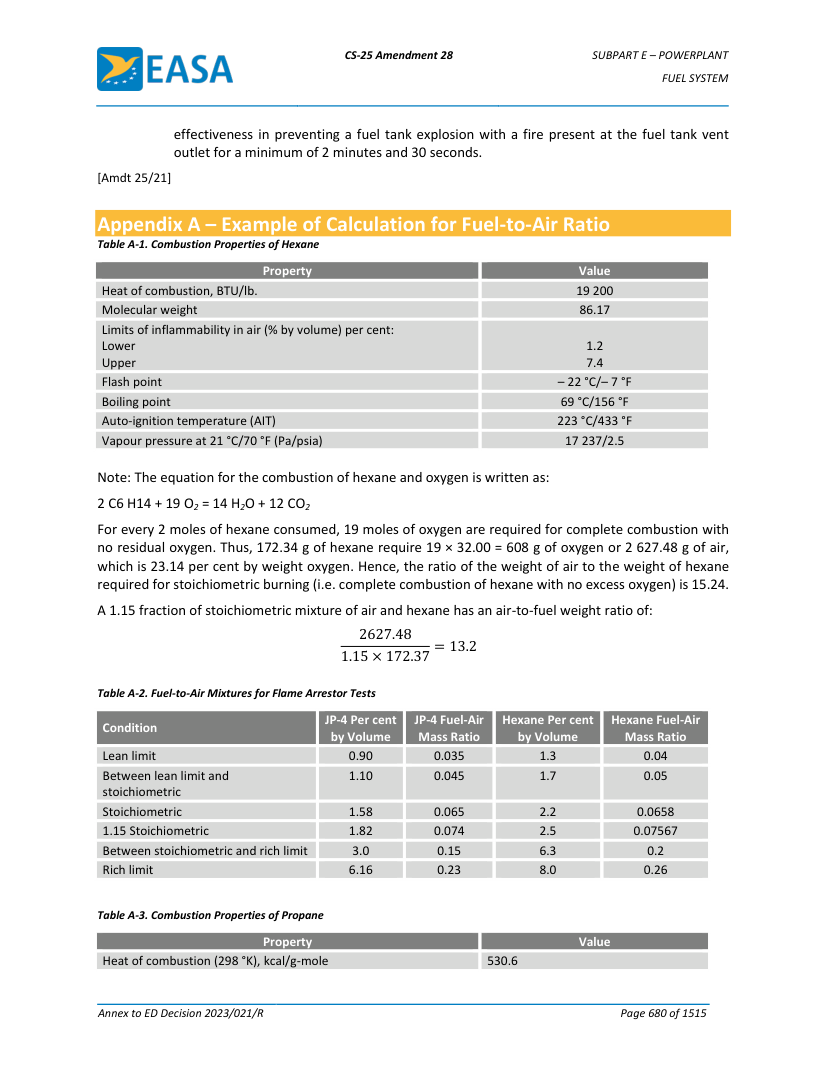
Appendix A – Example of Calculation for Fuel-to-Air Ratio Table A-1. Combustion Properties of Hexane
Property Value Heat of combustion, BTU/lb. 19 200 Molecular weight 86.17 Limits of inflammability in air (% by volume) per cent: Lower Upper
1.2 7.4 Flash point – 22 °C/– 7 °F Boiling point 69 °C/156 °F Auto-ignition temperature (AIT) 223 °C/433 °F Vapour pressure at 21 °C/70 °F (Pa/psia) 17 237/2.5 Note: The equation for the combustion of hexane and oxygen is written as:
2 C6 H14 + 19 O2 = 14 H2O + 12 CO2
For every 2 moles of hexane consumed, 19 moles of oxygen are required for complete combustion with no residual oxygen. Thus, 172.34 g of hexane require 19 × 32.00 = 608 g of oxygen or 2 627.48 g of air, which is 23.14 per cent by weight oxygen. Hence, the ratio of the weight of air to the weight of hexane required for stoichiometric burning (i.e. complete combustion of hexane with no excess oxygen) is 15.24.
A 1.15 fraction of stoichiometric mixture of air and hexane has an air-to-fuel weight ratio of:
2627.48 1.15 × 172.37 = 13.2
Table A-2. Fuel-to-Air Mixtures for Flame Arrestor Tests
JP-4 Fuel-Air
Hexane Per cent
Hexane Fuel-Air
Condition JP-4 Per cent
by Volume
Mass Ratio
by Volume
1.10 0.045 1.7 0.05
Mass Ratio Lean limit 0.90 0.035 1.3 0.04 Between lean limit and stoichiometric
Stoichiometric 1.58 0.065 2.2 0.0658 1.15 Stoichiometric 1.82 0.074 2.5 0.07567 Between stoichiometric and rich limit 3.0 0.15 6.3 0.2 Rich limit 6.16 0.23 8.0 0.26
Table A-3. Combustion Properties of Propane
Property Value Heat of combustion (298 °K), kcal/g-mole 530.6
View figures, tables and original page layout
Connected references
Source-backed citations and subject-based engineering context are labelled separately. These links do not establish equivalence or project acceptance.
Listed as related material by
Source-backedEvidence and scope
AMC 20-152A §8(a)(2)
Lists CS-25 without an amendment or specific paragraph.
Family reference; does not select a certification basis.
Supporting source