
CS-25
Large Aeroplanes
Amendment 28; corrected 20 November 2025 Source checked 2026-11-28
Scope, source and reading notes
Complete official CS-25 Amendment 28, including AMC and appendices.
Aerospace Consulting reference note: Certification specifications and acceptable means of compliance for large aeroplanes, using the corrected official publication.
The complete selected publication is available in reading text and as the original PDF. Reading text is extracted from the official PDF; page layout is simplified, and figures and tables should be checked in the original page view.
Search covers extracted text. Words contained only in graphics may not be searchable. The original publication is available below.
Official source recordOriginal PDF on this siteSource: EASA. Reproduced with source acknowledgment; source edition and status are shown above. SHA-256: 32f1a9acf26e8ceceb291d206bf07a7071f7f59f40f10c096bb17f34c6a58007
(c) Servo tabs. Servo tabs must be designed for deflections consistent with the primary control surface loading conditions obtainable within the pilot manoeuvring effort, considering possible opposition from the trim tabs.
CS 25.415 Ground gust conditions
(See AMC 25.415)
(a) The flight control systems and surfaces must be designed for the limit loads generated when the aircraft is subjected to a horizontal 33.44 m/sec (65 knots) ground gust from any direction, while taxying with the controls locked and unlocked and while parked with the controls locked.
(b) The control system and surface loads due to ground gust may be assumed to be static loads and the hinge moments H, in Newton metres (foot pounds), must be computed from the formula:
𝐻= 𝐾 1/2𝜌𝑜𝑉2𝑐𝑆
where:
K = hinge moment factor for ground gusts derived in subparagraph (c) of this paragraph
ρo = density of air at sea level = 1.225 (kg/m3) (0.0023769 (slugs/ft3) = 0.0023769 (lb-sec2/ ft4))
V = 33.44 m/sec (65 knots = 109.71 fps) relative to the aircraft
S = area of the control surface aft of the hinge line (m2) (ft2)
c = mean aerodynamic chord of the control surface aft of the hinge line (m) (ft)
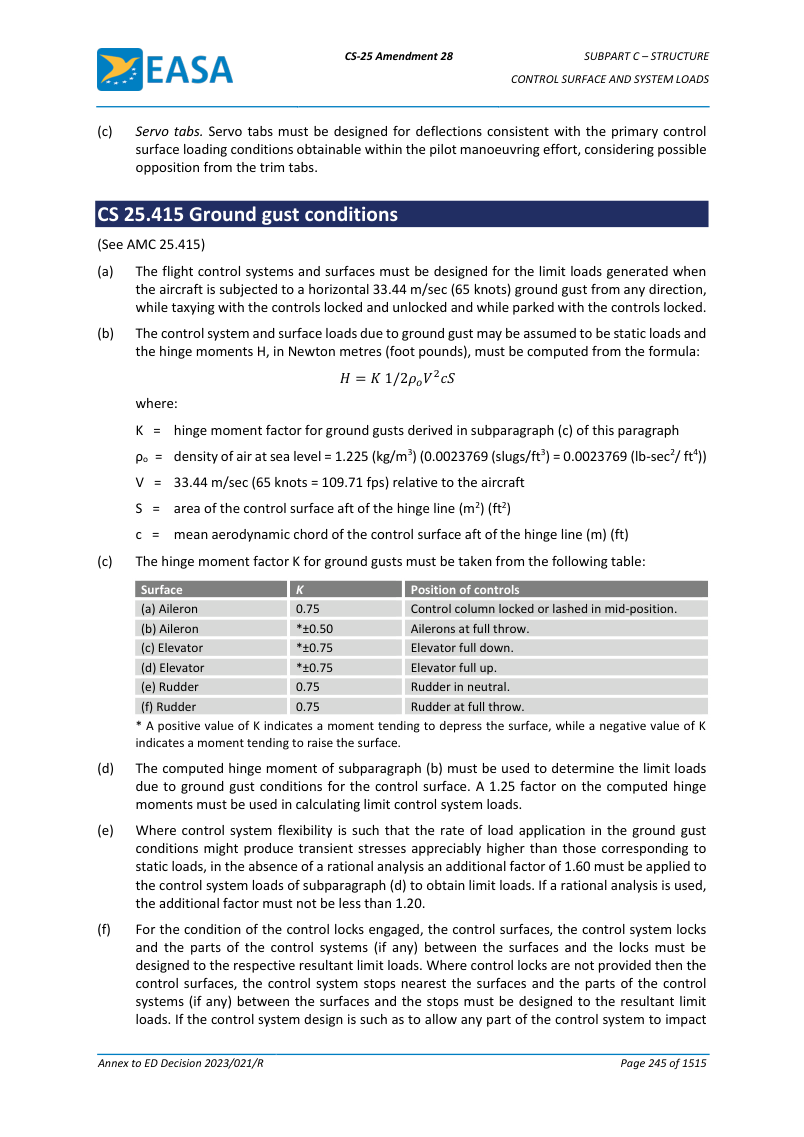
(c) The hinge moment factor K for ground gusts must be taken from the following table:
Surface K Position of controls (a) Aileron 0.75 Control column locked or lashed in mid-position. (b) Aileron *±0.50 Ailerons at full throw. (c) Elevator *±0.75 Elevator full down. (d) Elevator *±0.75 Elevator full up. (e) Rudder 0.75 Rudder in neutral. (f) Rudder 0.75 Rudder at full throw. * A positive value of K indicates a moment tending to depress the surface, while a negative value of K indicates a moment tending to raise the surface.
(d) The computed hinge moment of subparagraph (b) must be used to determine the limit loads due to ground gust conditions for the control surface. A 1.25 factor on the computed hinge moments must be used in calculating limit control system loads.
(e) Where control system flexibility is such that the rate of load application in the ground gust conditions might produce transient stresses appreciably higher than those corresponding to static loads, in the absence of a rational analysis an additional factor of 1.60 must be applied to the control system loads of subparagraph (d) to obtain limit loads. If a rational analysis is used, the additional factor must not be less than 1.20.
(f) For the condition of the control locks engaged, the control surfaces, the control system locks and the parts of the control systems (if any) between the surfaces and the locks must be designed to the respective resultant limit loads. Where control locks are not provided then the control surfaces, the control system stops nearest the surfaces and the parts of the control systems (if any) between the surfaces and the stops must be designed to the resultant limit loads. If the control system design is such as to allow any part of the control system to impact
View figures, tables and original page layout
Connected references
Source-backed citations and subject-based engineering context are labelled separately. These links do not establish equivalence or project acceptance.
Listed as related material by
Source-backedEvidence and scope
AMC 20-152A §8(a)(2)
Lists CS-25 without an amendment or specific paragraph.
Family reference; does not select a certification basis.
Supporting source