
CS-25
Large Aeroplanes
Amendment 28; corrected 20 November 2025 Source checked 2026-11-28
Scope, source and reading notes
Complete official CS-25 Amendment 28, including AMC and appendices.
Aerospace Consulting reference note: Certification specifications and acceptable means of compliance for large aeroplanes, using the corrected official publication.
The complete selected publication is available in reading text and as the original PDF. Reading text is extracted from the official PDF; page layout is simplified, and figures and tables should be checked in the original page view.
Search covers extracted text. Words contained only in graphics may not be searchable. The original publication is available below.
Official source recordOriginal PDF on this siteSource: EASA. Reproduced with source acknowledgment; source edition and status are shown above. SHA-256: 32f1a9acf26e8ceceb291d206bf07a7071f7f59f40f10c096bb17f34c6a58007
(2) If the emergency lighting sub-system illuminating the assisting means serves no other assist means, is independent of the aeroplane’s main emergency lighting system, and is automatically activated when the assisting means is erected, the lighting provisions –
(i) May not be adversely affected by stowage; and
(ii) Must provide illumination of not less than 0.3 lux (0.03 foot candle) (measured normal to the direction of the incident light) at the ground end of the erected assisting means where an evacuee would normally make first contact with the ground, with the aeroplane in each of the attitudes corresponding to the collapse of one or more legs of the landing gear.
(i) The energy supply to each emergency lighting unit must provide the required level of illumination for at least 10 minutes at the critical ambient conditions after emergency landing.
(j) If storage batteries are used as the energy supply for the emergency lighting system, they may be recharged from the aeroplane’s main electric power system: Provided, that the charging circuit is designed to preclude inadvertent battery discharge into charging circuit faults.
(k) Components of the emergency lighting system, including batteries, wiring relays, lamps, and switches must be capable of normal operation after having been subjected to the inertia forces listed in CS 25.561(b).
(l) The emergency lighting system must be designed so that after any single transverse vertical separation of the fuselage during crash landing:
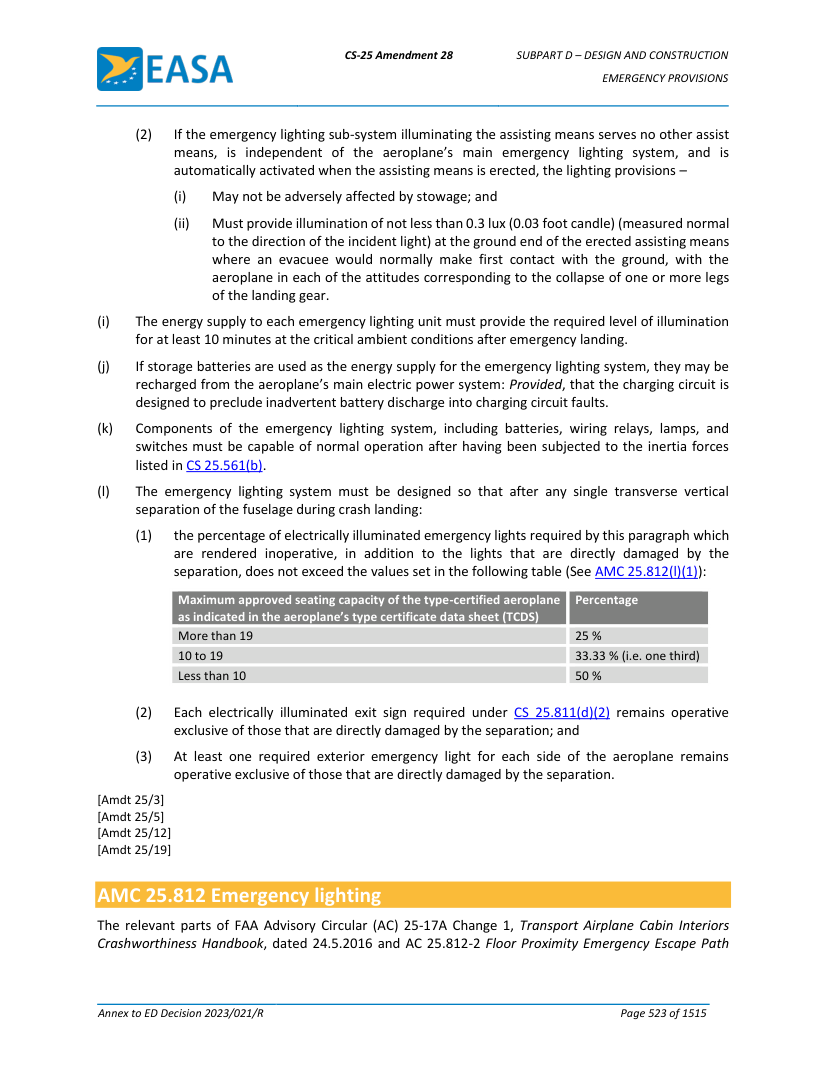
(1) the percentage of electrically illuminated emergency lights required by this paragraph which are rendered inoperative, in addition to the lights that are directly damaged by the separation, does not exceed the values set in the following table (See AMC 25.812(l)(1)):
Percentage
Maximum approved seating capacity of the type-certified aeroplane as indicated in the aeroplane’s type certificate data sheet (TCDS)
More than 19 25 % 10 to 19 33.33 % (i.e. one third) Less than 10 50 %
(2) Each electrically illuminated exit sign required under CS 25.811(d)(2) remains operative exclusive of those that are directly damaged by the separation; and
(3) At least one required exterior emergency light for each side of the aeroplane remains operative exclusive of those that are directly damaged by the separation.
[Amdt 25/3] [Amdt 25/5] [Amdt 25/12] [Amdt 25/19]
AMC 25.812 Emergency lighting
The relevant parts of FAA Advisory Circular (AC) 25-17A Change 1, Transport Airplane Cabin Interiors Crashworthiness Handbook, dated 24.5.2016 and AC 25.812-2 Floor Proximity Emergency Escape Path
View figures, tables and original page layout
Connected references
Source-backed citations and subject-based engineering context are labelled separately. These links do not establish equivalence or project acceptance.
Listed as related material by
Source-backedEvidence and scope
AMC 20-152A §8(a)(2)
Lists CS-25 without an amendment or specific paragraph.
Family reference; does not select a certification basis.
Supporting source