
CS-25
Large Aeroplanes
Amendment 28; corrected 20 November 2025 Source checked 2026-11-28
Scope, source and reading notes
Complete official CS-25 Amendment 28, including AMC and appendices.
Aerospace Consulting reference note: Certification specifications and acceptable means of compliance for large aeroplanes, using the corrected official publication.
The complete selected publication is available in reading text and as the original PDF. Reading text is extracted from the official PDF; page layout is simplified, and figures and tables should be checked in the original page view.
Search covers extracted text. Words contained only in graphics may not be searchable. The original publication is available below.
Official source recordOriginal PDF on this siteSource: EASA. Reproduced with source acknowledgment; source edition and status are shown above. SHA-256: 32f1a9acf26e8ceceb291d206bf07a7071f7f59f40f10c096bb17f34c6a58007
I 25.3 Performance requirements
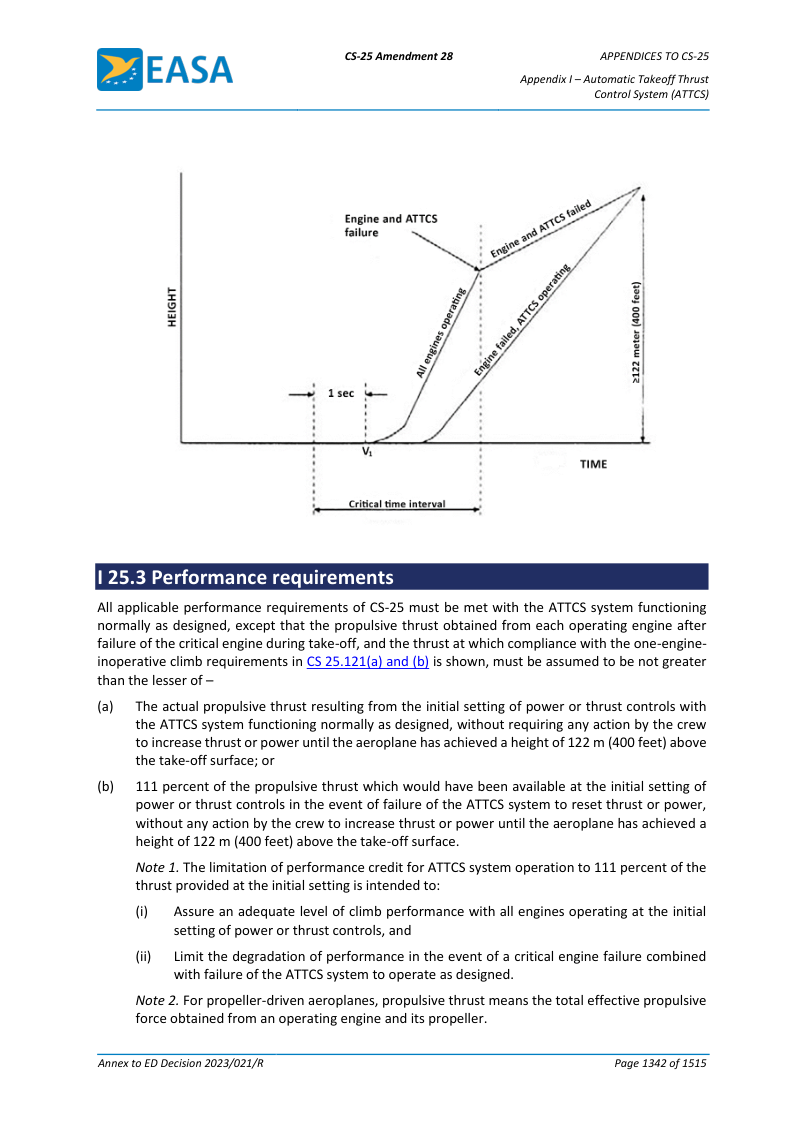
All applicable performance requirements of CS-25 must be met with the ATTCS system functioning normally as designed, except that the propulsive thrust obtained from each operating engine after failure of the critical engine during take-off, and the thrust at which compliance with the one-engine- inoperative climb requirements in CS 25.121(a) and (b) is shown, must be assumed to be not greater than the lesser of –
(a) The actual propulsive thrust resulting from the initial setting of power or thrust controls with the ATTCS system functioning normally as designed, without requiring any action by the crew to increase thrust or power until the aeroplane has achieved a height of 122 m (400 feet) above the take-off surface; or
(b) 111 percent of the propulsive thrust which would have been available at the initial setting of power or thrust controls in the event of failure of the ATTCS system to reset thrust or power, without any action by the crew to increase thrust or power until the aeroplane has achieved a height of 122 m (400 feet) above the take-off surface.
Note 1. The limitation of performance credit for ATTCS system operation to 111 percent of the thrust provided at the initial setting is intended to:
(i) Assure an adequate level of climb performance with all engines operating at the initial setting of power or thrust controls, and
(ii) Limit the degradation of performance in the event of a critical engine failure combined with failure of the ATTCS system to operate as designed.
Note 2. For propeller-driven aeroplanes, propulsive thrust means the total effective propulsive force obtained from an operating engine and its propeller.
View figures, tables and original page layout
Connected references
Source-backed citations and subject-based engineering context are labelled separately. These links do not establish equivalence or project acceptance.
Listed as related material by
Source-backedEvidence and scope
AMC 20-152A §8(a)(2)
Lists CS-25 without an amendment or specific paragraph.
Family reference; does not select a certification basis.
Supporting source