
CS-25
Large Aeroplanes
Amendment 28; corrected 20 November 2025 Source checked 2026-11-28
Scope, source and reading notes
Complete official CS-25 Amendment 28, including AMC and appendices.
Aerospace Consulting reference note: Certification specifications and acceptable means of compliance for large aeroplanes, using the corrected official publication.
The complete selected publication is available in reading text and as the original PDF. Reading text is extracted from the official PDF; page layout is simplified, and figures and tables should be checked in the original page view.
Search covers extracted text. Words contained only in graphics may not be searchable. The original publication is available below.
Official source recordOriginal PDF on this siteSource: EASA. Reproduced with source acknowledgment; source edition and status are shown above. SHA-256: 32f1a9acf26e8ceceb291d206bf07a7071f7f59f40f10c096bb17f34c6a58007
8. Entrapment
The seat design should be free of any gaps into which it would be possible to place a foot, hand or arm in such a way as to delay or hamper free movement of passengers to the exit. Any opening/gap that is assessed as being positioned such that it poses a risk and which is more than 2.54 cm (one inch) in width will need to be the subject of particular scrutiny before being found acceptable.
9 Minor obstructions
An item may be acceptable as meeting the intent of a minor obstruction in accordance with CS 25.813(c)(4)(ii) provided that, as soon as an occupant begins to open the emergency exit using only the required and visible operating handle, the obstruction moves such that the occupant instinctively understands how to complete removal of the obstructive item. Examples of such items are unattached (or loosely attached) soft seat back cushions on side-facing divans, provided that the cushion may be readily moved away and the emergency exit then easily fully opened. Ease of opening from the outside should also be assessed with the minor obstruction in place. Neither the emergency exit sign nor the operating handle should be obscured at any point.
[Amdt 25/9] [Amdt 25/19]
AMC 25.813(e) Interior Doors
Doors separating occupiable areas of the aeroplane cabin that do not obstruct a possible passenger egress path when closed are not prohibited by CS 25 813(e).
Any such door should be openable from both sides without the use of any tool, which means without the need to use any item; it is not acceptable to require the use of even common items such as coins, credit cards, pens etc. (note: lavatory doors must comply with CS 25.820).
It is acceptable to have a door between a passenger compartment and a passenger emergency exit in contradiction with the prohibition of CS 25.813(e), provided that this door is secured in the open position by means acceptable to EASA that cannot be overridden except by a maintenance action (i.e. the necessary actions should be such that aeroplane occupants are unlikely to be equipped to perform them).
[Amdt 25/19]
CS 25.815 Width of aisle
(See AMC 25.815)
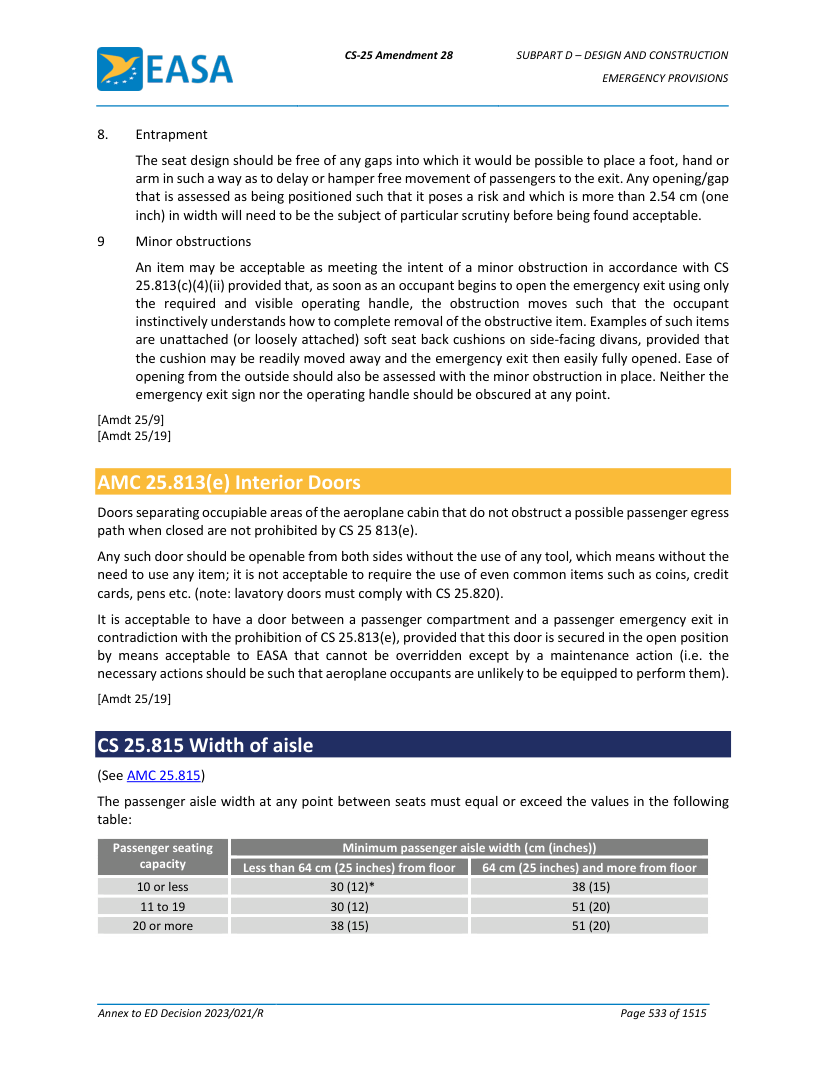
The passenger aisle width at any point between seats must equal or exceed the values in the following table:
Passenger seating
capacity
Minimum passenger aisle width (cm (inches)) Less than 64 cm (25 inches) from floor 64 cm (25 inches) and more from floor 10 or less 30 (12)* 38 (15) 11 to 19 30 (12) 51 (20) 20 or more 38 (15) 51 (20)
View figures, tables and original page layout
Connected references
Source-backed citations and subject-based engineering context are labelled separately. These links do not establish equivalence or project acceptance.
Listed as related material by
Source-backedEvidence and scope
AMC 20-152A §8(a)(2)
Lists CS-25 without an amendment or specific paragraph.
Family reference; does not select a certification basis.
Supporting source