
CS-25
Large Aeroplanes
Amendment 28; corrected 20 November 2025 Source checked 2026-11-28
Scope, source and reading notes
Complete official CS-25 Amendment 28, including AMC and appendices.
Aerospace Consulting reference note: Certification specifications and acceptable means of compliance for large aeroplanes, using the corrected official publication.
The complete selected publication is available in reading text and as the original PDF. Reading text is extracted from the official PDF; page layout is simplified, and figures and tables should be checked in the original page view.
Search covers extracted text. Words contained only in graphics may not be searchable. The original publication is available below.
Official source recordOriginal PDF on this siteSource: EASA. Reproduced with source acknowledgment; source edition and status are shown above. SHA-256: 32f1a9acf26e8ceceb291d206bf07a7071f7f59f40f10c096bb17f34c6a58007
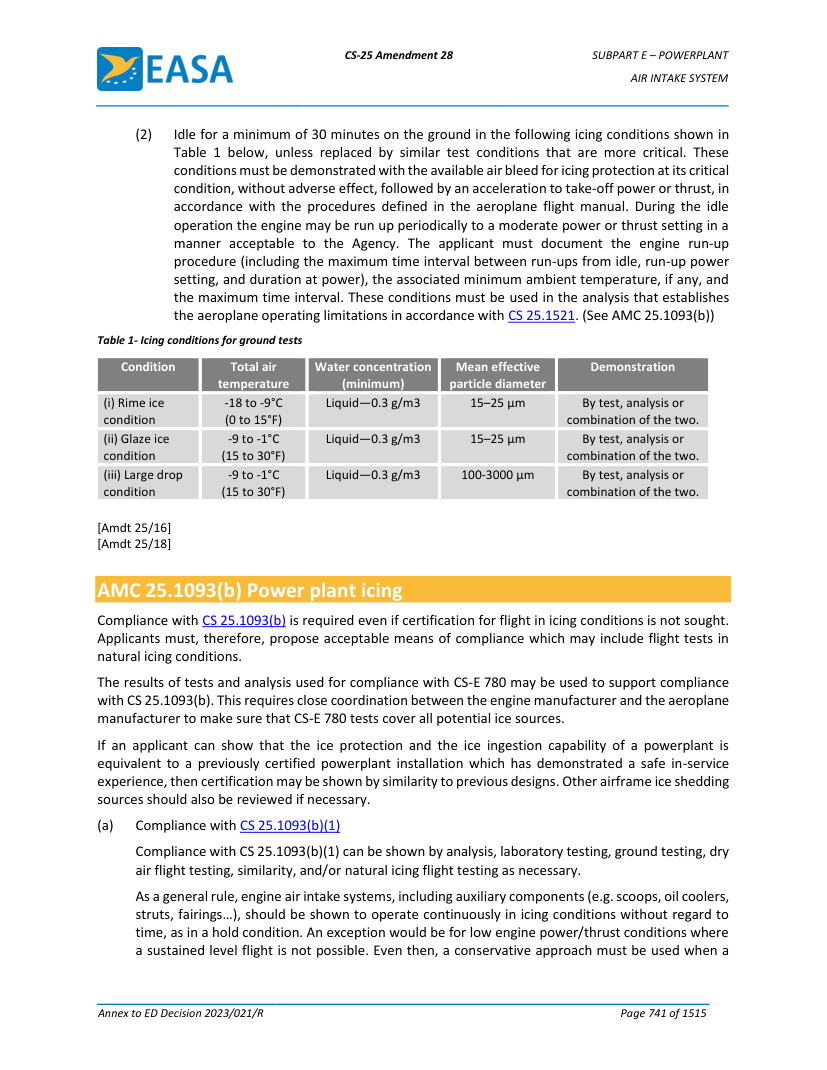
(2) Idle for a minimum of 30 minutes on the ground in the following icing conditions shown in Table 1 below, unless replaced by similar test conditions that are more critical. These conditions must be demonstrated with the available air bleed for icing protection at its critical condition, without adverse effect, followed by an acceleration to take-off power or thrust, in accordance with the procedures defined in the aeroplane flight manual. During the idle operation the engine may be run up periodically to a moderate power or thrust setting in a manner acceptable to the Agency. The applicant must document the engine run-up procedure (including the maximum time interval between run-ups from idle, run-up power setting, and duration at power), the associated minimum ambient temperature, if any, and the maximum time interval. These conditions must be used in the analysis that establishes the aeroplane operating limitations in accordance with CS 25.1521. (See AMC 25.1093(b))
Table 1- Icing conditions for ground tests
Water concentration
Demonstration
Condition Total air temperature
(minimum)
Mean effective particle diameter
(i) Rime ice condition
-18 to -9°C (0 to 15°F)
Liquid—0.3 g/m3 15–25 µm By test, analysis or combination of the two. (ii) Glaze ice condition
-9 to -1°C (15 to 30°F)
Liquid—0.3 g/m3 15–25 µm By test, analysis or combination of the two. (iii) Large drop condition
-9 to -1°C (15 to 30°F)
Liquid—0.3 g/m3 100-3000 µm By test, analysis or combination of the two. [Amdt 25/16] [Amdt 25/18]
AMC 25.1093(b) Power plant icing
Compliance with CS 25.1093(b) is required even if certification for flight in icing conditions is not sought. Applicants must, therefore, propose acceptable means of compliance which may include flight tests in natural icing conditions.
The results of tests and analysis used for compliance with CS-E 780 may be used to support compliance with CS 25.1093(b). This requires close coordination between the engine manufacturer and the aeroplane manufacturer to make sure that CS-E 780 tests cover all potential ice sources.
If an applicant can show that the ice protection and the ice ingestion capability of a powerplant is equivalent to a previously certified powerplant installation which has demonstrated a safe in-service experience, then certification may be shown by similarity to previous designs. Other airframe ice shedding sources should also be reviewed if necessary.
(a) Compliance with CS 25.1093(b)(1)
Compliance with CS 25.1093(b)(1) can be shown by analysis, laboratory testing, ground testing, dry air flight testing, similarity, and/or natural icing flight testing as necessary.
As a general rule, engine air intake systems, including auxiliary components (e.g. scoops, oil coolers, struts, fairings…), should be shown to operate continuously in icing conditions without regard to time, as in a hold condition. An exception would be for low engine power/thrust conditions where a sustained level flight is not possible. Even then, a conservative approach must be used when a
View figures, tables and original page layout
Connected references
Source-backed citations and subject-based engineering context are labelled separately. These links do not establish equivalence or project acceptance.
Listed as related material by
Source-backedEvidence and scope
AMC 20-152A §8(a)(2)
Lists CS-25 without an amendment or specific paragraph.
Family reference; does not select a certification basis.
Supporting source