
CS-25
Large Aeroplanes
Amendment 28; corrected 20 November 2025 Source checked 2026-11-28
Scope, source and reading notes
Complete official CS-25 Amendment 28, including AMC and appendices.
Aerospace Consulting reference note: Certification specifications and acceptable means of compliance for large aeroplanes, using the corrected official publication.
The complete selected publication is available in reading text and as the original PDF. Reading text is extracted from the official PDF; page layout is simplified, and figures and tables should be checked in the original page view.
Search covers extracted text. Words contained only in graphics may not be searchable. The original publication is available below.
Official source recordOriginal PDF on this siteSource: EASA. Reproduced with source acknowledgment; source edition and status are shown above. SHA-256: 32f1a9acf26e8ceceb291d206bf07a7071f7f59f40f10c096bb17f34c6a58007
For long term application 44,5 (10) 22 (5) 89 (20) (e) Approved operating procedures or conventional operating practices must be followed when demonstrating compliance with the control force limitations for short term application that are prescribed in sub-paragraph (d) of this paragraph. The aeroplane must be in trim, or as near to being in trim as practical, in the immediately preceding steady flight condition. For the take-off condition, the aeroplane must be trimmed according to the approved operating procedures.
(f) When demonstrating compliance with the control force limitations for long term application that are prescribed in sub-paragraph (d) of this paragraph, the aeroplane must be in trim, or as near to being in trim as practical.
(g) When manoeuvring at a constant airspeed or Mach number (up to VFC/MFC), the stick forces and the gradient of the stick force versus manoeuvring load factor must lie within satisfactory limits. The stick forces must not be so great as to make excessive demands on the pilot’s strength when manoeuvring the aeroplane (see AMC No. 1 to CS 25.143(g)), and must not be so low that the aeroplane can easily be overstressed inadvertently. Changes of gradient that occur with changes of load factor must not cause undue difficulty in maintaining control of the aeroplane, and local gradients must not be so low as to result in a danger of over-controlling. (See AMC No. 2 to CS 25.143(g)).
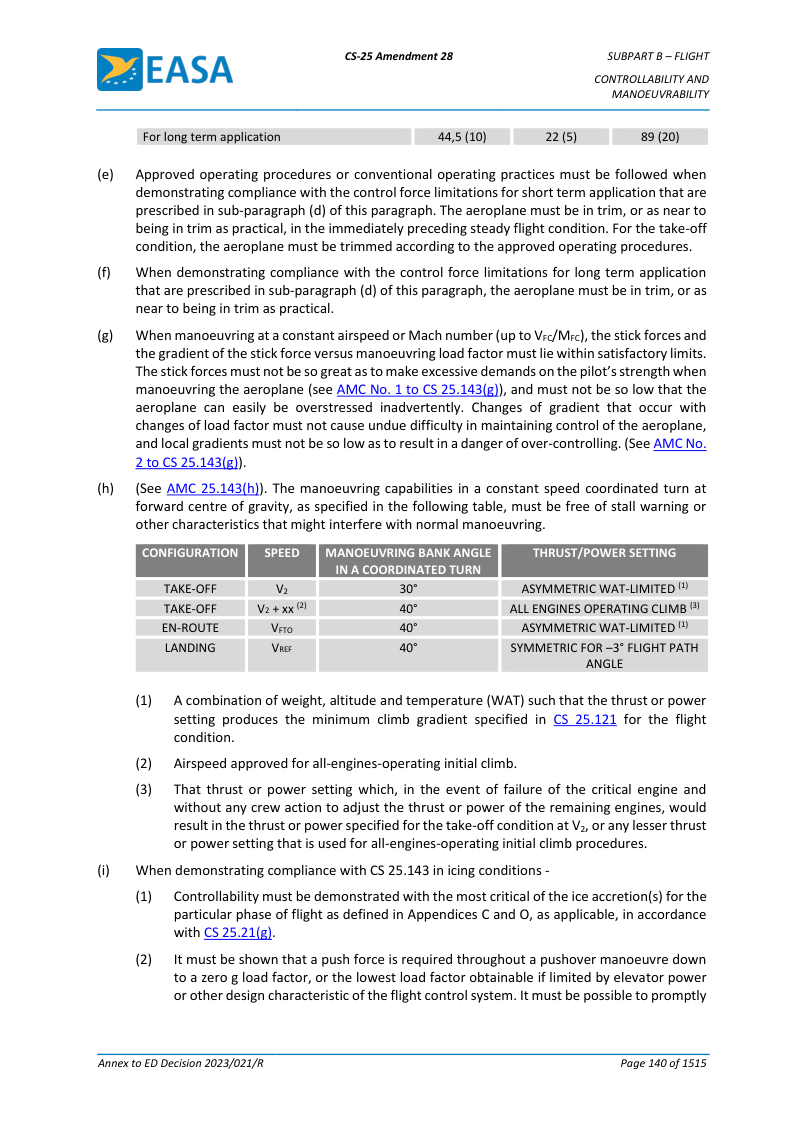
(h) (See AMC 25.143(h)). The manoeuvring capabilities in a constant speed coordinated turn at forward centre of gravity, as specified in the following table, must be free of stall warning or other characteristics that might interfere with normal manoeuvring.
CONFIGURATION SPEED MANOEUVRING BANK ANGLE
THRUST/POWER SETTING
IN A COORDINATED TURN
TAKE-OFF V2 30° ASYMMETRIC WAT-LIMITED (1) TAKE-OFF V2 + xx (2) 40° ALL ENGINES OPERATING CLIMB (3) EN-ROUTE VFTO 40° ASYMMETRIC WAT-LIMITED (1) LANDING VREF 40° SYMMETRIC FOR –3° FLIGHT PATH
ANGLE
(1) A combination of weight, altitude and temperature (WAT) such that the thrust or power setting produces the minimum climb gradient specified in CS 25.121 for the flight condition.
(2) Airspeed approved for all-engines-operating initial climb.
(3) That thrust or power setting which, in the event of failure of the critical engine and without any crew action to adjust the thrust or power of the remaining engines, would result in the thrust or power specified for the take-off condition at V2, or any lesser thrust or power setting that is used for all-engines-operating initial climb procedures.
(i) When demonstrating compliance with CS 25.143 in icing conditions -
(1) Controllability must be demonstrated with the most critical of the ice accretion(s) for the particular phase of flight as defined in Appendices C and O, as applicable, in accordance with CS 25.21(g).
(2) It must be shown that a push force is required throughout a pushover manoeuvre down to a zero g load factor, or the lowest load factor obtainable if limited by elevator power or other design characteristic of the flight control system. It must be possible to promptly
View figures, tables and original page layout
Connected references
Source-backed citations and subject-based engineering context are labelled separately. These links do not establish equivalence or project acceptance.
Listed as related material by
Source-backedEvidence and scope
AMC 20-152A §8(a)(2)
Lists CS-25 without an amendment or specific paragraph.
Family reference; does not select a certification basis.
Supporting source