
CS-25
Large Aeroplanes
Amendment 28; corrected 20 November 2025 Source checked 2026-11-28
Scope, source and reading notes
Complete official CS-25 Amendment 28, including AMC and appendices.
Aerospace Consulting reference note: Certification specifications and acceptable means of compliance for large aeroplanes, using the corrected official publication.
The complete selected publication is available in reading text and as the original PDF. Reading text is extracted from the official PDF; page layout is simplified, and figures and tables should be checked in the original page view.
Search covers extracted text. Words contained only in graphics may not be searchable. The original publication is available below.
Official source recordOriginal PDF on this siteSource: EASA. Reproduced with source acknowledgment; source edition and status are shown above. SHA-256: 32f1a9acf26e8ceceb291d206bf07a7071f7f59f40f10c096bb17f34c6a58007
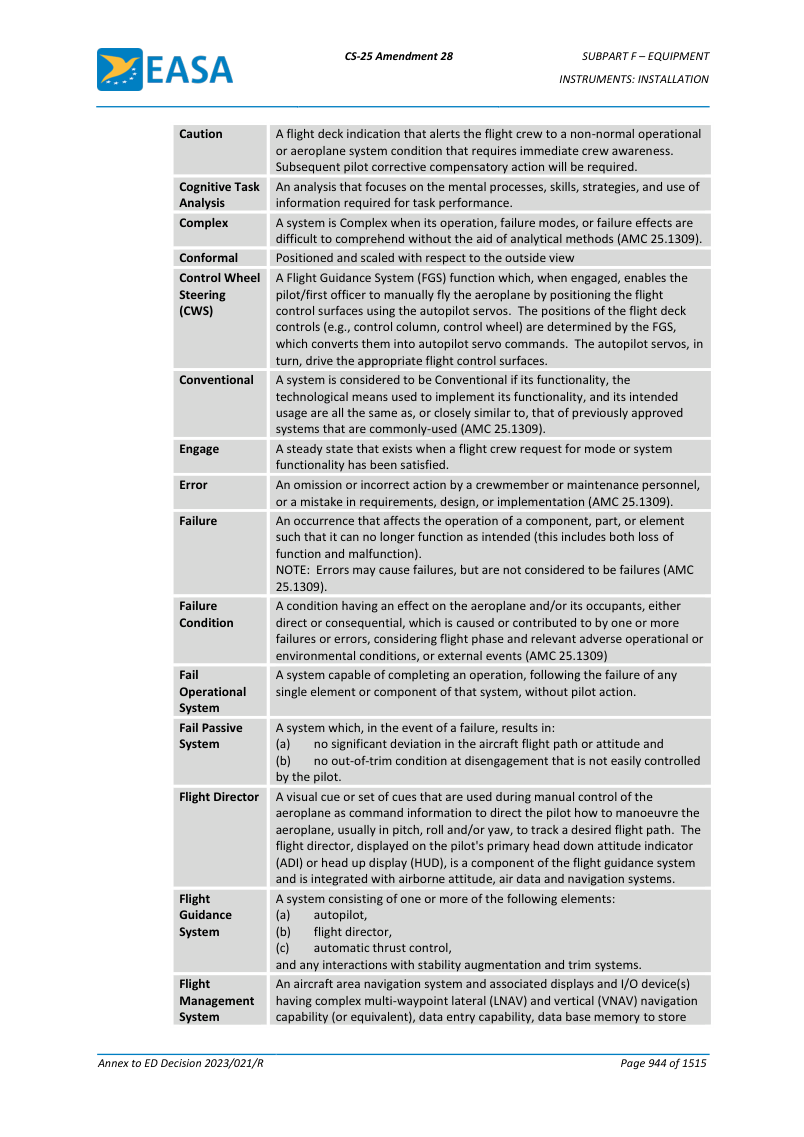
Caution A flight deck indication that alerts the flight crew to a non-normal operational or aeroplane system condition that requires immediate crew awareness. Subsequent pilot corrective compensatory action will be required. Cognitive Task Analysis
An analysis that focuses on the mental processes, skills, strategies, and use of information required for task performance. Complex A system is Complex when its operation, failure modes, or failure effects are difficult to comprehend without the aid of analytical methods (AMC 25.1309). Conformal Positioned and scaled with respect to the outside view Control Wheel Steering (CWS)
A Flight Guidance System (FGS) function which, when engaged, enables the pilot/first officer to manually fly the aeroplane by positioning the flight control surfaces using the autopilot servos. The positions of the flight deck controls (e.g., control column, control wheel) are determined by the FGS, which converts them into autopilot servo commands. The autopilot servos, in turn, drive the appropriate flight control surfaces. Conventional A system is considered to be Conventional if its functionality, the technological means used to implement its functionality, and its intended usage are all the same as, or closely similar to, that of previously approved systems that are commonly-used (AMC 25.1309). Engage A steady state that exists when a flight crew request for mode or system functionality has been satisfied. Error An omission or incorrect action by a crewmember or maintenance personnel, or a mistake in requirements, design, or implementation (AMC 25.1309). Failure An occurrence that affects the operation of a component, part, or element such that it can no longer function as intended (this includes both loss of function and malfunction). NOTE: Errors may cause failures, but are not considered to be failures (AMC 25.1309). Failure Condition
A system capable of completing an operation, following the failure of any single element or component of that system, without pilot action.
A condition having an effect on the aeroplane and/or its occupants, either direct or consequential, which is caused or contributed to by one or more failures or errors, considering flight phase and relevant adverse operational or environmental conditions, or external events (AMC 25.1309) Fail Operational System
Fail Passive System
A system which, in the event of a failure, results in: (a) no significant deviation in the aircraft flight path or attitude and (b) no out-of-trim condition at disengagement that is not easily controlled by the pilot. Flight Director A visual cue or set of cues that are used during manual control of the aeroplane as command information to direct the pilot how to manoeuvre the aeroplane, usually in pitch, roll and/or yaw, to track a desired flight path. The flight director, displayed on the pilot's primary head down attitude indicator (ADI) or head up display (HUD), is a component of the flight guidance system and is integrated with airborne attitude, air data and navigation systems. Flight Guidance System
A system consisting of one or more of the following elements: (a) autopilot, (b) flight director, (c) automatic thrust control, and any interactions with stability augmentation and trim systems. Flight Management System
An aircraft area navigation system and associated displays and I/O device(s) having complex multi-waypoint lateral (LNAV) and vertical (VNAV) navigation capability (or equivalent), data entry capability, data base memory to store
View figures, tables and original page layout
Connected references
Source-backed citations and subject-based engineering context are labelled separately. These links do not establish equivalence or project acceptance.
Listed as related material by
Source-backedEvidence and scope
AMC 20-152A §8(a)(2)
Lists CS-25 without an amendment or specific paragraph.
Family reference; does not select a certification basis.
Supporting source