
CS-25
Large Aeroplanes
Amendment 28; corrected 20 November 2025 Source checked 2026-11-28
Scope, source and reading notes
Complete official CS-25 Amendment 28, including AMC and appendices.
Aerospace Consulting reference note: Certification specifications and acceptable means of compliance for large aeroplanes, using the corrected official publication.
The complete selected publication is available in reading text and as the original PDF. Reading text is extracted from the official PDF; page layout is simplified, and figures and tables should be checked in the original page view.
Search covers extracted text. Words contained only in graphics may not be searchable. The original publication is available below.
Official source recordOriginal PDF on this siteSource: EASA. Reproduced with source acknowledgment; source edition and status are shown above. SHA-256: 32f1a9acf26e8ceceb291d206bf07a7071f7f59f40f10c096bb17f34c6a58007
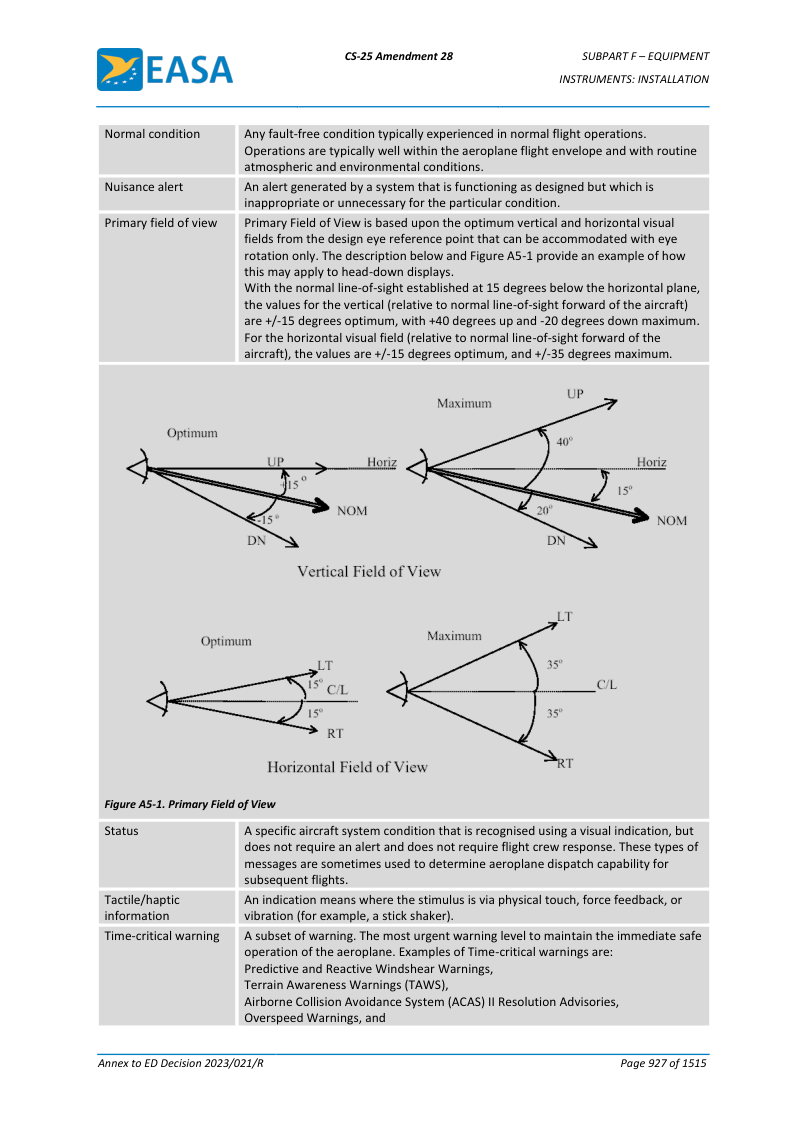
Normal condition Any fault-free condition typically experienced in normal flight operations. Operations are typically well within the aeroplane flight envelope and with routine atmospheric and environmental conditions. Nuisance alert An alert generated by a system that is functioning as designed but which is inappropriate or unnecessary for the particular condition. Primary field of view Primary Field of View is based upon the optimum vertical and horizontal visual fields from the design eye reference point that can be accommodated with eye rotation only. The description below and Figure A5-1 provide an example of how this may apply to head-down displays. With the normal line-of-sight established at 15 degrees below the horizontal plane, the values for the vertical (relative to normal line-of-sight forward of the aircraft) are +/-15 degrees optimum, with +40 degrees up and -20 degrees down maximum. For the horizontal visual field (relative to normal line-of-sight forward of the aircraft), the values are +/-15 degrees optimum, and +/-35 degrees maximum.
Figure A5-1. Primary Field of View
Status A specific aircraft system condition that is recognised using a visual indication, but does not require an alert and does not require flight crew response. These types of messages are sometimes used to determine aeroplane dispatch capability for subsequent flights. Tactile/haptic information
An indication means where the stimulus is via physical touch, force feedback, or vibration (for example, a stick shaker). Time-critical warning A subset of warning. The most urgent warning level to maintain the immediate safe operation of the aeroplane. Examples of Time-critical warnings are: Predictive and Reactive Windshear Warnings, Terrain Awareness Warnings (TAWS), Airborne Collision Avoidance System (ACAS) II Resolution Advisories, Overspeed Warnings, and
View figures, tables and original page layout
Connected references
Source-backed citations and subject-based engineering context are labelled separately. These links do not establish equivalence or project acceptance.
Listed as related material by
Source-backedEvidence and scope
AMC 20-152A §8(a)(2)
Lists CS-25 without an amendment or specific paragraph.
Family reference; does not select a certification basis.
Supporting source