
CS-25
Large Aeroplanes
Amendment 28; corrected 20 November 2025 Source checked 2026-11-28
Scope, source and reading notes
Complete official CS-25 Amendment 28, including AMC and appendices.
Aerospace Consulting reference note: Certification specifications and acceptable means of compliance for large aeroplanes, using the corrected official publication.
The complete selected publication is available in reading text and as the original PDF. Reading text is extracted from the official PDF; page layout is simplified, and figures and tables should be checked in the original page view.
Search covers extracted text. Words contained only in graphics may not be searchable. The original publication is available below.
Official source recordOriginal PDF on this siteSource: EASA. Reproduced with source acknowledgment; source edition and status are shown above. SHA-256: 32f1a9acf26e8ceceb291d206bf07a7071f7f59f40f10c096bb17f34c6a58007
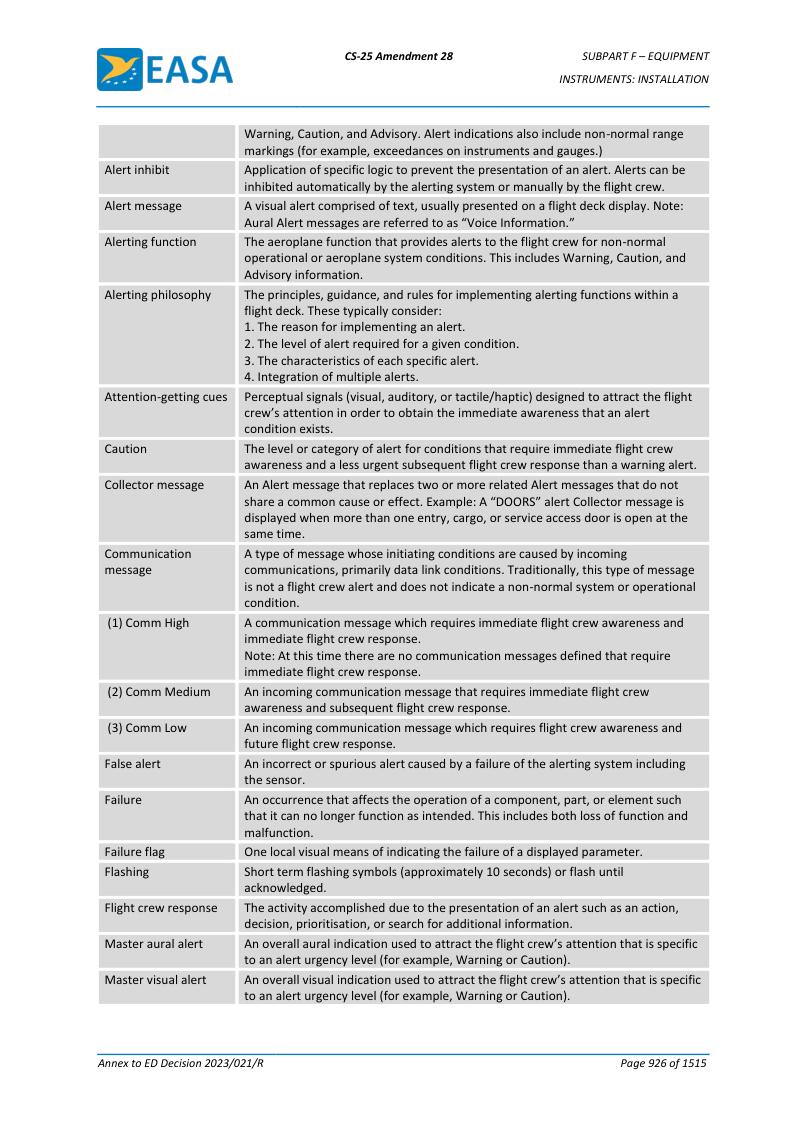
Warning, Caution, and Advisory. Alert indications also include non-normal range markings (for example, exceedances on instruments and gauges.) Alert inhibit Application of specific logic to prevent the presentation of an alert. Alerts can be inhibited automatically by the alerting system or manually by the flight crew. Alert message A visual alert comprised of text, usually presented on a flight deck display. Note: Aural Alert messages are referred to as “Voice Information.” Alerting function The aeroplane function that provides alerts to the flight crew for non-normal operational or aeroplane system conditions. This includes Warning, Caution, and Advisory information. Alerting philosophy The principles, guidance, and rules for implementing alerting functions within a flight deck. These typically consider: 1. The reason for implementing an alert. 2. The level of alert required for a given condition. 3. The characteristics of each specific alert. 4. Integration of multiple alerts. Attention-getting cues Perceptual signals (visual, auditory, or tactile/haptic) designed to attract the flight crew’s attention in order to obtain the immediate awareness that an alert condition exists. Caution The level or category of alert for conditions that require immediate flight crew awareness and a less urgent subsequent flight crew response than a warning alert. Collector message An Alert message that replaces two or more related Alert messages that do not share a common cause or effect. Example: A “DOORS” alert Collector message is displayed when more than one entry, cargo, or service access door is open at the same time. Communication message
A type of message whose initiating conditions are caused by incoming communications, primarily data link conditions. Traditionally, this type of message is not a flight crew alert and does not indicate a non-normal system or operational condition. (1) Comm High A communication message which requires immediate flight crew awareness and immediate flight crew response. Note: At this time there are no communication messages defined that require immediate flight crew response. (2) Comm Medium An incoming communication message that requires immediate flight crew awareness and subsequent flight crew response. (3) Comm Low An incoming communication message which requires flight crew awareness and future flight crew response. False alert An incorrect or spurious alert caused by a failure of the alerting system including the sensor. Failure An occurrence that affects the operation of a component, part, or element such that it can no longer function as intended. This includes both loss of function and malfunction. Failure flag One local visual means of indicating the failure of a displayed parameter. Flashing Short term flashing symbols (approximately 10 seconds) or flash until acknowledged. Flight crew response The activity accomplished due to the presentation of an alert such as an action, decision, prioritisation, or search for additional information. Master aural alert An overall aural indication used to attract the flight crew’s attention that is specific to an alert urgency level (for example, Warning or Caution). Master visual alert An overall visual indication used to attract the flight crew’s attention that is specific to an alert urgency level (for example, Warning or Caution).
View figures, tables and original page layout
Connected references
Source-backed citations and subject-based engineering context are labelled separately. These links do not establish equivalence or project acceptance.
Listed as related material by
Source-backedEvidence and scope
AMC 20-152A §8(a)(2)
Lists CS-25 without an amendment or specific paragraph.
Family reference; does not select a certification basis.
Supporting source