
CS-25
Large Aeroplanes
Amendment 28; corrected 20 November 2025 Source checked 2026-11-28
Scope, source and reading notes
Complete official CS-25 Amendment 28, including AMC and appendices.
Aerospace Consulting reference note: Certification specifications and acceptable means of compliance for large aeroplanes, using the corrected official publication.
The complete selected publication is available in reading text and as the original PDF. Reading text is extracted from the official PDF; page layout is simplified, and figures and tables should be checked in the original page view.
Search covers extracted text. Words contained only in graphics may not be searchable. The original publication is available below.
Official source recordOriginal PDF on this siteSource: EASA. Reproduced with source acknowledgment; source edition and status are shown above. SHA-256: 32f1a9acf26e8ceceb291d206bf07a7071f7f59f40f10c096bb17f34c6a58007
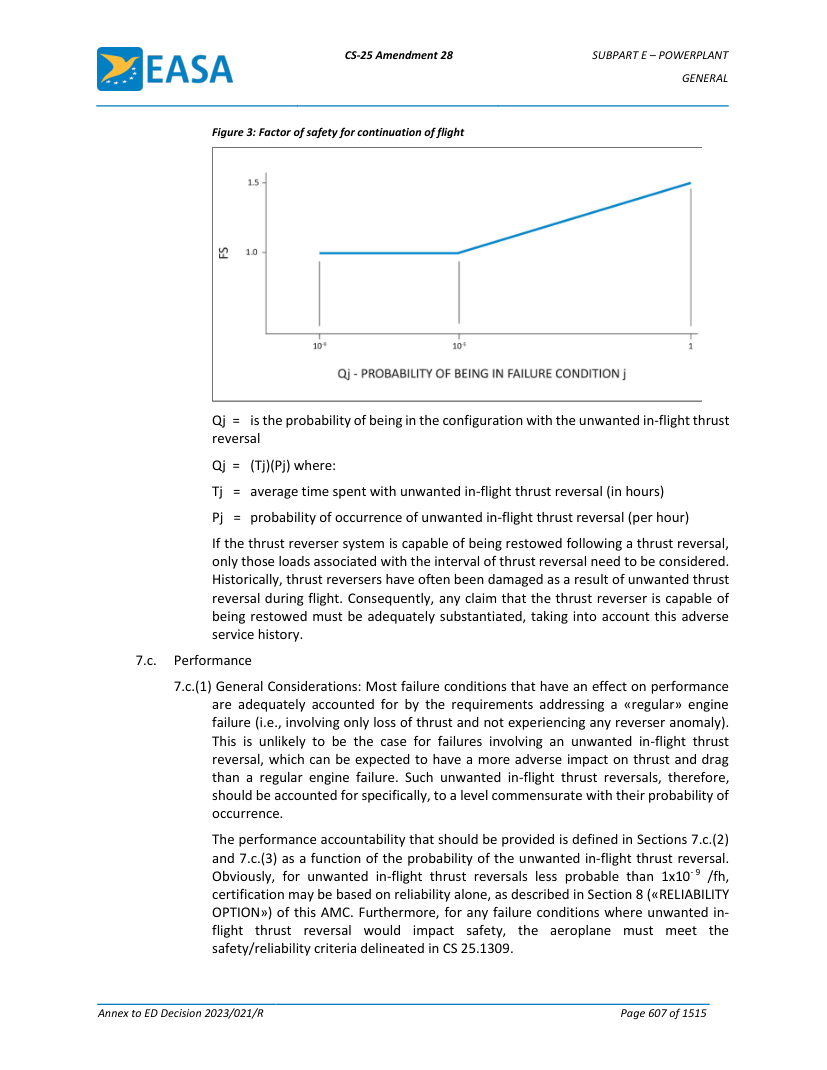
Figure 3: Factor of safety for continuation of flight
Qj = is the probability of being in the configuration with the unwanted in-flight thrust reversal
Qj = (Tj)(Pj) where:
Tj = average time spent with unwanted in-flight thrust reversal (in hours)
Pj = probability of occurrence of unwanted in-flight thrust reversal (per hour)
If the thrust reverser system is capable of being restowed following a thrust reversal, only those loads associated with the interval of thrust reversal need to be considered. Historically, thrust reversers have often been damaged as a result of unwanted thrust reversal during flight. Consequently, any claim that the thrust reverser is capable of being restowed must be adequately substantiated, taking into account this adverse service history.
7.c. Performance
7.c.(1) General Considerations: Most failure conditions that have an effect on performance
are adequately accounted for by the requirements addressing a «regular» engine failure (i.e., involving only loss of thrust and not experiencing any reverser anomaly). This is unlikely to be the case for failures involving an unwanted in-flight thrust reversal, which can be expected to have a more adverse impact on thrust and drag than a regular engine failure. Such unwanted in-flight thrust reversals, therefore, should be accounted for specifically, to a level commensurate with their probability of occurrence.
The performance accountability that should be provided is defined in Sections 7.c.(2) and 7.c.(3) as a function of the probability of the unwanted in-flight thrust reversal. Obviously, for unwanted in-flight thrust reversals less probable than 1x10- 9 /fh, certification may be based on reliability alone, as described in Section 8 («RELIABILITY OPTION») of this AMC. Furthermore, for any failure conditions where unwanted in- flight thrust reversal would impact safety, the aeroplane must meet the safety/reliability criteria delineated in CS 25.1309.
View figures, tables and original page layout
Connected references
Source-backed citations and subject-based engineering context are labelled separately. These links do not establish equivalence or project acceptance.
Listed as related material by
Source-backedEvidence and scope
AMC 20-152A §8(a)(2)
Lists CS-25 without an amendment or specific paragraph.
Family reference; does not select a certification basis.
Supporting source