
CS-25
Large Aeroplanes
Amendment 28; corrected 20 November 2025 Source checked 2026-11-28
Scope, source and reading notes
Complete official CS-25 Amendment 28, including AMC and appendices.
Aerospace Consulting reference note: Certification specifications and acceptable means of compliance for large aeroplanes, using the corrected official publication.
The complete selected publication is available in reading text and as the original PDF. Reading text is extracted from the official PDF; page layout is simplified, and figures and tables should be checked in the original page view.
Search covers extracted text. Words contained only in graphics may not be searchable. The original publication is available below.
Official source recordOriginal PDF on this siteSource: EASA. Reproduced with source acknowledgment; source edition and status are shown above. SHA-256: 32f1a9acf26e8ceceb291d206bf07a7071f7f59f40f10c096bb17f34c6a58007
compartment so caution should be exercised to relate the measurements taken in an actual loaded compartment in flight.
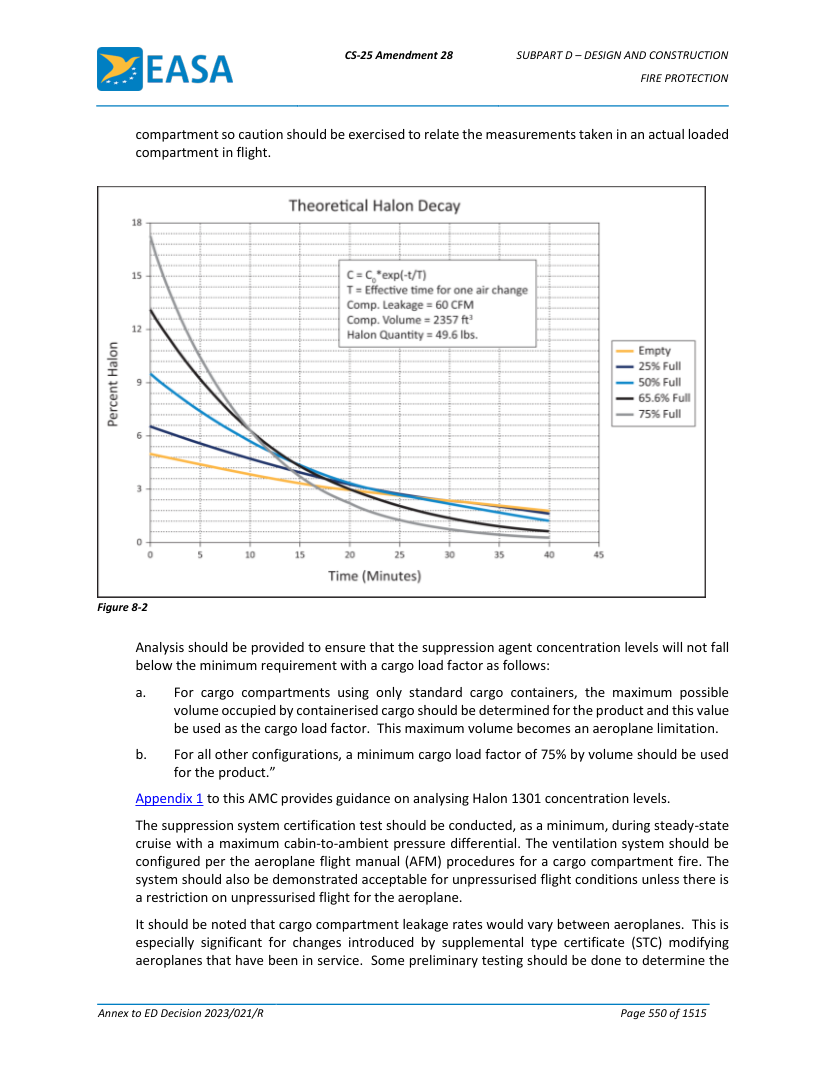
Figure 8-2
Analysis should be provided to ensure that the suppression agent concentration levels will not fall below the minimum requirement with a cargo load factor as follows:
a. For cargo compartments using only standard cargo containers, the maximum possible volume occupied by containerised cargo should be determined for the product and this value be used as the cargo load factor. This maximum volume becomes an aeroplane limitation.
b. For all other configurations, a minimum cargo load factor of 75% by volume should be used for the product.”
Appendix 1 to this AMC provides guidance on analysing Halon 1301 concentration levels.
The suppression system certification test should be conducted, as a minimum, during steady-state cruise with a maximum cabin-to-ambient pressure differential. The ventilation system should be configured per the aeroplane flight manual (AFM) procedures for a cargo compartment fire. The system should also be demonstrated acceptable for unpressurised flight conditions unless there is a restriction on unpressurised flight for the aeroplane.
It should be noted that cargo compartment leakage rates would vary between aeroplanes. This is especially significant for changes introduced by supplemental type certificate (STC) modifying aeroplanes that have been in service. Some preliminary testing should be done to determine the
View figures, tables and original page layout
Connected references
Source-backed citations and subject-based engineering context are labelled separately. These links do not establish equivalence or project acceptance.
Listed as related material by
Source-backedEvidence and scope
AMC 20-152A §8(a)(2)
Lists CS-25 without an amendment or specific paragraph.
Family reference; does not select a certification basis.
Supporting source