
CS-25
Large Aeroplanes
Amendment 28; corrected 20 November 2025 Source checked 2026-11-28
Scope, source and reading notes
Complete official CS-25 Amendment 28, including AMC and appendices.
Aerospace Consulting reference note: Certification specifications and acceptable means of compliance for large aeroplanes, using the corrected official publication.
The complete selected publication is available in reading text and as the original PDF. Reading text is extracted from the official PDF; page layout is simplified, and figures and tables should be checked in the original page view.
Search covers extracted text. Words contained only in graphics may not be searchable. The original publication is available below.
Official source recordOriginal PDF on this siteSource: EASA. Reproduced with source acknowledgment; source edition and status are shown above. SHA-256: 32f1a9acf26e8ceceb291d206bf07a7071f7f59f40f10c096bb17f34c6a58007
Flight tests are required to demonstrate function and dissipation of the fire extinguishing agent or simulant in a cargo compartment. For certification tests, the aeroplane and relevant systems should be in the type design configuration.
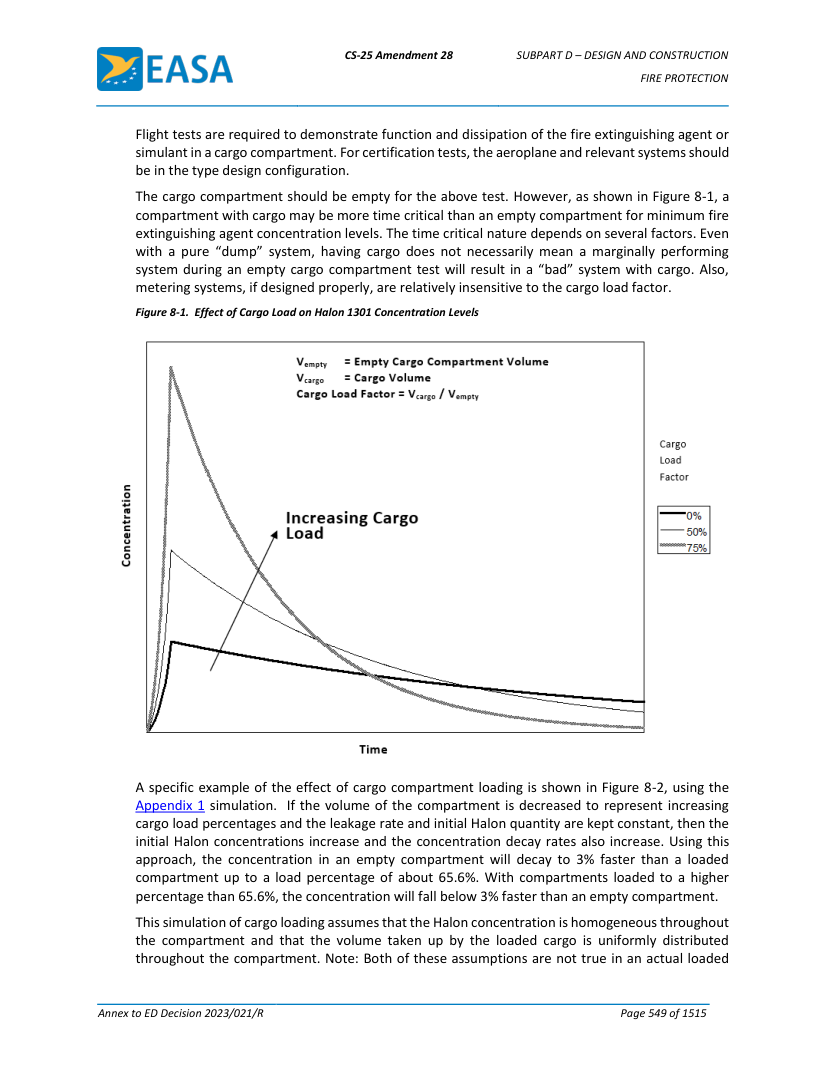
The cargo compartment should be empty for the above test. However, as shown in Figure 8-1, a compartment with cargo may be more time critical than an empty compartment for minimum fire extinguishing agent concentration levels. The time critical nature depends on several factors. Even with a pure “dump” system, having cargo does not necessarily mean a marginally performing system during an empty cargo compartment test will result in a “bad” system with cargo. Also, metering systems, if designed properly, are relatively insensitive to the cargo load factor.
Figure 8-1. Effect of Cargo Load on Halon 1301 Concentration Levels
A specific example of the effect of cargo compartment loading is shown in Figure 8-2, using the Appendix 1 simulation. If the volume of the compartment is decreased to represent increasing cargo load percentages and the leakage rate and initial Halon quantity are kept constant, then the initial Halon concentrations increase and the concentration decay rates also increase. Using this approach, the concentration in an empty compartment will decay to 3% faster than a loaded compartment up to a load percentage of about 65.6%. With compartments loaded to a higher percentage than 65.6%, the concentration will fall below 3% faster than an empty compartment.
This simulation of cargo loading assumes that the Halon concentration is homogeneous throughout the compartment and that the volume taken up by the loaded cargo is uniformly distributed throughout the compartment. Note: Both of these assumptions are not true in an actual loaded
View figures, tables and original page layout
Connected references
Source-backed citations and subject-based engineering context are labelled separately. These links do not establish equivalence or project acceptance.
Listed as related material by
Source-backedEvidence and scope
AMC 20-152A §8(a)(2)
Lists CS-25 without an amendment or specific paragraph.
Family reference; does not select a certification basis.
Supporting source