
CS-25
Large Aeroplanes
Amendment 28; corrected 20 November 2025 Source checked 2026-11-28
Scope, source and reading notes
Complete official CS-25 Amendment 28, including AMC and appendices.
Aerospace Consulting reference note: Certification specifications and acceptable means of compliance for large aeroplanes, using the corrected official publication.
The complete selected publication is available in reading text and as the original PDF. Reading text is extracted from the official PDF; page layout is simplified, and figures and tables should be checked in the original page view.
Search covers extracted text. Words contained only in graphics may not be searchable. The original publication is available below.
Official source recordOriginal PDF on this siteSource: EASA. Reproduced with source acknowledgment; source edition and status are shown above. SHA-256: 32f1a9acf26e8ceceb291d206bf07a7071f7f59f40f10c096bb17f34c6a58007
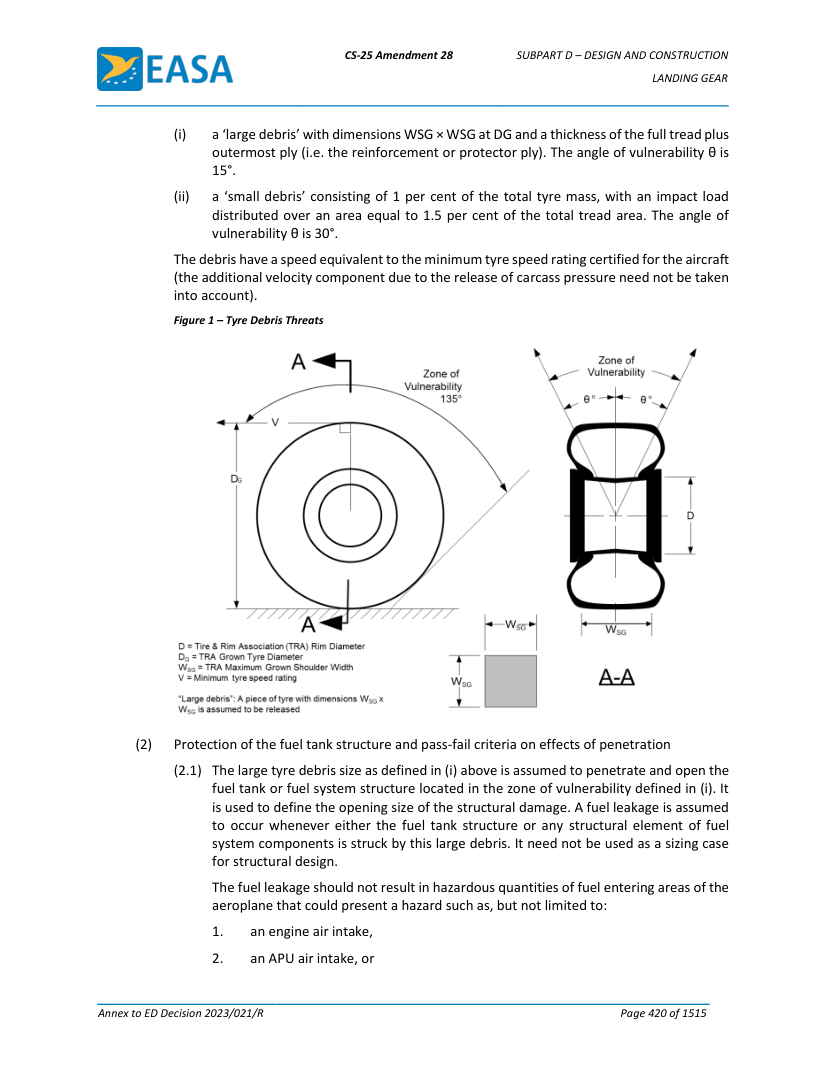
(i) a ‘large debris’ with dimensions WSG × WSG at DG and a thickness of the full tread plus outermost ply (i.e. the reinforcement or protector ply). The angle of vulnerability θ is 15°.
(ii) a ‘small debris’ consisting of 1 per cent of the total tyre mass, with an impact load distributed over an area equal to 1.5 per cent of the total tread area. The angle of vulnerability θ is 30°.
The debris have a speed equivalent to the minimum tyre speed rating certified for the aircraft (the additional velocity component due to the release of carcass pressure need not be taken into account).
Figure 1 – Tyre Debris Threats
(2) Protection of the fuel tank structure and pass-fail criteria on effects of penetration
(2.1) The large tyre debris size as defined in (i) above is assumed to penetrate and open the
fuel tank or fuel system structure located in the zone of vulnerability defined in (i). It is used to define the opening size of the structural damage. A fuel leakage is assumed to occur whenever either the fuel tank structure or any structural element of fuel system components is struck by this large debris. It need not be used as a sizing case for structural design.
The fuel leakage should not result in hazardous quantities of fuel entering areas of the aeroplane that could present a hazard such as, but not limited to:
1. an engine air intake,
2. an APU air intake, or
View figures, tables and original page layout
Connected references
Source-backed citations and subject-based engineering context are labelled separately. These links do not establish equivalence or project acceptance.
Listed as related material by
Source-backedEvidence and scope
AMC 20-152A §8(a)(2)
Lists CS-25 without an amendment or specific paragraph.
Family reference; does not select a certification basis.
Supporting source