
CS-25
Large Aeroplanes
Amendment 28; corrected 20 November 2025 Source checked 2026-11-28
Scope, source and reading notes
Complete official CS-25 Amendment 28, including AMC and appendices.
Aerospace Consulting reference note: Certification specifications and acceptable means of compliance for large aeroplanes, using the corrected official publication.
The complete selected publication is available in reading text and as the original PDF. Reading text is extracted from the official PDF; page layout is simplified, and figures and tables should be checked in the original page view.
Search covers extracted text. Words contained only in graphics may not be searchable. The original publication is available below.
Official source recordOriginal PDF on this siteSource: EASA. Reproduced with source acknowledgment; source edition and status are shown above. SHA-256: 32f1a9acf26e8ceceb291d206bf07a7071f7f59f40f10c096bb17f34c6a58007
Hazardous fuel leak: a definition is provided in AMC 25.963(e).
Maximum unloaded operational pressure: Unloaded rated tyre pressure (available from the TRA Year Book) divided by the 1.07 factor from CS 25.733(c)(1).
Minimum tyre speed rating: The lowest tyre speed rating certified for the aeroplane in compliance with CS 25.733(a) or (c). The aeroplane manufacturer may decide to certify several tyre speed ratings; in this case, the lowest certified speed rating value should be taken as the ‘minimum tyre speed rating’ used in the models of this AMC.
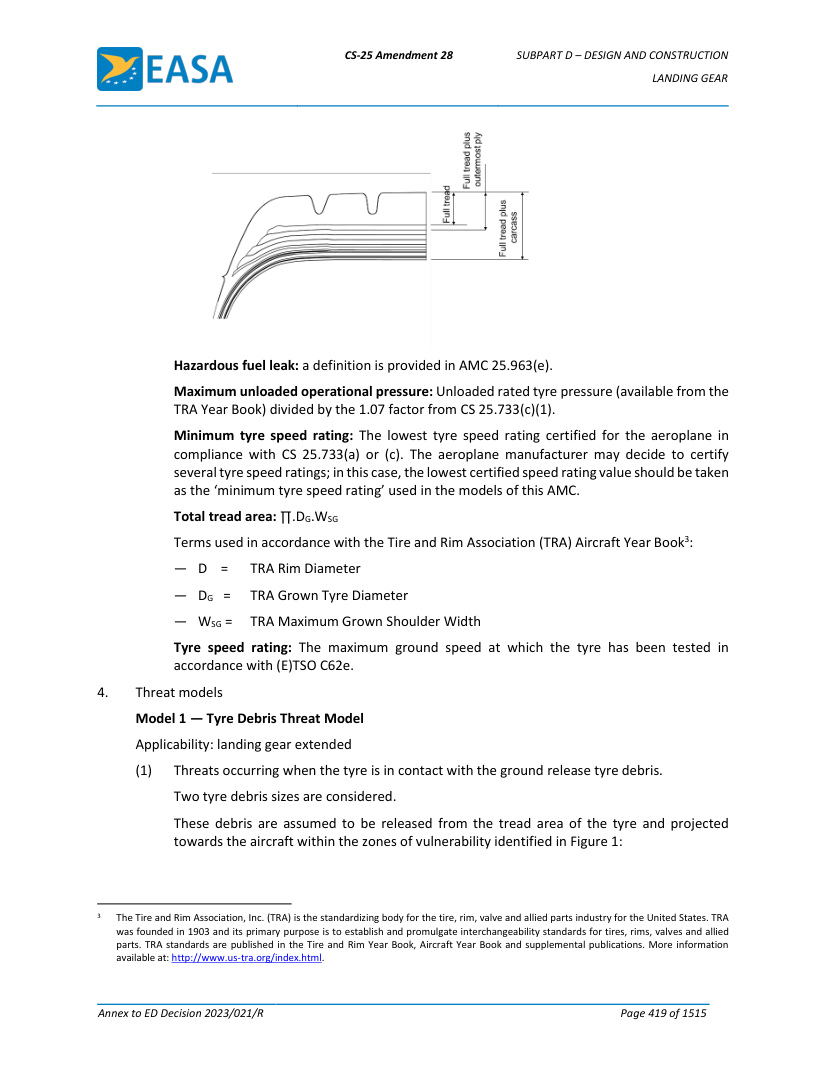
Total tread area: ∏.DG.WSG
Terms used in accordance with the Tire and Rim Association (TRA) Aircraft Year Book3:
— D = TRA Rim Diameter
— DG = TRA Grown Tyre Diameter
— WSG = TRA Maximum Grown Shoulder Width
Tyre speed rating: The maximum ground speed at which the tyre has been tested in accordance with (E)TSO C62e.
4. Threat models
Model 1 — Tyre Debris Threat Model
Applicability: landing gear extended
(1) Threats occurring when the tyre is in contact with the ground release tyre debris.
Two tyre debris sizes are considered.
These debris are assumed to be released from the tread area of the tyre and projected towards the aircraft within the zones of vulnerability identified in Figure 1:
3 The Tire and Rim Association, Inc. (TRA) is the standardizing body for the tire, rim, valve and allied parts industry for the United States. TRA was founded in 1903 and its primary purpose is to establish and promulgate interchangeability standards for tires, rims, valves and allied parts. TRA standards are published in the Tire and Rim Year Book, Aircraft Year Book and supplemental publications. More information available at: http://www.us-tra.org/index.html.
View figures, tables and original page layout
Connected references
Source-backed citations and subject-based engineering context are labelled separately. These links do not establish equivalence or project acceptance.
Listed as related material by
Source-backedEvidence and scope
AMC 20-152A §8(a)(2)
Lists CS-25 without an amendment or specific paragraph.
Family reference; does not select a certification basis.
Supporting source