
CS-25
Large Aeroplanes
Amendment 28; corrected 20 November 2025 Source checked 2026-11-28
Scope, source and reading notes
Complete official CS-25 Amendment 28, including AMC and appendices.
Aerospace Consulting reference note: Certification specifications and acceptable means of compliance for large aeroplanes, using the corrected official publication.
The complete selected publication is available in reading text and as the original PDF. Reading text is extracted from the official PDF; page layout is simplified, and figures and tables should be checked in the original page view.
Search covers extracted text. Words contained only in graphics may not be searchable. The original publication is available below.
Official source recordOriginal PDF on this siteSource: EASA. Reproduced with source acknowledgment; source edition and status are shown above. SHA-256: 32f1a9acf26e8ceceb291d206bf07a7071f7f59f40f10c096bb17f34c6a58007
Extremely Improbable
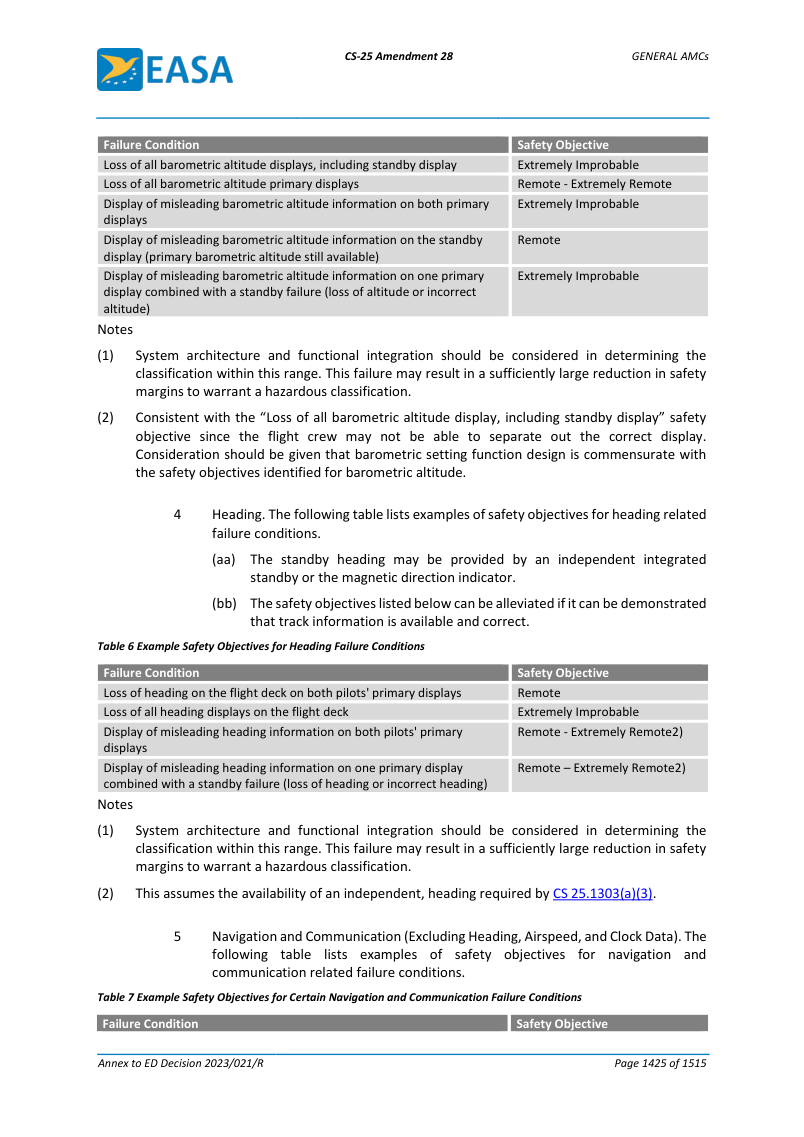
Failure Condition Safety Objective Loss of all barometric altitude displays, including standby display Extremely Improbable Loss of all barometric altitude primary displays Remote - Extremely Remote Display of misleading barometric altitude information on both primary displays
Remote
Display of misleading barometric altitude information on the standby display (primary barometric altitude still available)
Extremely Improbable
Display of misleading barometric altitude information on one primary display combined with a standby failure (loss of altitude or incorrect altitude)
Notes
(1) System architecture and functional integration should be considered in determining the classification within this range. This failure may result in a sufficiently large reduction in safety margins to warrant a hazardous classification.
(2) Consistent with the “Loss of all barometric altitude display, including standby display” safety objective since the flight crew may not be able to separate out the correct display. Consideration should be given that barometric setting function design is commensurate with the safety objectives identified for barometric altitude.
4 Heading. The following table lists examples of safety objectives for heading related failure conditions.
(aa) The standby heading may be provided by an independent integrated
standby or the magnetic direction indicator.
(bb) The safety objectives listed below can be alleviated if it can be demonstrated
that track information is available and correct.
Table 6 Example Safety Objectives for Heading Failure Conditions
Remote - Extremely Remote2)
Failure Condition Safety Objective Loss of heading on the flight deck on both pilots' primary displays Remote Loss of all heading displays on the flight deck Extremely Improbable Display of misleading heading information on both pilots' primary displays
Remote – Extremely Remote2)
Display of misleading heading information on one primary display combined with a standby failure (loss of heading or incorrect heading)
Notes
(1) System architecture and functional integration should be considered in determining the classification within this range. This failure may result in a sufficiently large reduction in safety margins to warrant a hazardous classification.
(2) This assumes the availability of an independent, heading required by CS 25.1303(a)(3).
5 Navigation and Communication (Excluding Heading, Airspeed, and Clock Data). The following table lists examples of safety objectives for navigation and communication related failure conditions.
Table 7 Example Safety Objectives for Certain Navigation and Communication Failure Conditions
Failure Condition Safety Objective
View figures, tables and original page layout
Connected references
Source-backed citations and subject-based engineering context are labelled separately. These links do not establish equivalence or project acceptance.
Listed as related material by
Source-backedEvidence and scope
AMC 20-152A §8(a)(2)
Lists CS-25 without an amendment or specific paragraph.
Family reference; does not select a certification basis.
Supporting source