
CS-25
Large Aeroplanes
Amendment 28; corrected 20 November 2025 Source checked 2026-11-28
Scope, source and reading notes
Complete official CS-25 Amendment 28, including AMC and appendices.
Aerospace Consulting reference note: Certification specifications and acceptable means of compliance for large aeroplanes, using the corrected official publication.
The complete selected publication is available in reading text and as the original PDF. Reading text is extracted from the official PDF; page layout is simplified, and figures and tables should be checked in the original page view.
Search covers extracted text. Words contained only in graphics may not be searchable. The original publication is available below.
Official source recordOriginal PDF on this siteSource: EASA. Reproduced with source acknowledgment; source edition and status are shown above. SHA-256: 32f1a9acf26e8ceceb291d206bf07a7071f7f59f40f10c096bb17f34c6a58007
higher safety objectives, while reduced functional capability or increase operational mitigation may result in lower safety objectives.
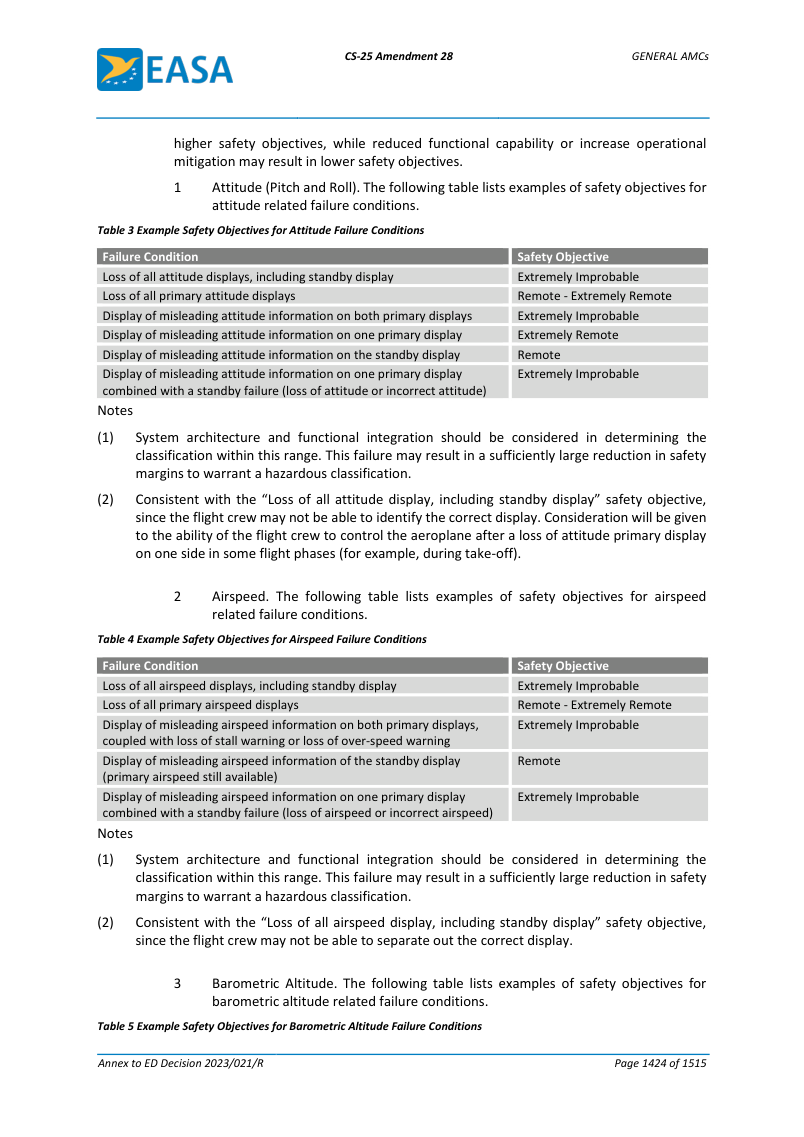
1 Attitude (Pitch and Roll). The following table lists examples of safety objectives for attitude related failure conditions.
Table 3 Example Safety Objectives for Attitude Failure Conditions
Extremely Improbable
Failure Condition Safety Objective Loss of all attitude displays, including standby display Extremely Improbable Loss of all primary attitude displays Remote - Extremely Remote Display of misleading attitude information on both primary displays Extremely Improbable Display of misleading attitude information on one primary display Extremely Remote Display of misleading attitude information on the standby display Remote Display of misleading attitude information on one primary display combined with a standby failure (loss of attitude or incorrect attitude)
Notes
(1) System architecture and functional integration should be considered in determining the classification within this range. This failure may result in a sufficiently large reduction in safety margins to warrant a hazardous classification.
(2) Consistent with the “Loss of all attitude display, including standby display” safety objective, since the flight crew may not be able to identify the correct display. Consideration will be given to the ability of the flight crew to control the aeroplane after a loss of attitude primary display on one side in some flight phases (for example, during take-off).
2 Airspeed. The following table lists examples of safety objectives for airspeed related failure conditions.
Table 4 Example Safety Objectives for Airspeed Failure Conditions
Extremely Improbable
Failure Condition Safety Objective Loss of all airspeed displays, including standby display Extremely Improbable Loss of all primary airspeed displays Remote - Extremely Remote Display of misleading airspeed information on both primary displays, coupled with loss of stall warning or loss of over-speed warning
Remote
Display of misleading airspeed information of the standby display (primary airspeed still available)
Extremely Improbable
Display of misleading airspeed information on one primary display combined with a standby failure (loss of airspeed or incorrect airspeed)
Notes
(1) System architecture and functional integration should be considered in determining the classification within this range. This failure may result in a sufficiently large reduction in safety margins to warrant a hazardous classification.
(2) Consistent with the “Loss of all airspeed display, including standby display” safety objective, since the flight crew may not be able to separate out the correct display.
3 Barometric Altitude. The following table lists examples of safety objectives for barometric altitude related failure conditions.
Table 5 Example Safety Objectives for Barometric Altitude Failure Conditions
View figures, tables and original page layout
Connected references
Source-backed citations and subject-based engineering context are labelled separately. These links do not establish equivalence or project acceptance.
Listed as related material by
Source-backedEvidence and scope
AMC 20-152A §8(a)(2)
Lists CS-25 without an amendment or specific paragraph.
Family reference; does not select a certification basis.
Supporting source