
CS-25
Large Aeroplanes
Amendment 28; corrected 20 November 2025 Source checked 2026-11-28
Scope, source and reading notes
Complete official CS-25 Amendment 28, including AMC and appendices.
Aerospace Consulting reference note: Certification specifications and acceptable means of compliance for large aeroplanes, using the corrected official publication.
The complete selected publication is available in reading text and as the original PDF. Reading text is extracted from the official PDF; page layout is simplified, and figures and tables should be checked in the original page view.
Search covers extracted text. Words contained only in graphics may not be searchable. The original publication is available below.
Official source recordOriginal PDF on this siteSource: EASA. Reproduced with source acknowledgment; source edition and status are shown above. SHA-256: 32f1a9acf26e8ceceb291d206bf07a7071f7f59f40f10c096bb17f34c6a58007
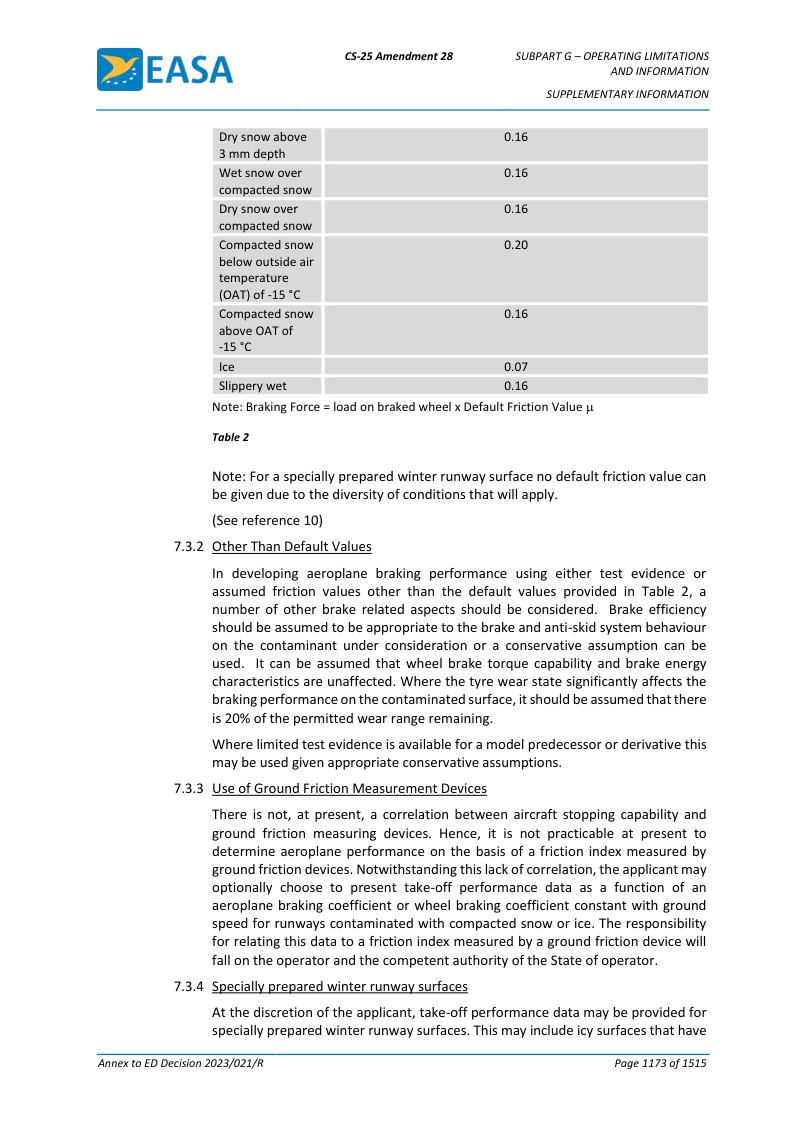
0.16
Dry snow above 3 mm depth
0.16
Wet snow over compacted snow
0.16
Dry snow over compacted snow
0.20
Compacted snow below outside air temperature (OAT) of -15 °C
0.16
Compacted snow above OAT of -15 °C
Ice 0.07 Slippery wet 0.16
Note: Braking Force = load on braked wheel x Default Friction Value
Table 2
Note: For a specially prepared winter runway surface no default friction value can be given due to the diversity of conditions that will apply.
(See reference 10)
7.3.2 Other Than Default Values
In developing aeroplane braking performance using either test evidence or assumed friction values other than the default values provided in Table 2, a number of other brake related aspects should be considered. Brake efficiency should be assumed to be appropriate to the brake and anti-skid system behaviour on the contaminant under consideration or a conservative assumption can be used. It can be assumed that wheel brake torque capability and brake energy characteristics are unaffected. Where the tyre wear state significantly affects the braking performance on the contaminated surface, it should be assumed that there is 20% of the permitted wear range remaining.
Where limited test evidence is available for a model predecessor or derivative this may be used given appropriate conservative assumptions.
7.3.3 Use of Ground Friction Measurement Devices
There is not, at present, a correlation between aircraft stopping capability and ground friction measuring devices. Hence, it is not practicable at present to determine aeroplane performance on the basis of a friction index measured by ground friction devices. Notwithstanding this lack of correlation, the applicant may optionally choose to present take-off performance data as a function of an aeroplane braking coefficient or wheel braking coefficient constant with ground speed for runways contaminated with compacted snow or ice. The responsibility for relating this data to a friction index measured by a ground friction device will fall on the operator and the competent authority of the State of operator.
7.3.4 Specially prepared winter runway surfaces
At the discretion of the applicant, take-off performance data may be provided for specially prepared winter runway surfaces. This may include icy surfaces that have
View figures, tables and original page layout
Connected references
Source-backed citations and subject-based engineering context are labelled separately. These links do not establish equivalence or project acceptance.
Listed as related material by
Source-backedEvidence and scope
AMC 20-152A §8(a)(2)
Lists CS-25 without an amendment or specific paragraph.
Family reference; does not select a certification basis.
Supporting source