
CS-25
Large Aeroplanes
Amendment 28; corrected 20 November 2025 Source checked 2026-11-28
Scope, source and reading notes
Complete official CS-25 Amendment 28, including AMC and appendices.
Aerospace Consulting reference note: Certification specifications and acceptable means of compliance for large aeroplanes, using the corrected official publication.
The complete selected publication is available in reading text and as the original PDF. Reading text is extracted from the official PDF; page layout is simplified, and figures and tables should be checked in the original page view.
Search covers extracted text. Words contained only in graphics may not be searchable. The original publication is available below.
Official source recordOriginal PDF on this siteSource: EASA. Reproduced with source acknowledgment; source edition and status are shown above. SHA-256: 32f1a9acf26e8ceceb291d206bf07a7071f7f59f40f10c096bb17f34c6a58007
deformation perpendicular to the tyre direction of motion, this deformation occurs mainly at or below the bottom of the rut and therefore does not affect the deformation in front of the adjacent tyre. Hence, interference effects can be ignored.
In the case of a bogie landing gear only the leading tyres have to be considered for the drag calculation, as explained in Reference 8. After the initial compression of the snow by the leading tyres, the snow in the rut becomes stronger and a higher pressure must be applied to compress the snow further. Therefore, the drag on the trailing tyres can be neglected and the drag on a bogie landing gear is assumed to be equal to that of a dual tyre configuration. All other multiple-tyre configurations can be treated in the same manner.
7.2.3 Spray Impingement Drag
Experiments have shown that the snow spray coming from the tyres is limited with only small amounts striking the airframe. The speed and the density of the snow spray are much lower than, for instance, that of water spray. Therefore, the drag due to snow impingement on the airframe can be neglected.
7.2.4 Total Landing Gear Drag
To obtain the total drag on the tyres due to snow, DC and DD for each single tyre (excluding the trailing tyres of a bogie gear) should be calculated and summed.
7.3 Braking Friction (All Contaminants)
On most contaminant surfaces the braking action of the aeroplane will be impaired. Performance data showing these effects can be based on either the minimum conservative ‘default’ values, given in Table 2 or test evidence and assumed values (see paragraph 7.3.2). In addition the applicant may optionally provide performance data as a function of aeroplane braking coefficient or wheel braking coefficient.
7.3.1 Default Values
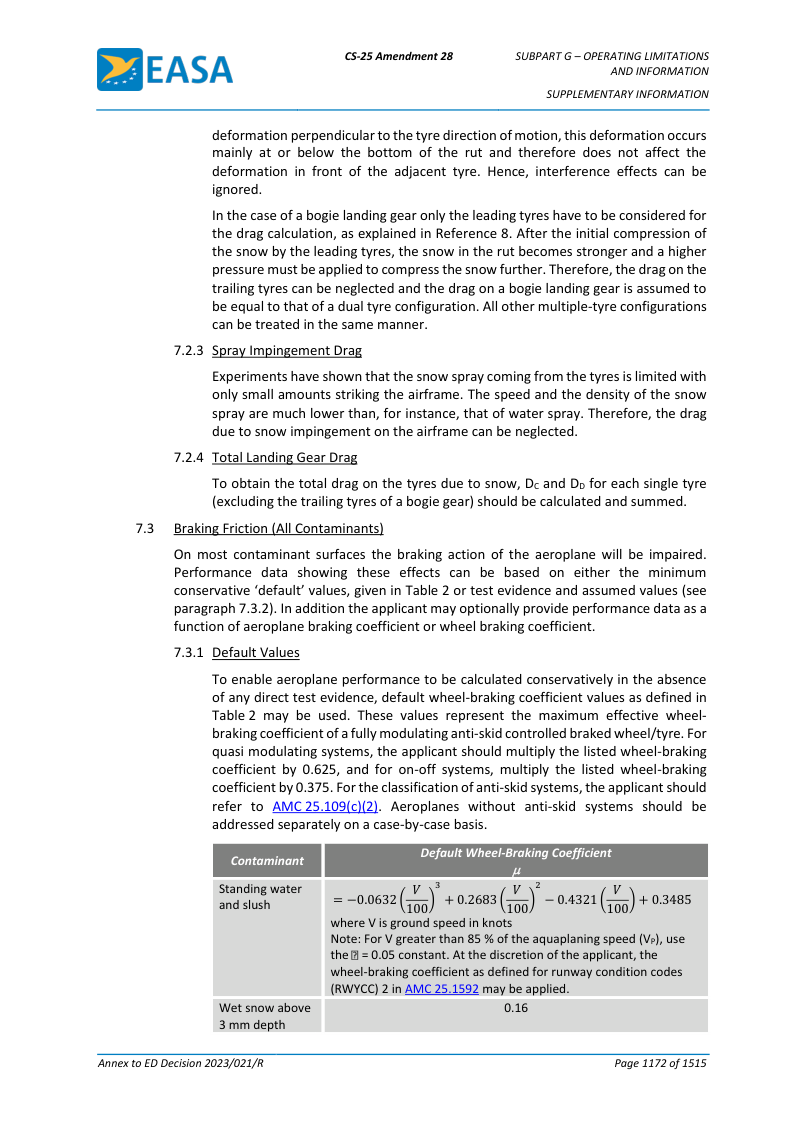
To enable aeroplane performance to be calculated conservatively in the absence of any direct test evidence, default wheel-braking coefficient values as defined in Table 2 may be used. These values represent the maximum effective wheel- braking coefficient of a fully modulating anti-skid controlled braked wheel/tyre. For quasi modulating systems, the applicant should multiply the listed wheel-braking coefficient by 0.625, and for on-off systems, multiply the listed wheel-braking coefficient by 0.375. For the classification of anti-skid systems, the applicant should refer to AMC 25.109(c)(2). Aeroplanes without anti-skid systems should be addressed separately on a case-by-case basis.
Contaminant Default Wheel-Braking Coefficient
3
2
+ 0.2683 ( 𝑉
−0.4321 ( 𝑉
Standing water and slush = −0.0632 ( 𝑉
100)
100)
100) + 0.3485
0.16
where V is ground speed in knots Note: For V greater than 85 % of the aquaplaning speed (VP), use the = 0.05 constant. At the discretion of the applicant, the wheel-braking coefficient as defined for runway condition codes (RWYCC) 2 in AMC 25.1592 may be applied. Wet snow above 3 mm depth
View figures, tables and original page layout
Connected references
Source-backed citations and subject-based engineering context are labelled separately. These links do not establish equivalence or project acceptance.
Listed as related material by
Source-backedEvidence and scope
AMC 20-152A §8(a)(2)
Lists CS-25 without an amendment or specific paragraph.
Family reference; does not select a certification basis.
Supporting source