
MOC-2 SC-VTOL
Means of Compliance with SC-VTOL — Batch 2
Issue 3 — FINAL Source checked 2026-11-28
Scope, source and reading notes
Complete final batch 2 of SC-VTOL means of compliance. Later batches may amend individual provisions in earlier batches.
Aerospace Consulting reference note: Second final batch of means of compliance. Adds and revises earlier material; MOC VTOL.2105 was excluded from this final publication for further revision.
The complete selected publication is available in reading text and as the original PDF. Reading text is extracted from the official PDF; page layout is simplified, and figures and tables should be checked in the original page view.
Search covers extracted text. Words contained only in graphics may not be searchable. The original publication is available below.
Official source recordOriginal PDF on this siteSource: EASA. Reproduced with source acknowledgment; source edition and status are shown above. SHA-256: 1fcaf1c7db56acce38f5379ba2117f1137dbc35be3fa6ee4136a0f572d856136
Doc. No: MOC-2 SC-VTOL Issue: 3 Date: 22 Dec 2022
Condition VTOL
(ii) Considering the nature of an eAFM software application, certain adaptations to the DO-
178()/ED-12() objectives may be necessary. The rationale for any objective alleviation should be documented. It should be demonstrated that any objective removal can only cause at worst eAFM availability problems and cannot lead to data integrity problems (i.e. production of erroneous data). (iii) The following adaptations to ED-12C (or later revisions) objectives are provided as
examples:
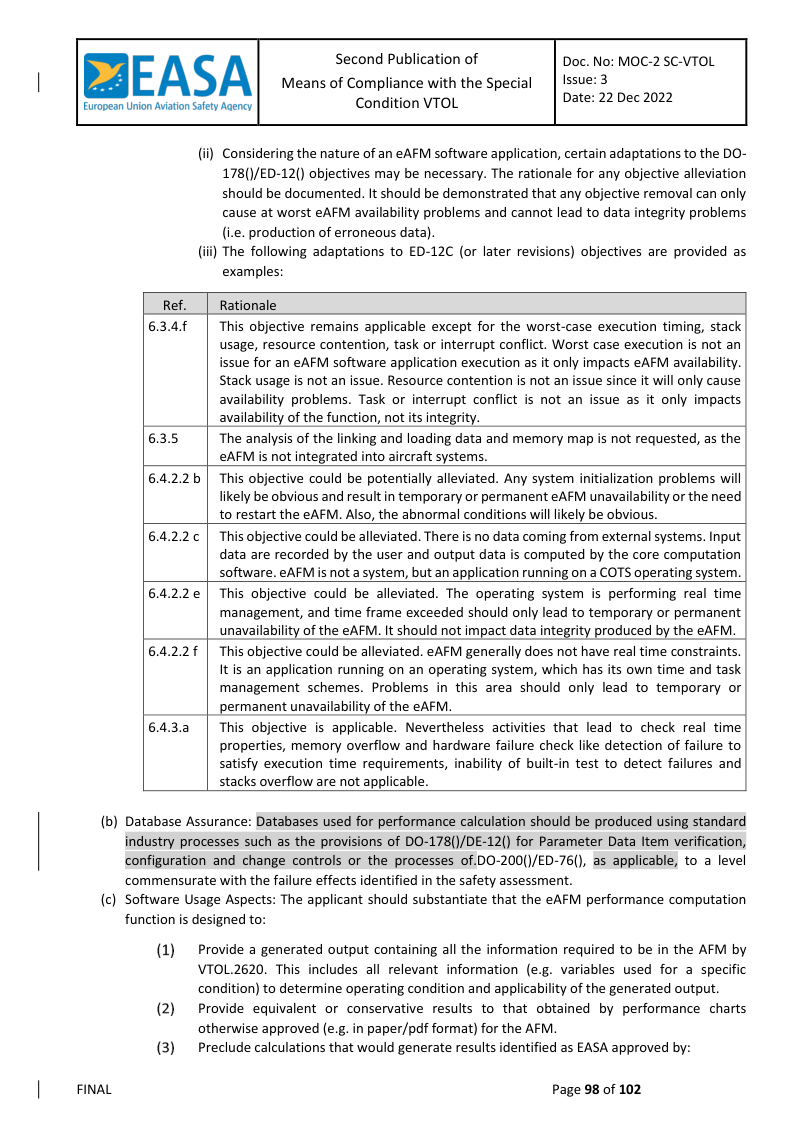
Ref. Rationale 6.3.4.f This objective remains applicable except for the worst-case execution timing, stack usage, resource contention, task or interrupt conflict. Worst case execution is not an issue for an eAFM software application execution as it only impacts eAFM availability. Stack usage is not an issue. Resource contention is not an issue since it will only cause availability problems. Task or interrupt conflict is not an issue as it only impacts availability of the function, not its integrity. 6.3.5 The analysis of the linking and loading data and memory map is not requested, as the eAFM is not integrated into aircraft systems. 6.4.2.2 b This objective could be potentially alleviated. Any system initialization problems will likely be obvious and result in temporary or permanent eAFM unavailability or the need to restart the eAFM. Also, the abnormal conditions will likely be obvious. 6.4.2.2 c This objective could be alleviated. There is no data coming from external systems. Input data are recorded by the user and output data is computed by the core computation software. eAFM is not a system, but an application running on a COTS operating system. 6.4.2.2 e This objective could be alleviated. The operating system is performing real time management, and time frame exceeded should only lead to temporary or permanent unavailability of the eAFM. It should not impact data integrity produced by the eAFM. 6.4.2.2 f This objective could be alleviated. eAFM generally does not have real time constraints. It is an application running on an operating system, which has its own time and task management schemes. Problems in this area should only lead to temporary or permanent unavailability of the eAFM. 6.4.3.a This objective is applicable. Nevertheless activities that lead to check real time properties, memory overflow and hardware failure check like detection of failure to satisfy execution time requirements, inability of built-in test to detect failures and stacks overflow are not applicable. (b) Database Assurance: Databases used for performance calculation should be produced using standard
industry processes such as the provisions of DO-178()/DE-12() for Parameter Data Item verification, configuration and change controls or the processes of.DO-200()/ED-76(), as applicable, to a level commensurate with the failure effects identified in the safety assessment. (c) Software Usage Aspects: The applicant should substantiate that the eAFM performance computation
function is designed to:
Provide a generated output containing all the information required to be in the AFM by VTOL.2620. This includes all relevant information (e.g. variables used for a specific condition) to determine operating condition and applicability of the generated output. Provide equivalent or conservative results to that obtained by performance charts otherwise approved (e.g. in paper/pdf format) for the AFM. Preclude calculations that would generate results identified as EASA approved by:
View figures, tables and original page layout
Connected references
Source-backed citations and subject-based engineering context are labelled separately. These links do not establish equivalence or project acceptance.
Related technical context
Engineering contextEvidence and scope
SC-VTOL-02 and MOC-2 SC-VTOL — published scope
Aerospace Consulting navigation suggestion based on the subject and stated scope of the two publications.
This connection does not establish regulatory equivalence, acceptance of a newer edition, or applicability of a project-specific precedent to another programme.
Supporting source