
MOC-2 SC-VTOL
Means of Compliance with SC-VTOL — Batch 2
Issue 3 — FINAL Source checked 2026-11-28
Scope, source and reading notes
Complete final batch 2 of SC-VTOL means of compliance. Later batches may amend individual provisions in earlier batches.
Aerospace Consulting reference note: Second final batch of means of compliance. Adds and revises earlier material; MOC VTOL.2105 was excluded from this final publication for further revision.
The complete selected publication is available in reading text and as the original PDF. Reading text is extracted from the official PDF; page layout is simplified, and figures and tables should be checked in the original page view.
Search covers extracted text. Words contained only in graphics may not be searchable. The original publication is available below.
Official source recordOriginal PDF on this siteSource: EASA. Reproduced with source acknowledgment; source edition and status are shown above. SHA-256: 1fcaf1c7db56acce38f5379ba2117f1137dbc35be3fa6ee4136a0f572d856136
Doc. No: MOC-2 SC-VTOL Issue: 3 Date: 22 Dec 2022
Condition VTOL
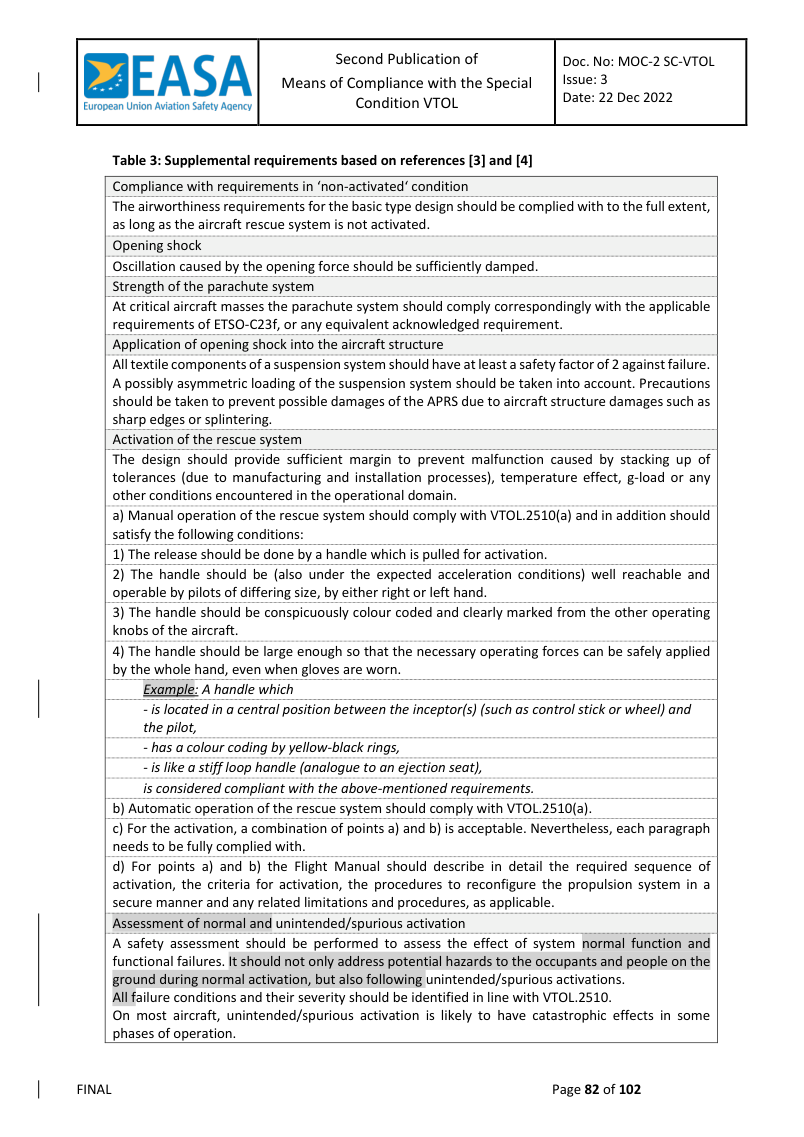
Table 3: Supplemental requirements based on references [3] and [4]
Compliance with requirements in ‘non-activated‘ condition The airworthiness requirements for the basic type design should be complied with to the full extent, as long as the aircraft rescue system is not activated. Opening shock Oscillation caused by the opening force should be sufficiently damped. Strength of the parachute system At critical aircraft masses the parachute system should comply correspondingly with the applicable requirements of ETSO-C23f, or any equivalent acknowledged requirement. Application of opening shock into the aircraft structure All textile components of a suspension system should have at least a safety factor of 2 against failure. A possibly asymmetric loading of the suspension system should be taken into account. Precautions should be taken to prevent possible damages of the APRS due to aircraft structure damages such as sharp edges or splintering. Activation of the rescue system The design should provide sufficient margin to prevent malfunction caused by stacking up of tolerances (due to manufacturing and installation processes), temperature effect, g-load or any other conditions encountered in the operational domain. a) Manual operation of the rescue system should comply with VTOL.2510(a) and in addition should satisfy the following conditions: 1) The release should be done by a handle which is pulled for activation. 2) The handle should be (also under the expected acceleration conditions) well reachable and operable by pilots of differing size, by either right or left hand. 3) The handle should be conspicuously colour coded and clearly marked from the other operating knobs of the aircraft. 4) The handle should be large enough so that the necessary operating forces can be safely applied by the whole hand, even when gloves are worn.
Example: A handle which - is located in a central position between the inceptor(s) (such as control stick or wheel) and the pilot, - has a colour coding by yellow-black rings, - is like a stiff loop handle (analogue to an ejection seat), is considered compliant with the above-mentioned requirements. b) Automatic operation of the rescue system should comply with VTOL.2510(a). c) For the activation, a combination of points a) and b) is acceptable. Nevertheless, each paragraph needs to be fully complied with. d) For points a) and b) the Flight Manual should describe in detail the required sequence of activation, the criteria for activation, the procedures to reconfigure the propulsion system in a secure manner and any related limitations and procedures, as applicable. Assessment of normal and unintended/spurious activation A safety assessment should be performed to assess the effect of system normal function and functional failures. It should not only address potential hazards to the occupants and people on the ground during normal activation, but also following unintended/spurious activations. All failure conditions and their severity should be identified in line with VTOL.2510. On most aircraft, unintended/spurious activation is likely to have catastrophic effects in some phases of operation.
View figures, tables and original page layout
Connected references
Source-backed citations and subject-based engineering context are labelled separately. These links do not establish equivalence or project acceptance.
Related technical context
Engineering contextEvidence and scope
SC-VTOL-02 and MOC-2 SC-VTOL — published scope
Aerospace Consulting navigation suggestion based on the subject and stated scope of the two publications.
This connection does not establish regulatory equivalence, acceptance of a newer edition, or applicability of a project-specific precedent to another programme.
Supporting source