
MOC-2 SC-VTOL
Means of Compliance with SC-VTOL — Batch 2
Issue 3 — FINAL Source checked 2026-11-28
Scope, source and reading notes
Complete final batch 2 of SC-VTOL means of compliance. Later batches may amend individual provisions in earlier batches.
Aerospace Consulting reference note: Second final batch of means of compliance. Adds and revises earlier material; MOC VTOL.2105 was excluded from this final publication for further revision.
The complete selected publication is available in reading text and as the original PDF. Reading text is extracted from the official PDF; page layout is simplified, and figures and tables should be checked in the original page view.
Search covers extracted text. Words contained only in graphics may not be searchable. The original publication is available below.
Official source recordOriginal PDF on this siteSource: EASA. Reproduced with source acknowledgment; source edition and status are shown above. SHA-256: 1fcaf1c7db56acce38f5379ba2117f1137dbc35be3fa6ee4136a0f572d856136
Doc. No: MOC-2 SC-VTOL Issue: 3 Date: 22 Dec 2022
Condition VTOL
(ii) For static strength substantiation, each part of the structure should be able to withstand
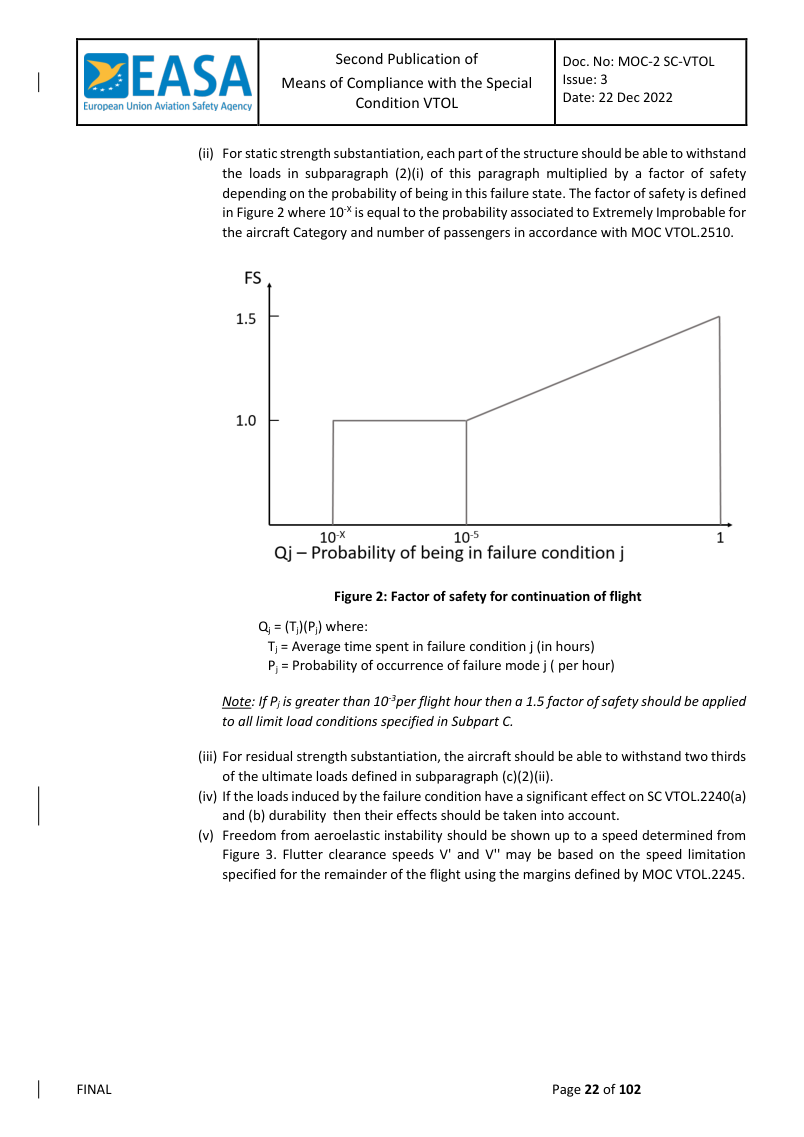
the loads in subparagraph (2)(i) of this paragraph multiplied by a factor of safety depending on the probability of being in this failure state. The factor of safety is defined in Figure 2 where 10-X is equal to the probability associated to Extremely Improbable for the aircraft Category and number of passengers in accordance with MOC VTOL.2510.
Figure 2: Factor of safety for continuation of flight
Qj = (Tj)(Pj) where:
Tj = Average time spent in failure condition j (in hours) Pj = Probability of occurrence of failure mode j ( per hour)
Note: If Pj is greater than 10-3per flight hour then a 1.5 factor of safety should be applied to all limit load conditions specified in Subpart C.
(iii) For residual strength substantiation, the aircraft should be able to withstand two thirds
of the ultimate loads defined in subparagraph (c)(2)(ii). (iv) If the loads induced by the failure condition have a significant effect on SC VTOL.2240(a)
and (b) durability then their effects should be taken into account. (v) Freedom from aeroelastic instability should be shown up to a speed determined from
Figure 3. Flutter clearance speeds V' and V'' may be based on the speed limitation specified for the remainder of the flight using the margins defined by MOC VTOL.2245.
View figures, tables and original page layout
Connected references
Source-backed citations and subject-based engineering context are labelled separately. These links do not establish equivalence or project acceptance.
Related technical context
Engineering contextEvidence and scope
SC-VTOL-02 and MOC-2 SC-VTOL — published scope
Aerospace Consulting navigation suggestion based on the subject and stated scope of the two publications.
This connection does not establish regulatory equivalence, acceptance of a newer edition, or applicability of a project-specific precedent to another programme.
Supporting source