
MOC-2 SC-VTOL
Means of Compliance with SC-VTOL — Batch 2
Issue 3 — FINAL Source checked 2026-11-28
Scope, source and reading notes
Complete final batch 2 of SC-VTOL means of compliance. Later batches may amend individual provisions in earlier batches.
Aerospace Consulting reference note: Second final batch of means of compliance. Adds and revises earlier material; MOC VTOL.2105 was excluded from this final publication for further revision.
The complete selected publication is available in reading text and as the original PDF. Reading text is extracted from the official PDF; page layout is simplified, and figures and tables should be checked in the original page view.
Search covers extracted text. Words contained only in graphics may not be searchable. The original publication is available below.
Official source recordOriginal PDF on this siteSource: EASA. Reproduced with source acknowledgment; source edition and status are shown above. SHA-256: 1fcaf1c7db56acce38f5379ba2117f1137dbc35be3fa6ee4136a0f572d856136
Doc. No: MOC-2 SC-VTOL Issue: 3 Date: 22 Dec 2022
Condition VTOL
2200 (including altitude effects), except that manoeuvring load factors need not exceed the maximum values expected in operations. The loading spectra as severe as those expected in operations based on loads or stresses determined under (c)(1), including external load operations, if applicable, and other high frequency power-cycle operations. Take-off, landing, and taxi loads when evaluating the landing gear (including skis and floats) and other affected SSEs. For each SSE identified in (b), a threat assessment, which includes a determination of the probable locations, types, and sizes of damage taking into account fatigue, environmental effects, intrinsic and discrete flaws, or accidental damage that may occur during manufacture or operation. A determination of the fatigue tolerance characteristics for the SSE with the damage identified in (c)(4) that supports the inspection and retirement times, or other approved equivalent means. Analyses supported by test evidence and, if available, service experience.
(d) A residual strength determination should be performed that substantiates the maximum damage size
assumed in the fatigue tolerance evaluation. In determining inspection intervals based on damage growth, the residual strength evaluation should show that the remaining structure, after damage growth, is able to withstand design limit loads without failure. (e) The effect of damage on stiffness, dynamic behaviour, loads and functional performance should be
considered. (f) The inspection and retirement times or approved equivalent means established under this Section
should be included in the Airworthiness Limitation Section of the Instructions for Continued Airworthiness required by VTOL.2625 (g) If inspections for any of the damage types identified in (c)(4) cannot be established within the limitations
of geometry, inspectability, or good design practice, then supplemental procedures, in conjunction with the SSE retirement time, should be established to minimize the risk of occurrence of these types of damage that could result in a failure during the operational life of the VTOL aircraft. (h) Discrete source damage tolerance evaluation. The aircraft should be capable of successfully completing
a flight during which likely structural damage occurs as a result of
Uncontained High-Energy Fragments and Sustained Imbalance as specified in VTOL.2240 (d) Bird impact as specified in VTOL.2250
Additional guidance for structural durability of metallic structures in the category Enhanced:
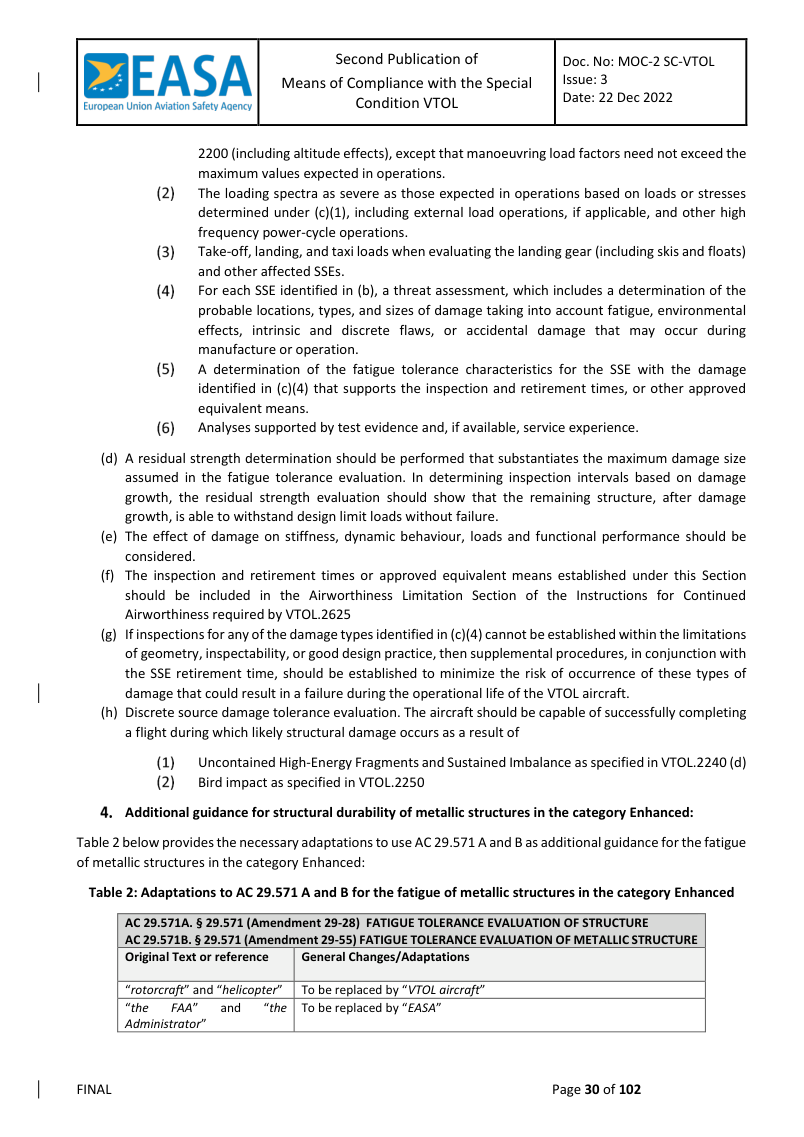
Table 2 below provides the necessary adaptations to use AC 29.571 A and B as additional guidance for the fatigue of metallic structures in the category Enhanced:
Table 2: Adaptations to AC 29.571 A and B for the fatigue of metallic structures in the category Enhanced
To be replaced by “EASA”
AC 29.571A. § 29.571 (Amendment 29-28) FATIGUE TOLERANCE EVALUATION OF STRUCTURE AC 29.571B. § 29.571 (Amendment 29-55) FATIGUE TOLERANCE EVALUATION OF METALLIC STRUCTURE Original Text or reference General Changes/Adaptations “rotorcraft” and “helicopter” To be replaced by “VTOL aircraft” “the FAA” and “the Administrator”
View figures, tables and original page layout
Connected references
Source-backed citations and subject-based engineering context are labelled separately. These links do not establish equivalence or project acceptance.
Related technical context
Engineering contextEvidence and scope
SC-VTOL-02 and MOC-2 SC-VTOL — published scope
Aerospace Consulting navigation suggestion based on the subject and stated scope of the two publications.
This connection does not establish regulatory equivalence, acceptance of a newer edition, or applicability of a project-specific precedent to another programme.
Supporting source