
MOC-2 SC-VTOL
Means of Compliance with SC-VTOL — Batch 2
Issue 3 — FINAL Source checked 2026-11-28
Scope, source and reading notes
Complete final batch 2 of SC-VTOL means of compliance. Later batches may amend individual provisions in earlier batches.
Aerospace Consulting reference note: Second final batch of means of compliance. Adds and revises earlier material; MOC VTOL.2105 was excluded from this final publication for further revision.
The complete selected publication is available in reading text and as the original PDF. Reading text is extracted from the official PDF; page layout is simplified, and figures and tables should be checked in the original page view.
Search covers extracted text. Words contained only in graphics may not be searchable. The original publication is available below.
Official source recordOriginal PDF on this siteSource: EASA. Reproduced with source acknowledgment; source edition and status are shown above. SHA-256: 1fcaf1c7db56acce38f5379ba2117f1137dbc35be3fa6ee4136a0f572d856136
Doc. No: MOC-2 SC-VTOL Issue: 3 Date: 22 Dec 2022
Condition VTOL
305 m (A)
(1 000’)
≥ 61 m (A)
(200’)
Positive RoC
and VTOSS
heights are referenced
to vertiport elevation
1st
2nd
segment
manual configuration
allowed
change
not allowed
airspeed
acceleration
accel.
≥VTOSS
≥VFTO
power setting
contingency
take-off
maximum continuous
(A) See Note A
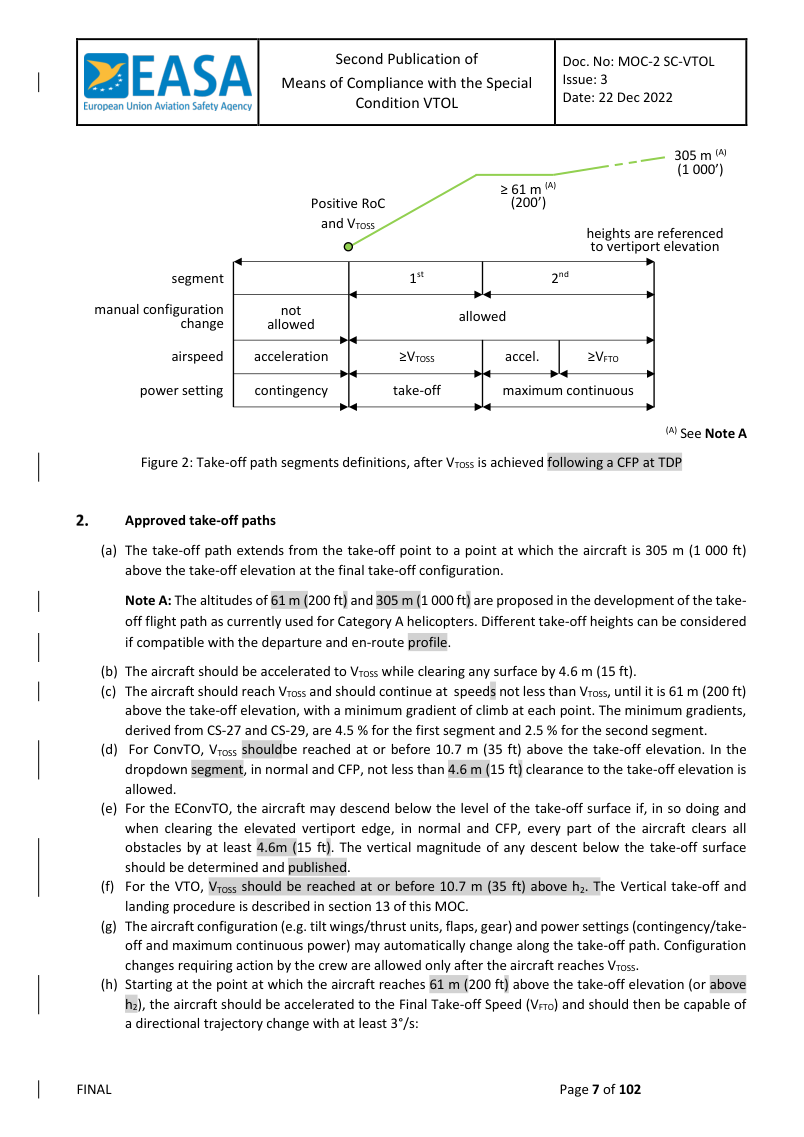
Figure 2: Take-off path segments definitions, after VTOSS is achieved following a CFP at TDP
Approved take-off paths
(a) The take-off path extends from the take-off point to a point at which the aircraft is 305 m (1 000 ft)
above the take-off elevation at the final take-off configuration.
Note A: The altitudes of 61 m (200 ft) and 305 m (1 000 ft) are proposed in the development of the take- off flight path as currently used for Category A helicopters. Different take-off heights can be considered if compatible with the departure and en-route profile.
(b) The aircraft should be accelerated to VTOSS while clearing any surface by 4.6 m (15 ft). (c) The aircraft should reach VTOSS and should continue at speeds not less than VTOSS, until it is 61 m (200 ft)
above the take-off elevation, with a minimum gradient of climb at each point. The minimum gradients, derived from CS-27 and CS-29, are 4.5 % for the first segment and 2.5 % for the second segment. (d) For ConvTO, VTOSS shouldbe reached at or before 10.7 m (35 ft) above the take-off elevation. In the
dropdown segment, in normal and CFP, not less than 4.6 m (15 ft) clearance to the take-off elevation is allowed. (e) For the EConvTO, the aircraft may descend below the level of the take-off surface if, in so doing and
when clearing the elevated vertiport edge, in normal and CFP, every part of the aircraft clears all obstacles by at least 4.6m (15 ft). The vertical magnitude of any descent below the take-off surface should be determined and published. (f) For the VTO, VTOSS should be reached at or before 10.7 m (35 ft) above h2. The Vertical take-off and
landing procedure is described in section 13 of this MOC. (g) The aircraft configuration (e.g. tilt wings/thrust units, flaps, gear) and power settings (contingency/take-
off and maximum continuous power) may automatically change along the take-off path. Configuration changes requiring action by the crew are allowed only after the aircraft reaches VTOSS. (h) Starting at the point at which the aircraft reaches 61 m (200 ft) above the take-off elevation (or above
h2), the aircraft should be accelerated to the Final Take-off Speed (VFTO) and should then be capable of a directional trajectory change with at least 3°/s:
View figures, tables and original page layout
Connected references
Source-backed citations and subject-based engineering context are labelled separately. These links do not establish equivalence or project acceptance.
Related technical context
Engineering contextEvidence and scope
SC-VTOL-02 and MOC-2 SC-VTOL — published scope
Aerospace Consulting navigation suggestion based on the subject and stated scope of the two publications.
This connection does not establish regulatory equivalence, acceptance of a newer edition, or applicability of a project-specific precedent to another programme.
Supporting source