
MOC-2 SC-VTOL
Means of Compliance with SC-VTOL — Batch 2
Issue 3 — FINAL Source checked 2026-11-28
Scope, source and reading notes
Complete final batch 2 of SC-VTOL means of compliance. Later batches may amend individual provisions in earlier batches.
Aerospace Consulting reference note: Second final batch of means of compliance. Adds and revises earlier material; MOC VTOL.2105 was excluded from this final publication for further revision.
The complete selected publication is available in reading text and as the original PDF. Reading text is extracted from the official PDF; page layout is simplified, and figures and tables should be checked in the original page view.
Search covers extracted text. Words contained only in graphics may not be searchable. The original publication is available below.
Official source recordOriginal PDF on this siteSource: EASA. Reproduced with source acknowledgment; source edition and status are shown above. SHA-256: 1fcaf1c7db56acce38f5379ba2117f1137dbc35be3fa6ee4136a0f572d856136
Doc. No: MOC-2 SC-VTOL Issue: 3 Date: 22 Dec 2022
Condition VTOL
(b) VFTO can be reached and maintained requiring configuration changes, including landing gear retraction,
commanded by the flight crew. (c) VFTO should be determined for each weight, most critical centre of gravity position, altitude, and
temperature for which take-off data are to be determined. (d) Flying at VFTO should provide a steady gradient of climb of at least 2.5 % at maximum continuous power
and a manoeuvring capability of not less than 3°/s of turn rate while not descending.
Dimension “D”
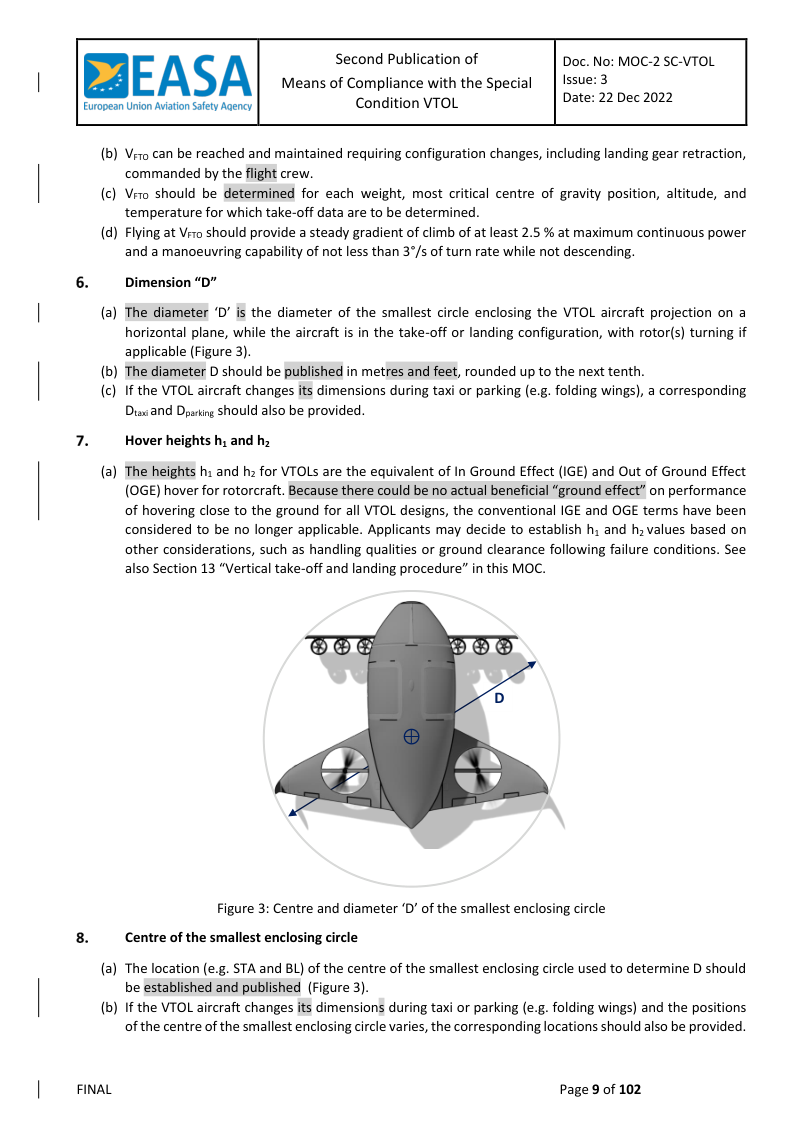
(a) The diameter ‘D’ is the diameter of the smallest circle enclosing the VTOL aircraft projection on a
horizontal plane, while the aircraft is in the take-off or landing configuration, with rotor(s) turning if applicable (Figure 3). (b) The diameter D should be published in metres and feet, rounded up to the next tenth. (c) If the VTOL aircraft changes its dimensions during taxi or parking (e.g. folding wings), a corresponding
Dtaxi and Dparking should also be provided.
Hover heights h1 and h2
(a) The heights h1 and h2 for VTOLs are the equivalent of In Ground Effect (IGE) and Out of Ground Effect
(OGE) hover for rotorcraft. Because there could be no actual beneficial “ground effect” on performance of hovering close to the ground for all VTOL designs, the conventional IGE and OGE terms have been considered to be no longer applicable. Applicants may decide to establish h1 and h2 values based on other considerations, such as handling qualities or ground clearance following failure conditions. See also Section 13 “Vertical take-off and landing procedure” in this MOC.
D
Figure 3: Centre and diameter ‘D’ of the smallest enclosing circle
Centre of the smallest enclosing circle
(a) The location (e.g. STA and BL) of the centre of the smallest enclosing circle used to determine D should
be established and published (Figure 3). (b) If the VTOL aircraft changes its dimensions during taxi or parking (e.g. folding wings) and the positions
of the centre of the smallest enclosing circle varies, the corresponding locations should also be provided.
View figures, tables and original page layout
Connected references
Source-backed citations and subject-based engineering context are labelled separately. These links do not establish equivalence or project acceptance.
Related technical context
Engineering contextEvidence and scope
SC-VTOL-02 and MOC-2 SC-VTOL — published scope
Aerospace Consulting navigation suggestion based on the subject and stated scope of the two publications.
This connection does not establish regulatory equivalence, acceptance of a newer edition, or applicability of a project-specific precedent to another programme.
Supporting source