
MOC-2 SC-VTOL
Means of Compliance with SC-VTOL — Batch 2
Issue 3 — FINAL Source checked 2026-11-28
Scope, source and reading notes
Complete final batch 2 of SC-VTOL means of compliance. Later batches may amend individual provisions in earlier batches.
Aerospace Consulting reference note: Second final batch of means of compliance. Adds and revises earlier material; MOC VTOL.2105 was excluded from this final publication for further revision.
The complete selected publication is available in reading text and as the original PDF. Reading text is extracted from the official PDF; page layout is simplified, and figures and tables should be checked in the original page view.
Search covers extracted text. Words contained only in graphics may not be searchable. The original publication is available below.
Official source recordOriginal PDF on this siteSource: EASA. Reproduced with source acknowledgment; source edition and status are shown above. SHA-256: 1fcaf1c7db56acce38f5379ba2117f1137dbc35be3fa6ee4136a0f572d856136
Doc. No: MOC-2 SC-VTOL Issue: 3 Date: 22 Dec 2022
Condition VTOL
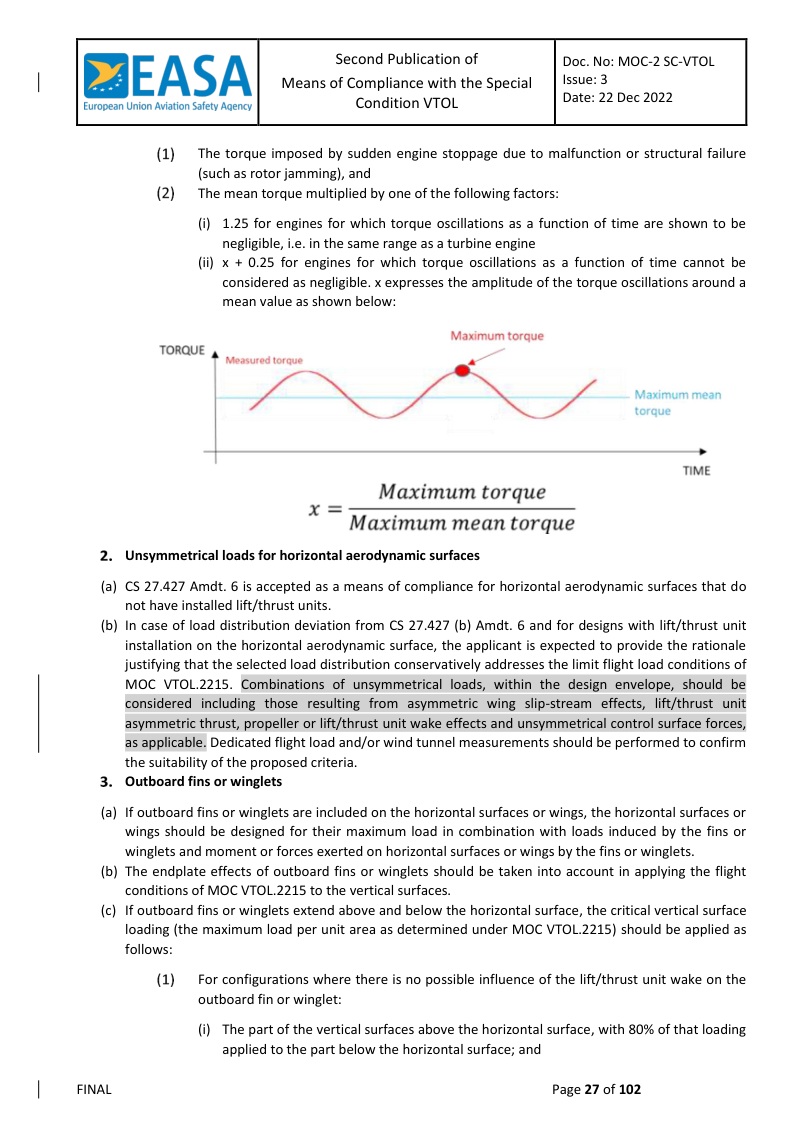
The torque imposed by sudden engine stoppage due to malfunction or structural failure (such as rotor jamming), and The mean torque multiplied by one of the following factors:
(i) 1.25 for engines for which torque oscillations as a function of time are shown to be
negligible, i.e. in the same range as a turbine engine (ii) x + 0.25 for engines for which torque oscillations as a function of time cannot be
considered as negligible. x expresses the amplitude of the torque oscillations around a mean value as shown below:
Unsymmetrical loads for horizontal aerodynamic surfaces
(a) CS 27.427 Amdt. 6 is accepted as a means of compliance for horizontal aerodynamic surfaces that do
not have installed lift/thrust units. (b) In case of load distribution deviation from CS 27.427 (b) Amdt. 6 and for designs with lift/thrust unit
installation on the horizontal aerodynamic surface, the applicant is expected to provide the rationale justifying that the selected load distribution conservatively addresses the limit flight load conditions of MOC VTOL.2215. Combinations of unsymmetrical loads, within the design envelope, should be considered including those resulting from asymmetric wing slip-stream effects, lift/thrust unit asymmetric thrust, propeller or lift/thrust unit wake effects and unsymmetrical control surface forces, as applicable. Dedicated flight load and/or wind tunnel measurements should be performed to confirm the suitability of the proposed criteria. Outboard fins or winglets
(a) If outboard fins or winglets are included on the horizontal surfaces or wings, the horizontal surfaces or
wings should be designed for their maximum load in combination with loads induced by the fins or winglets and moment or forces exerted on horizontal surfaces or wings by the fins or winglets. (b) The endplate effects of outboard fins or winglets should be taken into account in applying the flight
conditions of MOC VTOL.2215 to the vertical surfaces. (c) If outboard fins or winglets extend above and below the horizontal surface, the critical vertical surface
loading (the maximum load per unit area as determined under MOC VTOL.2215) should be applied as follows:
For configurations where there is no possible influence of the lift/thrust unit wake on the outboard fin or winglet:
(i) The part of the vertical surfaces above the horizontal surface, with 80% of that loading
applied to the part below the horizontal surface; and
View figures, tables and original page layout
Connected references
Source-backed citations and subject-based engineering context are labelled separately. These links do not establish equivalence or project acceptance.
Related technical context
Engineering contextEvidence and scope
SC-VTOL-02 and MOC-2 SC-VTOL — published scope
Aerospace Consulting navigation suggestion based on the subject and stated scope of the two publications.
This connection does not establish regulatory equivalence, acceptance of a newer edition, or applicability of a project-specific precedent to another programme.
Supporting source