
MOC-2 SC-VTOL
Means of Compliance with SC-VTOL — Batch 2
Issue 3 — FINAL Source checked 2026-11-28
Scope, source and reading notes
Complete final batch 2 of SC-VTOL means of compliance. Later batches may amend individual provisions in earlier batches.
Aerospace Consulting reference note: Second final batch of means of compliance. Adds and revises earlier material; MOC VTOL.2105 was excluded from this final publication for further revision.
The complete selected publication is available in reading text and as the original PDF. Reading text is extracted from the official PDF; page layout is simplified, and figures and tables should be checked in the original page view.
Search covers extracted text. Words contained only in graphics may not be searchable. The original publication is available below.
Official source recordOriginal PDF on this siteSource: EASA. Reproduced with source acknowledgment; source edition and status are shown above. SHA-256: 1fcaf1c7db56acce38f5379ba2117f1137dbc35be3fa6ee4136a0f572d856136
Doc. No: MOC-2 SC-VTOL Issue: 3 Date: 22 Dec 2022
Condition VTOL
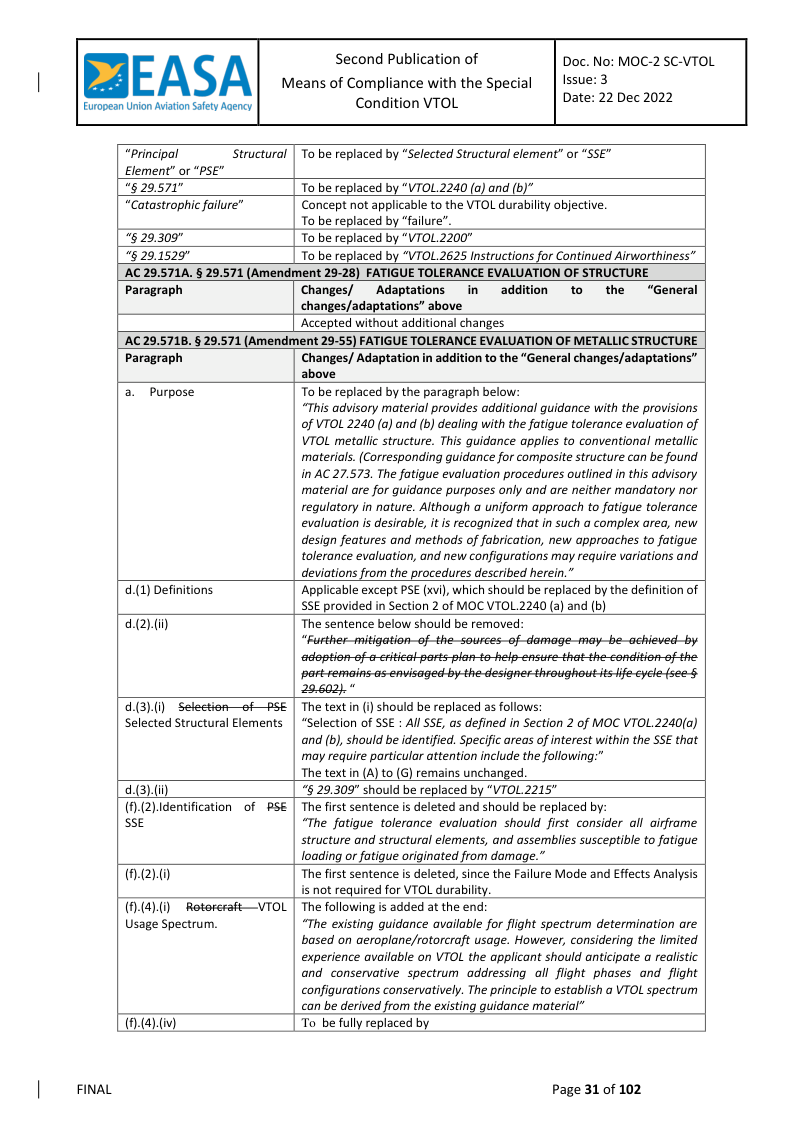
To be replaced by “Selected Structural element” or “SSE”
“Principal Structural Element” or “PSE”
“§ 29.571” To be replaced by “VTOL.2240 (a) and (b)” “Catastrophic failure” Concept not applicable to the VTOL durability objective. To be replaced by “failure”. “§ 29.309” To be replaced by “VTOL.2200” “§ 29.1529” To be replaced by “VTOL.2625 Instructions for Continued Airworthiness” AC 29.571A. § 29.571 (Amendment 29-28) FATIGUE TOLERANCE EVALUATION OF STRUCTURE Paragraph Changes/ Adaptations in addition to the “General changes/adaptations” above Accepted without additional changes AC 29.571B. § 29.571 (Amendment 29-55) FATIGUE TOLERANCE EVALUATION OF METALLIC STRUCTURE Paragraph Changes/ Adaptation in addition to the “General changes/adaptations” above a. Purpose To be replaced by the paragraph below: “This advisory material provides additional guidance with the provisions of VTOL 2240 (a) and (b) dealing with the fatigue tolerance evaluation of VTOL metallic structure. This guidance applies to conventional metallic materials. (Corresponding guidance for composite structure can be found in AC 27.573. The fatigue evaluation procedures outlined in this advisory material are for guidance purposes only and are neither mandatory nor regulatory in nature. Although a uniform approach to fatigue tolerance evaluation is desirable, it is recognized that in such a complex area, new design features and methods of fabrication, new approaches to fatigue tolerance evaluation, and new configurations may require variations and deviations from the procedures described herein.” d.(1) Definitions Applicable except PSE (xvi), which should be replaced by the definition of SSE provided in Section 2 of MOC VTOL.2240 (a) and (b) d.(2).(ii) The sentence below should be removed: “Further mitigation of the sources of damage may be achieved by adoption of a critical parts plan to help ensure that the condition of the part remains as envisaged by the designer throughout its life cycle (see § 29.602). “ d.(3).(i) Selection of PSE Selected Structural Elements
The text in (i) should be replaced as follows: “Selection of SSE : All SSE, as defined in Section 2 of MOC VTOL.2240(a) and (b), should be identified. Specific areas of interest within the SSE that may require particular attention include the following:” The text in (A) to (G) remains unchanged. d.(3).(ii) “§ 29.309” should be replaced by “VTOL.2215” (f).(2).Identification of PSE SSE
The first sentence is deleted and should be replaced by: “The fatigue tolerance evaluation should first consider all airframe structure and structural elements, and assemblies susceptible to fatigue loading or fatigue originated from damage.” (f).(2).(i) The first sentence is deleted, since the Failure Mode and Effects Analysis is not required for VTOL durability. (f).(4).(i) Rotorcraft VTOL Usage Spectrum.
The following is added at the end: “The existing guidance available for flight spectrum determination are based on aeroplane/rotorcraft usage. However, considering the limited experience available on VTOL the applicant should anticipate a realistic and conservative spectrum addressing all flight phases and flight configurations conservatively. The principle to establish a VTOL spectrum can be derived from the existing guidance material” (f).(4).(iv) To be fully replaced by
View figures, tables and original page layout
Connected references
Source-backed citations and subject-based engineering context are labelled separately. These links do not establish equivalence or project acceptance.
Related technical context
Engineering contextEvidence and scope
SC-VTOL-02 and MOC-2 SC-VTOL — published scope
Aerospace Consulting navigation suggestion based on the subject and stated scope of the two publications.
This connection does not establish regulatory equivalence, acceptance of a newer edition, or applicability of a project-specific precedent to another programme.
Supporting source