
MOC-2 SC-VTOL
Means of Compliance with SC-VTOL — Batch 2
Issue 3 — FINAL Source checked 2026-11-28
Scope, source and reading notes
Complete final batch 2 of SC-VTOL means of compliance. Later batches may amend individual provisions in earlier batches.
Aerospace Consulting reference note: Second final batch of means of compliance. Adds and revises earlier material; MOC VTOL.2105 was excluded from this final publication for further revision.
The complete selected publication is available in reading text and as the original PDF. Reading text is extracted from the official PDF; page layout is simplified, and figures and tables should be checked in the original page view.
Search covers extracted text. Words contained only in graphics may not be searchable. The original publication is available below.
Official source recordOriginal PDF on this siteSource: EASA. Reproduced with source acknowledgment; source edition and status are shown above. SHA-256: 1fcaf1c7db56acce38f5379ba2117f1137dbc35be3fa6ee4136a0f572d856136
Doc. No: MOC-2 SC-VTOL Issue: 3 Date: 22 Dec 2022
Condition VTOL
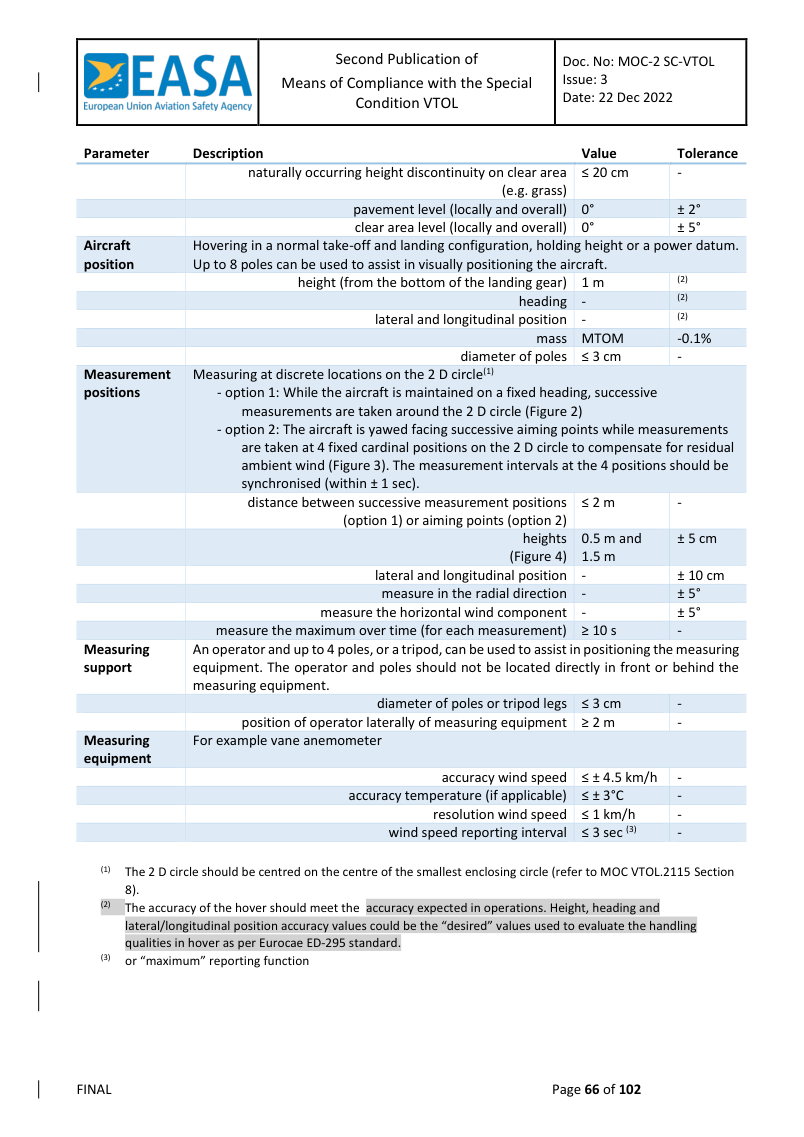
Parameter Description Value Tolerance naturally occurring height discontinuity on clear area
≤ 20 cm -
(e.g. grass)
pavement level (locally and overall) 0° ± 2° clear area level (locally and overall) 0° ± 5° Aircraft position
Hovering in a normal take-off and landing configuration, holding height or a power datum. Up to 8 poles can be used to assist in visually positioning the aircraft. height (from the bottom of the landing gear) 1 m (2)
Measuring at discrete locations on the 2 D circle(1)
heading - (2) lateral and longitudinal position - (2) mass MTOM -0.1% diameter of poles ≤ 3 cm - Measurement positions
- option 1: While the aircraft is maintained on a fixed heading, successive
measurements are taken around the 2 D circle (Figure 2) - option 2: The aircraft is yawed facing successive aiming points while measurements
are taken at 4 fixed cardinal positions on the 2 D circle to compensate for residual ambient wind (Figure 3). The measurement intervals at the 4 positions should be synchronised (within ± 1 sec). distance between successive measurement positions
≤ 2 m -
(option 1) or aiming points (option 2)
± 5 cm
heights (Figure 4)
0.5 m and 1.5 m
lateral and longitudinal position - ± 10 cm measure in the radial direction - ± 5° measure the horizontal wind component - ± 5° measure the maximum over time (for each measurement) ≥ 10 s - Measuring support
For example vane anemometer
An operator and up to 4 poles, or a tripod, can be used to assist in positioning the measuring equipment. The operator and poles should not be located directly in front or behind the measuring equipment. diameter of poles or tripod legs ≤ 3 cm - position of operator laterally of measuring equipment ≥ 2 m - Measuring equipment
accuracy wind speed ≤ ± 4.5 km/h - accuracy temperature (if applicable) ≤ ± 3°C - resolution wind speed ≤ 1 km/h - wind speed reporting interval ≤ 3 sec (3) -
(1) The 2 D circle should be centred on the centre of the smallest enclosing circle (refer to MOC VTOL.2115 Section 8). (2) The accuracy of the hover should meet the accuracy expected in operations. Height, heading and lateral/longitudinal position accuracy values could be the “desired” values used to evaluate the handling qualities in hover as per Eurocae ED-295 standard. (3) or “maximum” reporting function
View figures, tables and original page layout
Connected references
Source-backed citations and subject-based engineering context are labelled separately. These links do not establish equivalence or project acceptance.
Related technical context
Engineering contextEvidence and scope
SC-VTOL-02 and MOC-2 SC-VTOL — published scope
Aerospace Consulting navigation suggestion based on the subject and stated scope of the two publications.
This connection does not establish regulatory equivalence, acceptance of a newer edition, or applicability of a project-specific precedent to another programme.
Supporting source