
MOC-2 SC-VTOL
Means of Compliance with SC-VTOL — Batch 2
Issue 3 — FINAL Source checked 2026-11-28
Scope, source and reading notes
Complete final batch 2 of SC-VTOL means of compliance. Later batches may amend individual provisions in earlier batches.
Aerospace Consulting reference note: Second final batch of means of compliance. Adds and revises earlier material; MOC VTOL.2105 was excluded from this final publication for further revision.
The complete selected publication is available in reading text and as the original PDF. Reading text is extracted from the official PDF; page layout is simplified, and figures and tables should be checked in the original page view.
Search covers extracted text. Words contained only in graphics may not be searchable. The original publication is available below.
Official source recordOriginal PDF on this siteSource: EASA. Reproduced with source acknowledgment; source edition and status are shown above. SHA-256: 1fcaf1c7db56acce38f5379ba2117f1137dbc35be3fa6ee4136a0f572d856136
Doc. No: MOC-2 SC-VTOL Issue: 3 Date: 22 Dec 2022
Condition VTOL
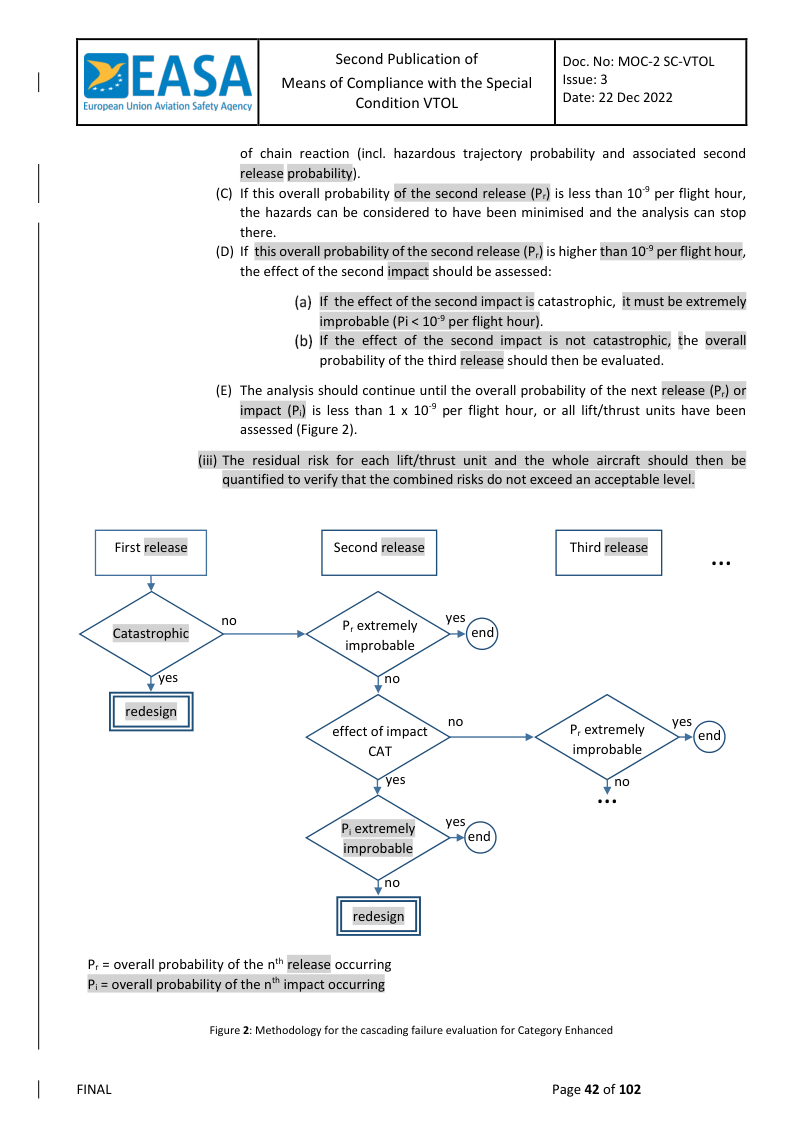
of chain reaction (incl. hazardous trajectory probability and associated second release probability). (C) If this overall probability of the second release (Pr) is less than 10-9 per flight hour,
the hazards can be considered to have been minimised and the analysis can stop there. (D) If this overall probability of the second release (Pr) is higher than 10-9 per flight hour,
the effect of the second impact should be assessed:
If the effect of the second impact is catastrophic, it must be extremely
improbable (Pi < 10-9 per flight hour). If the effect of the second impact is not catastrophic, the overall
probability of the third release should then be evaluated.
(E) The analysis should continue until the overall probability of the next release (Pr) or
impact (Pi) is less than 1 x 10⁻⁹ per flight hour, or all lift/thrust units have been assessed (Figure 2).
(iii) The residual risk for each lift/thrust unit and the whole aircraft should then be
quantified to verify that the combined risks do not exceed an acceptable level.
Second release Third release
… First release
yes
Pr extremely
end
no Catastrophic
improbable
yes
no
redesign
no
yes
Pr extremely
effect of impact
end
improbable
CAT
yes
no
…
Pi extremely
end yes
improbable
no
redesign
Pr = overall probability of the nth release occurring Pi = overall probability of the nth impact occurring
Figure 2: Methodology for the cascading failure evaluation for Category Enhanced
View figures, tables and original page layout
Connected references
Source-backed citations and subject-based engineering context are labelled separately. These links do not establish equivalence or project acceptance.
Related technical context
Engineering contextEvidence and scope
SC-VTOL-02 and MOC-2 SC-VTOL — published scope
Aerospace Consulting navigation suggestion based on the subject and stated scope of the two publications.
This connection does not establish regulatory equivalence, acceptance of a newer edition, or applicability of a project-specific precedent to another programme.
Supporting source