
MOC-2 SC-VTOL
Means of Compliance with SC-VTOL — Batch 2
Issue 3 — FINAL Source checked 2026-11-28
Scope, source and reading notes
Complete final batch 2 of SC-VTOL means of compliance. Later batches may amend individual provisions in earlier batches.
Aerospace Consulting reference note: Second final batch of means of compliance. Adds and revises earlier material; MOC VTOL.2105 was excluded from this final publication for further revision.
The complete selected publication is available in reading text and as the original PDF. Reading text is extracted from the official PDF; page layout is simplified, and figures and tables should be checked in the original page view.
Search covers extracted text. Words contained only in graphics may not be searchable. The original publication is available below.
Official source recordOriginal PDF on this siteSource: EASA. Reproduced with source acknowledgment; source edition and status are shown above. SHA-256: 1fcaf1c7db56acce38f5379ba2117f1137dbc35be3fa6ee4136a0f572d856136
Doc. No: MOC-2 SC-VTOL Issue: 3 Date: 22 Dec 2022
Condition VTOL
Parameter Short description Minimum/maximum1 Reference volume
Type 12
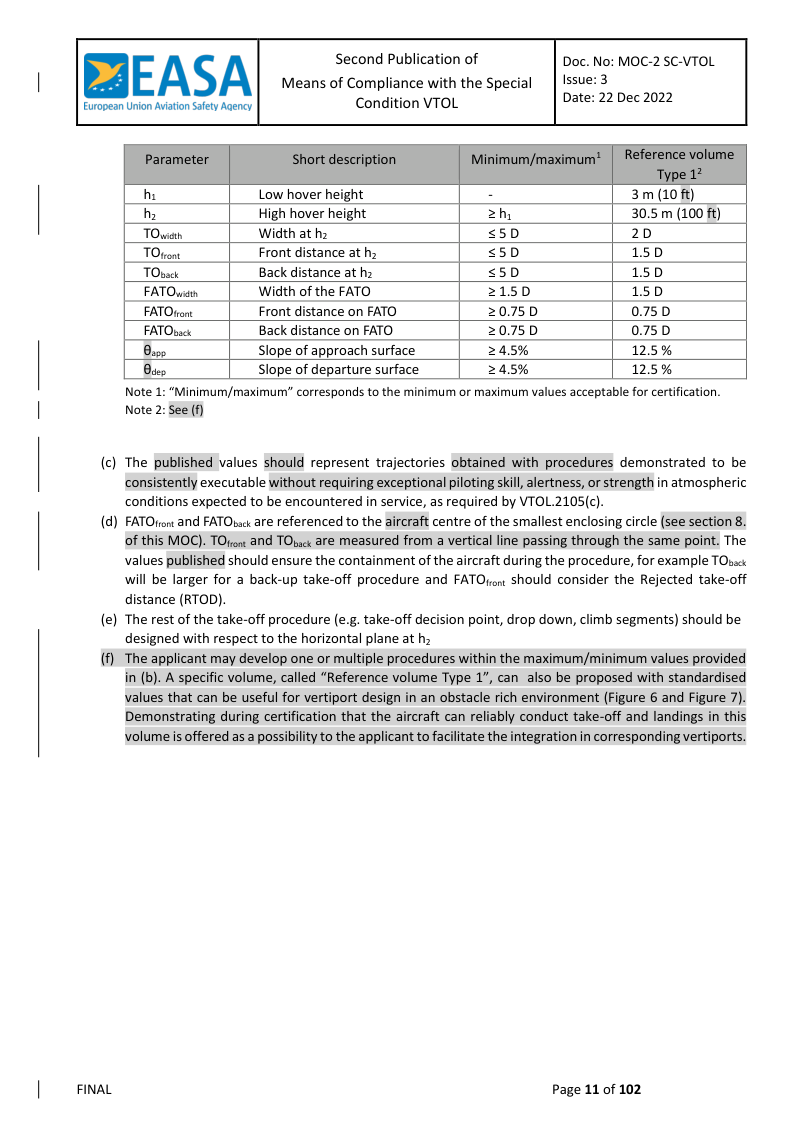
h1 Low hover height - 3 m (10 ft) h2 High hover height ≥ h1 30.5 m (100 ft) TOwidth Width at h2 ≤ 5 D 2 D TOfront Front distance at h2 ≤ 5 D 1.5 D TOback Back distance at h2 ≤ 5 D 1.5 D FATOwidth Width of the FATO ≥ 1.5 D 1.5 D FATOfront Front distance on FATO ≥ 0.75 D 0.75 D FATOback Back distance on FATO ≥ 0.75 D 0.75 D θapp Slope of approach surface ≥ 4.5% 12.5 % θdep Slope of departure surface ≥ 4.5% 12.5 %
Note 1: “Minimum/maximum” corresponds to the minimum or maximum values acceptable for certification. Note 2: See (f)
(c) The published values should represent trajectories obtained with procedures demonstrated to be
consistently executable without requiring exceptional piloting skill, alertness, or strength in atmospheric conditions expected to be encountered in service, as required by VTOL.2105(c). (d) FATOfront and FATOback are referenced to the aircraft centre of the smallest enclosing circle (see section 8.
of this MOC). TOfront and TOback are measured from a vertical line passing through the same point. The values published should ensure the containment of the aircraft during the procedure, for example TOback will be larger for a back-up take-off procedure and FATOfront should consider the Rejected take-off distance (RTOD). (e) The rest of the take-off procedure (e.g. take-off decision point, drop down, climb segments) should be
designed with respect to the horizontal plane at h2 (f) The applicant may develop one or multiple procedures within the maximum/minimum values provided
in (b). A specific volume, called “Reference volume Type 1”, can also be proposed with standardised values that can be useful for vertiport design in an obstacle rich environment (Figure 6 and Figure 7). Demonstrating during certification that the aircraft can reliably conduct take-off and landings in this volume is offered as a possibility to the applicant to facilitate the integration in corresponding vertiports.
View figures, tables and original page layout
Connected references
Source-backed citations and subject-based engineering context are labelled separately. These links do not establish equivalence or project acceptance.
Related technical context
Engineering contextEvidence and scope
SC-VTOL-02 and MOC-2 SC-VTOL — published scope
Aerospace Consulting navigation suggestion based on the subject and stated scope of the two publications.
This connection does not establish regulatory equivalence, acceptance of a newer edition, or applicability of a project-specific precedent to another programme.
Supporting source