
CS-25
Large Aeroplanes
Amendment 28; corrected 20 November 2025 Source checked 2026-11-28
Scope, source and reading notes
Complete official CS-25 Amendment 28, including AMC and appendices.
Aerospace Consulting reference note: Certification specifications and acceptable means of compliance for large aeroplanes, using the corrected official publication.
The complete selected publication is available in reading text and as the original PDF. Reading text is extracted from the official PDF; page layout is simplified, and figures and tables should be checked in the original page view.
Search covers extracted text. Words contained only in graphics may not be searchable. The original publication is available below.
Official source recordOriginal PDF on this siteSource: EASA. Reproduced with source acknowledgment; source edition and status are shown above. SHA-256: 32f1a9acf26e8ceceb291d206bf07a7071f7f59f40f10c096bb17f34c6a58007
Section / Paragraph
Section 9, Controls, Indications and Alerts
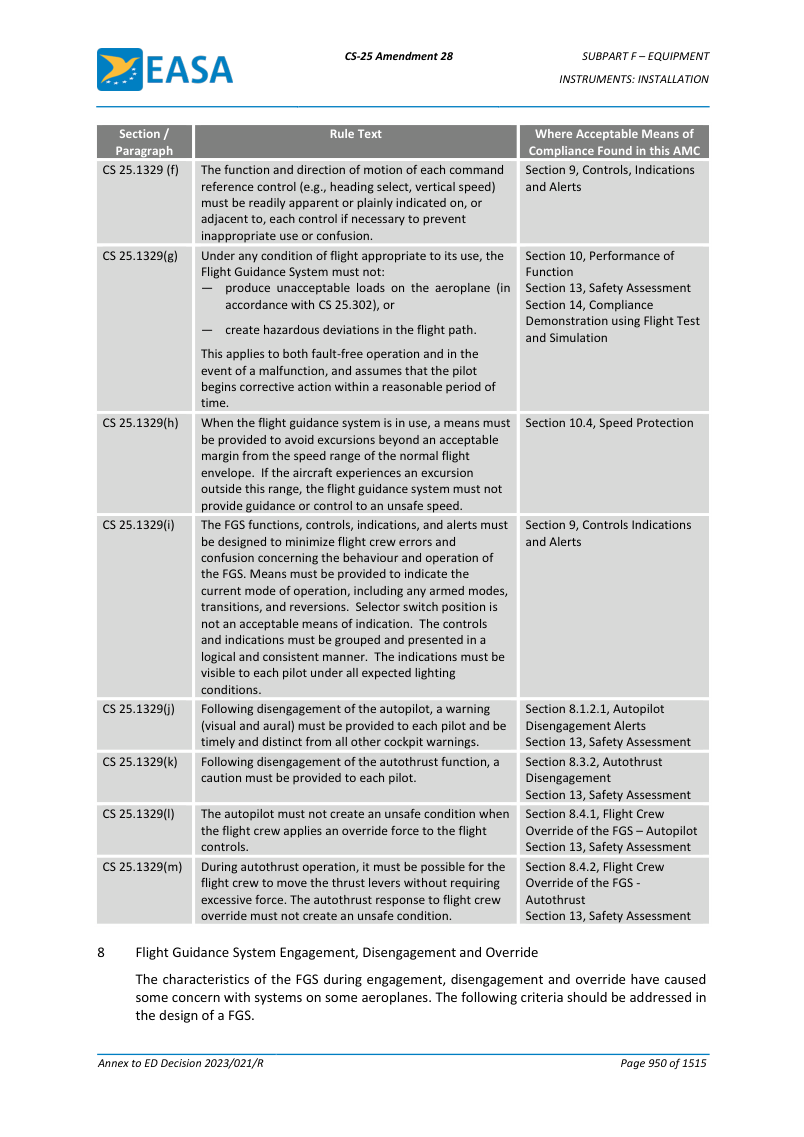
Rule Text Where Acceptable Means of Compliance Found in this AMC CS 25.1329 (f) The function and direction of motion of each command reference control (e.g., heading select, vertical speed) must be readily apparent or plainly indicated on, or adjacent to, each control if necessary to prevent inappropriate use or confusion.
CS 25.1329(g) Under any condition of flight appropriate to its use, the Flight Guidance System must not: — produce unacceptable loads on the aeroplane (in
accordance with CS 25.302), or
— create hazardous deviations in the flight path.
Section 10, Performance of Function Section 13, Safety Assessment Section 14, Compliance Demonstration using Flight Test and Simulation
This applies to both fault-free operation and in the event of a malfunction, and assumes that the pilot begins corrective action within a reasonable period of time.
Section 10.4, Speed Protection
CS 25.1329(h) When the flight guidance system is in use, a means must be provided to avoid excursions beyond an acceptable margin from the speed range of the normal flight envelope. If the aircraft experiences an excursion outside this range, the flight guidance system must not provide guidance or control to an unsafe speed.
Section 9, Controls Indications and Alerts
CS 25.1329(i) The FGS functions, controls, indications, and alerts must be designed to minimize flight crew errors and confusion concerning the behaviour and operation of the FGS. Means must be provided to indicate the current mode of operation, including any armed modes, transitions, and reversions. Selector switch position is not an acceptable means of indication. The controls and indications must be grouped and presented in a logical and consistent manner. The indications must be visible to each pilot under all expected lighting conditions.
CS 25.1329(j) Following disengagement of the autopilot, a warning (visual and aural) must be provided to each pilot and be timely and distinct from all other cockpit warnings.
Section 8.1.2.1, Autopilot Disengagement Alerts Section 13, Safety Assessment CS 25.1329(k) Following disengagement of the autothrust function, a caution must be provided to each pilot.
Section 8.3.2, Autothrust Disengagement Section 13, Safety Assessment CS 25.1329(l) The autopilot must not create an unsafe condition when the flight crew applies an override force to the flight controls.
Section 8.4.1, Flight Crew Override of the FGS – Autopilot Section 13, Safety Assessment CS 25.1329(m) During autothrust operation, it must be possible for the flight crew to move the thrust levers without requiring excessive force. The autothrust response to flight crew override must not create an unsafe condition.
Section 8.4.2, Flight Crew Override of the FGS - Autothrust Section 13, Safety Assessment 8 Flight Guidance System Engagement, Disengagement and Override
The characteristics of the FGS during engagement, disengagement and override have caused some concern with systems on some aeroplanes. The following criteria should be addressed in the design of a FGS.
View figures, tables and original page layout
Connected references
Source-backed citations and subject-based engineering context are labelled separately. These links do not establish equivalence or project acceptance.
Listed as related material by
Source-backedEvidence and scope
AMC 20-152A §8(a)(2)
Lists CS-25 without an amendment or specific paragraph.
Family reference; does not select a certification basis.
Supporting source