
CS-25
Large Aeroplanes
Amendment 28; corrected 20 November 2025 Source checked 2026-11-28
Scope, source and reading notes
Complete official CS-25 Amendment 28, including AMC and appendices.
Aerospace Consulting reference note: Certification specifications and acceptable means of compliance for large aeroplanes, using the corrected official publication.
The complete selected publication is available in reading text and as the original PDF. Reading text is extracted from the official PDF; page layout is simplified, and figures and tables should be checked in the original page view.
Search covers extracted text. Words contained only in graphics may not be searchable. The original publication is available below.
Official source recordOriginal PDF on this siteSource: EASA. Reproduced with source acknowledgment; source edition and status are shown above. SHA-256: 32f1a9acf26e8ceceb291d206bf07a7071f7f59f40f10c096bb17f34c6a58007
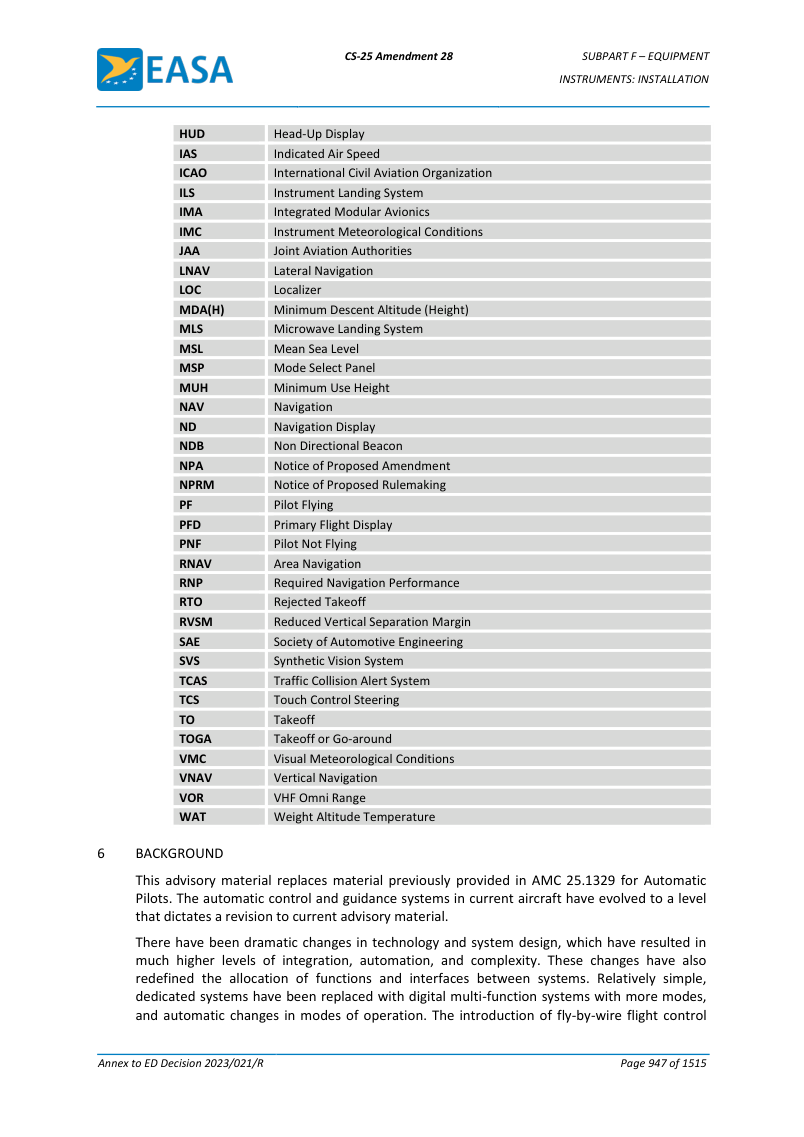
HUD Head-Up Display IAS Indicated Air Speed ICAO International Civil Aviation Organization ILS Instrument Landing System IMA Integrated Modular Avionics IMC Instrument Meteorological Conditions JAA Joint Aviation Authorities LNAV Lateral Navigation LOC Localizer MDA(H) Minimum Descent Altitude (Height) MLS Microwave Landing System MSL Mean Sea Level MSP Mode Select Panel MUH Minimum Use Height NAV Navigation ND Navigation Display NDB Non Directional Beacon NPA Notice of Proposed Amendment NPRM Notice of Proposed Rulemaking PF Pilot Flying PFD Primary Flight Display PNF Pilot Not Flying RNAV Area Navigation RNP Required Navigation Performance RTO Rejected Takeoff RVSM Reduced Vertical Separation Margin SAE Society of Automotive Engineering SVS Synthetic Vision System TCAS Traffic Collision Alert System TCS Touch Control Steering TO Takeoff TOGA Takeoff or Go-around VMC Visual Meteorological Conditions VNAV Vertical Navigation VOR VHF Omni Range WAT Weight Altitude Temperature 6 BACKGROUND
This advisory material replaces material previously provided in AMC 25.1329 for Automatic Pilots. The automatic control and guidance systems in current aircraft have evolved to a level that dictates a revision to current advisory material.
There have been dramatic changes in technology and system design, which have resulted in much higher levels of integration, automation, and complexity. These changes have also redefined the allocation of functions and interfaces between systems. Relatively simple, dedicated systems have been replaced with digital multi-function systems with more modes, and automatic changes in modes of operation. The introduction of fly-by-wire flight control
View figures, tables and original page layout
Connected references
Source-backed citations and subject-based engineering context are labelled separately. These links do not establish equivalence or project acceptance.
Listed as related material by
Source-backedEvidence and scope
AMC 20-152A §8(a)(2)
Lists CS-25 without an amendment or specific paragraph.
Family reference; does not select a certification basis.
Supporting source